Meaning at a glance
This article explains the documented history and changing contexts of the zodiac wheel motif, separates cultural or religious evidence from later popular interpretations, and gives practical guidance for choosing and wearing the motif in modern jewelry.
Documented historical evidence and specific cultural contexts
Museum research traces the zodiac wheel motif into the long history of diagrams and decoration that represent the sky and seasons. The Victoria and Albert Museum treats jewelry as a material record of changing uses and meanings, noting that motifs related to astronomy and the calendar have been used in metalwork, enamels, and gem settings across different periods as both practical markers and decorative imagery. The V&A places these motifs within the broader field of jewellery history rather than attributing a single, continuous meaning.
In European collections described by museum curators, zodiac imagery is commonly associated with medieval and early modern calendars and with Renaissance interest in classical cosmology, where circle diagrams dividing the sky became portable images on objects including rings and pendants. The motif also appears in decorative arts that circulated through trade and cultural exchange; museums observe stylistic borrowings rather than asserting identical beliefs across cultures. The V&A’s surveys of jewellery history emphasize that the same visual motif can serve varied functions depending on time and place.
Separating documented historical meanings from modern interpretations
Documented historical meanings recorded in museum catalogues and exhibitions tend to be material and functional: zodiac-like diagrams could indicate the months or seasons on a calendar, reflect scholarly interest in the arrangement of planets, or act as emblems of learned status. These functions are the kind of contextual evidence emphasized by the Victoria and Albert Museum when it treats motifs in its collections and related research.
By contrast, many contemporary readings of zodiac wheel jewelry are personal or new. Modern wearers often adopt the motif as an identity signifier tied to sun-sign astrology, as a fashion statement, or as an expression of a spiritual or metaphysical practice. Those contemporary meanings are valid personal interpretations, but they differ from the documentary record of how the motif functioned in earlier periods. Museums and historians distinguish between the object’s original documented uses and the meanings applied by later owners or by today’s audiences.
How the zodiac wheel motif and related traditions appear in jewelry
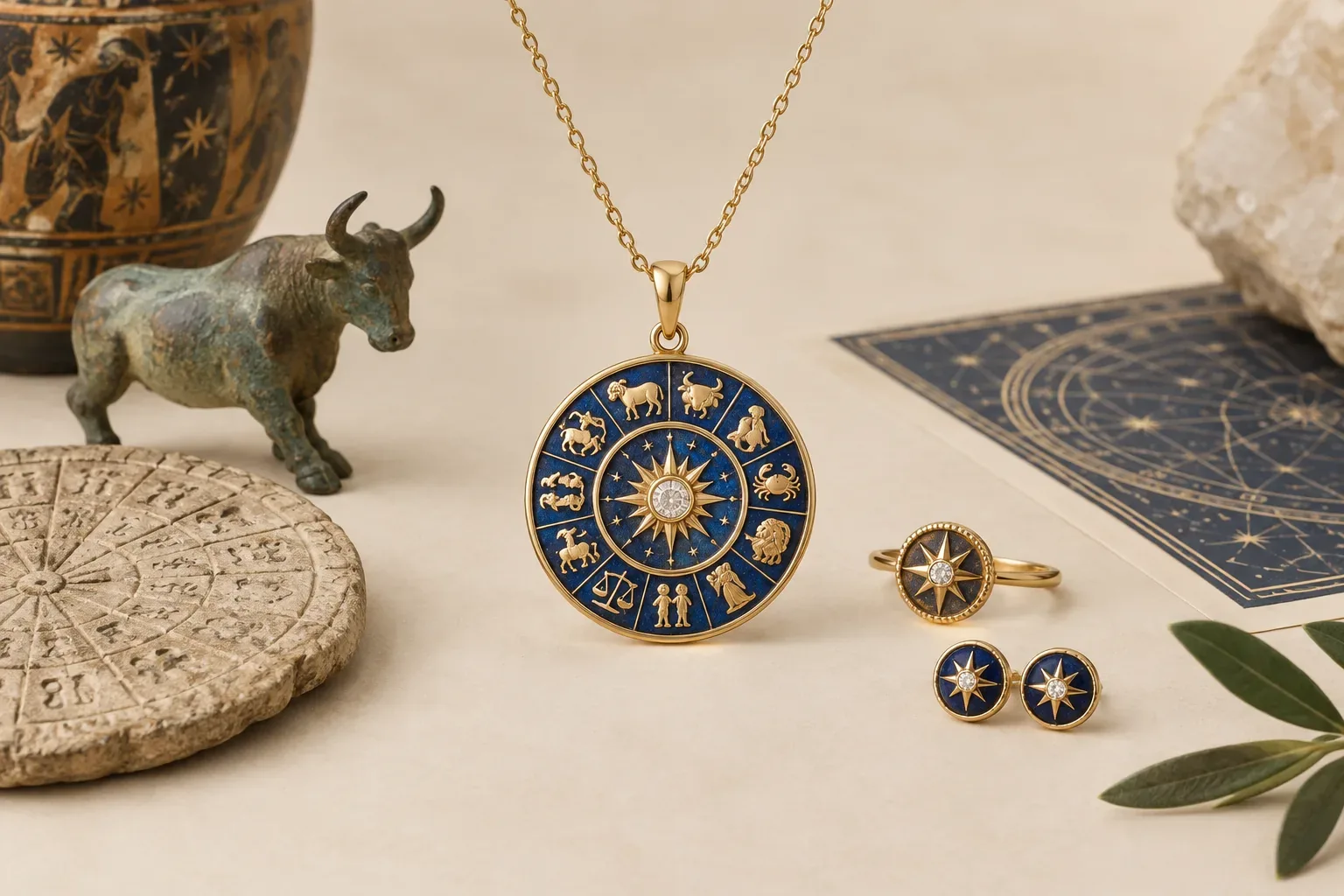
As a visual element, the zodiac wheel often appears as a circular dial or disc divided into twelve segments, sometimes with pictorial symbols for animals or figures, sometimes with simple glyphs. In historic pieces this could be engraved or enamelled on brooches, lockets, pendant dials, or watch faces; in later and contemporary jewelry it is commonly cast or stamped in metal, printed on a flat surface, engraved into signet rings, or used as a pattern on charm bracelets and necklaces.
Gemstones and settings are another way the motif is carried. Museums that catalogue gemstones describe how particular stones were chosen for color, hardness, or symbolic associations. In contemporary zodiac wheel jewelry, makers may set birthstones into each segment or highlight a wearer’s sun sign with a single gem. For consumers, the Victoria and Albert Museum’s materials on gemstones provide historical context for why certain stones appear with symbolic motifs, while guidance from consumer authorities explains the importance of disclosure when gems have been treated or when imitations are used.
Practical guidance for choosing or gifting zodiac wheel jewelry
Decide what meaning you want the piece to carry before you buy. If your priority is historical resonance—a piece that reflects the motif’s decorative or calendrical uses—look for museum-quality reproductions, older pieces with documented provenance, or contemporary designers who cite historical sources. If your priority is personal or astrological meaning, choose a design that highlights the sign or planet you and the recipient value, and consider including a birthstone or engraved date to personalize the gift.
Ask straightforward questions about materials and treatments. The Federal Trade Commission recommends that buyers request full disclosure of gem treatments, synthetics, and imitations. For example, if a seller advertises a ‘ruby’ or ‘emerald,’ ask whether the stone is natural, treated, or lab-grown, and whether any coatings or enhancements have been applied. Reliable sellers will provide certificates or clear explanations about treatments and origins.
Consider scale, wearability, and metal allergies. Zodiac wheel motifs are produced at many sizes. A detailed miniature wheel may read as a precious heirloom on a pendant but lose clarity on a thin ring, while a bold cuff with the wheel as a central motif is a statement piece suited to everyday visibility. If gifting, find out the recipient’s metal preferences and any allergies. For longevity, choose secure settings and reputable makers who guarantee craftsmanship.
Respect cultural and personal contexts. Because the motif has multiple histories and contemporary meanings, be mindful if a particular design is explicitly tied to a religious or cultural practice. If you are unsure whether a motif is appropriate as a casual gift, ask the buyer or recipient about their beliefs and preferences rather than assuming a single universal meaning.
Document the purchase. For pieces bought as keepsakes, retain receipts, certificates for gemstones, and any provenance information. This preserves both consumer protection rights—recommended by the FTC—and the piece’s potential historical value should you later wish to trace its background or sell it.
Conservation and care notes
Basic care for zodiac wheel jewelry follows standard guidance for jewelry conservation: protect fine enamels and delicate engraving from knocks, avoid harsh cleaning that could damage inlaid stones or finishes, and store pieces separately to prevent abrasion. Museum collections guidelines emphasize careful handling and appropriate storage to preserve surfaces and settings.
If a piece contains treated gemstones, follow the seller’s care instructions. Some treatments make stones more sensitive to heat, chemicals, or ultrasonic cleaners. Again, asking about treatments at the time of purchase is the best way to ensure you follow appropriate care.
Frequently asked questions
Does the zodiac wheel symbol always mean astrology?
No. Historically the circular, segmented diagram that we now call a zodiac wheel has been used for calendrical, astronomical, and decorative purposes. Museums such as the Victoria and Albert Museum document a range of historical uses; contemporary wearers may choose it for astrological meaning, but that is a modern interpretation layered over earlier functions.
Are the gemstones in zodiac wheel jewelry usually natural birthstones?
Not always. Some makers use traditional birthstones or natural gems, while others use lab-grown stones, simulants, or treated gems for cost or color reasons. The Federal Trade Commission advises buyers to request clear disclosure about whether a stone is natural, treated, or synthetic.
How can I tell if a zodiac wheel piece is antique or a modern reproduction?
Look for provenance, maker’s marks, and documentation; reputable dealers and auction houses provide condition reports and provenance. Museum collections and catalogues referenced by institutions like the Victoria and Albert Museum can help you compare style and technique, but if you need a definitive age or attribution, obtain a professional appraisal.
What should I ask a seller before buying zodiac wheel jewelry as a gift?
Ask about materials and metal purity, gemstone origin and treatments, measurements and scale, any hallmarks or maker’s marks, and the seller’s return policy and guarantees. If authenticity or treatment matters to you, request certificates or written disclosure as recommended by the Federal Trade Commission.
Is it appropriate to give zodiac wheel jewelry to someone of a different culture or religion?
Be sensitive to the recipient’s beliefs and preferences. The motif has varied historical meanings and modern personal meanings; if you are unsure whether a design has religious or culturally specific significance, check with the recipient or choose a neutral design instead.
How do I care for enamel or detailed metalwork on zodiac wheel pieces?
Handle such pieces gently, avoid exposure to harsh chemicals or ultrasonic cleaners, and store them separately to prevent abrasion. If the piece contains treated gemstones, follow any specific care guidance provided at purchase.
Sources and further reading
- Bedazzled: A History of Jewellery — Victoria and Albert Museum
- An A-Z of Gemstones — Victoria and Albert Museum
- Buying Gemstones, Diamonds, and Pearls — Federal Trade Commission