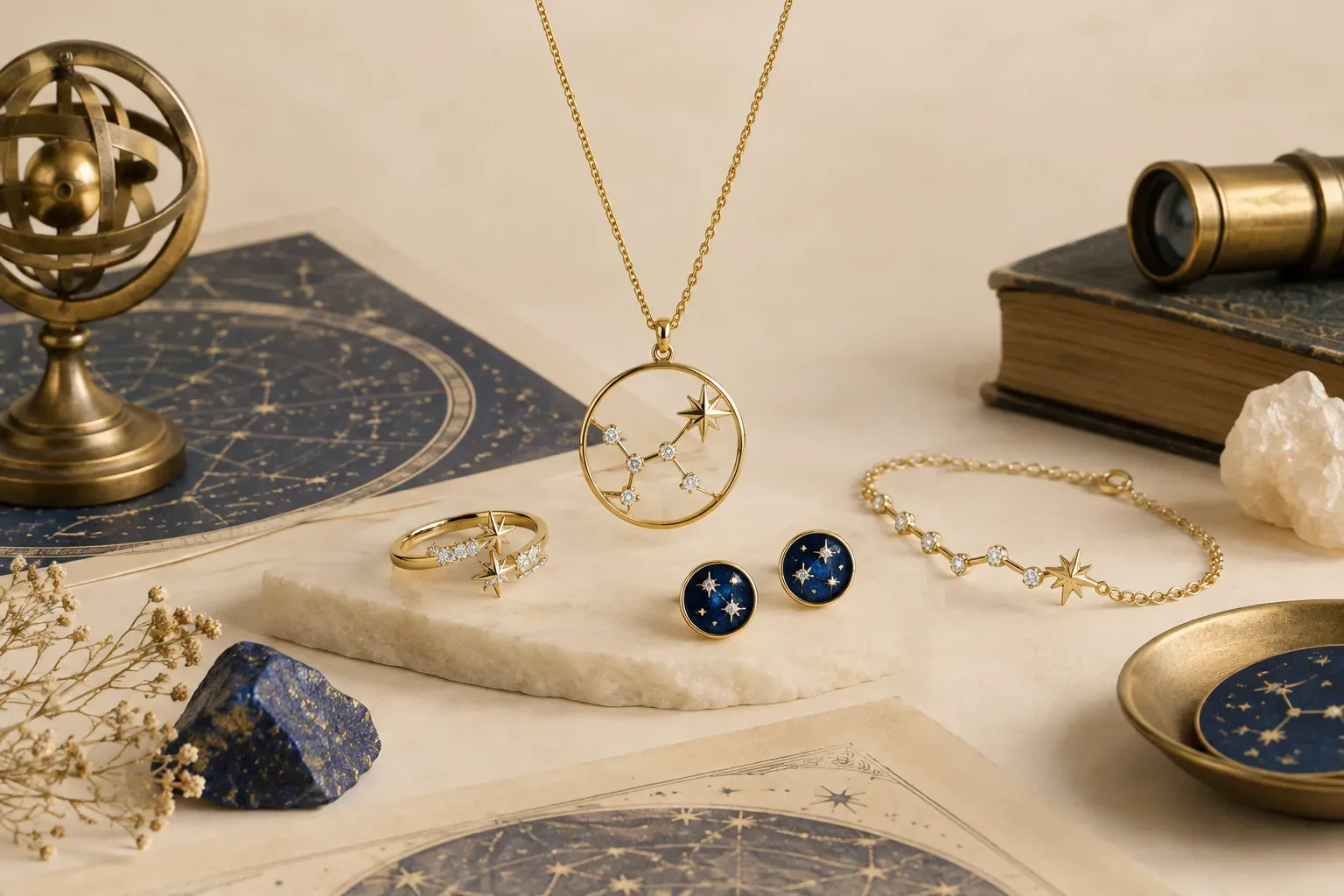
Meaning at a glance
Constellation jewelry meaning reflects a long history of jewelers using stars and star-groups as decorative and symbolic motifs; documented uses and meanings change by culture and period, while modern wearers often adopt personal or astrological meanings—this article distinguishes evidence-based history (as documented by museum scholarship) from contemporary interpretations and gives practical buying and gifting advice.
Documented historical evidence and precise contexts
Museum and curatorial sources show that astronomical imagery appears throughout the history of decorative jewelry, and that the meaning of celestial motifs shifts with social context. The Victoria and Albert Museum (V&A) frames jewellery as an evolving social language, where motifs such as stars, suns and night-sky arrangements are reused, reinvented, and given new meanings across eras. The V&A's historical surveys emphasize changing fashion, technology, and symbolism rather than a single continuous meaning.
Examples of periods and how makers used celestial motifs
Medieval and Renaissance jewelers and patrons borrowed astronomical imagery from learned and religious contexts, and gemstones and metalwork often carried layered symbolism appropriate to courtly or devotional settings. The V&A's historical accounts make clear that jewel motifs were read against the beliefs and aesthetics of their time, so a star might signal divine light in one object and cosmopolitan learning in another.
In the 18th and 19th centuries European jewellery saw repeated 'celestial' revivals. Court and fashionable tastes incorporated stylized stars, suns and crescents into brooches, pendants and hair adornments, frequently using seed pearls, diamonds and enamel to create twinkling effects. The V&A documents these shifts as part of broader changes in jewellery materials and social function: jewels could be public declarations of affiliation, mourning tokens, or amulets depending on the period and context.
In the 20th and 21st centuries, technological advances in gem-cutting, setting and mass production expanded the visual vocabulary for constellations. Designers began to place small stones in map-like arrangements to suggest star clusters or named constellations. The V&A treats this evolution as a continuation of jewellery’s ability to adapt imagery to new tastes, rather than evidence of a single fixed meaning attached to constellation motifs.
Documented cultural meanings versus later or popular interpretations
Where the historical record permits attribution, museum scholarship ties the meaning of star and constellation motifs to the social practices of the object’s makers and owners. That documented meaning depends on precise context: the function of the piece, inscriptions, accompanying imagery, and who owned it. The V&A's approach is to situate objects within those contexts rather than to generalize across cultures.
Modern popular interpretations—such as associating a constellation pendant universally with spiritual protection or a specific personality trait—are contemporary readings that often draw on astrology, personal storytelling, or marketing. These modern meanings are valid for individuals but are not the same as the historically documented functions and should not be presented as universal or ancient facts.
How constellation motifs, gemstones, and traditions appear in jewelry
Designers represent constellations in several consistent ways: by clustering stones to echo a star-map, by engraving or piercing a disc to suggest the night sky, or by using a single prominent 'star' stone surrounded by smaller stones to create a radiating effect. Historically, jewelers used the materials available and fashionable at the time; museum notes on gems document that diamonds, pearls, sapphires, and polished metals have long been chosen to mimic stellar shine or color.
Gemstone selection often follows visual logic rather than fixed symbolic code: colorless or white stones such as diamonds and pearls read as bright points of light, while blue stones like sapphires suggest the night sky or particular stars. The Victoria and Albert Museum's reference on gemstones describes how different stones carry both material and cultural histories, and how their appearance—cut, setting, and polish—contributes to an object's overall message.
Techniques matter: pavé and bead settings let many small stones suggest a field of stars; bezel-set single stones emphasize a named star; enamel and starburst metalwork create stylized or heraldic effects. Contemporary makers also produce map-like constellations, sometimes labeled or personalized with birth dates, coordinates, or engraved names to connect the motif to an event or person.
Materials, treatments and buyer protections
When choosing constellation jewelry, be aware that gemstones and metals can be treated, enhanced, or imitated. The U.S. Federal Trade Commission (FTC) provides guidance and rules about the disclosure of treatments, synthetics, and imitations in gemstone and pearl commerce. Reliable sellers will disclose whether stones are natural, lab-grown, treated, or simulated, and will state metal fineness and plating where relevant.
For historically informed collecting or for responsibly purchasing sentimental pieces, examine documentation and ask sellers for gem reports or treatment information. The visual effect of a constellation piece can be achieved with a wide range of materials—from high-grade diamonds to well-made simulated stones—so clarity about what you are buying helps align expectations with budget and care requirements.
Practical and respectful selection and gifting guidance
Begin by clarifying purpose: are you choosing a piece as an aesthetic gift, an astrological token, a commemorative object, or a historically inspired accessory? If the intent is personal or astrological, match the design to the recipient’s taste: discreet map-like arrangements suit minimalist wearers, while starburst pendants or richly bejeweled brooches suit someone who likes statement pieces.
Respect cultural meanings. If a design draws explicitly from a particular culture’s celestial imagery or religious symbology, learn about and acknowledge that origin when giving the piece. Museum resources and credible scholarship can provide context; framing a gift with a short note about the motif’s history signals care and respect.
Consider materials, durability and lifestyle. If the recipient wears jewelry daily, choose robust settings and harder stones; if the piece is for special occasions, artistry and delicacy may be the priority. Ask about gemstone treatments and lab-grown options if budget or ethical concerns matter to you, and request written disclosures where available, in line with FTC guidance.
Personalization is a thoughtful option: engraving a date, coordinates, or a short line of text turns a constellation motif into a personal map. When customizing, keep the design legible and balanced; overly small engraving or too many tiny stones can compromise long-term legibility and wearability.
Finally, include care instructions and, if relevant, provenance or certification. A short care card helps the recipient preserve the piece’s appearance, while any certification or treatment disclosure protects both buyer and maker and aligns with best practice for responsible jewelry transactions.
Wearing and long-term care
Routine care depends on the materials. Hard stones set in secure mounts are generally low maintenance but should still be cleaned periodically and checked for loose settings. Delicate pavé work or enameled pieces require gentler handling. If you are unsure about cleaning methods, consult the maker or a reputable jeweller; the V&A’s material overviews explain how different stones and treatments respond to cleaning and wear.
Store constellation pieces so that fine points and small stones are not subjected to abrasion. For pieces with mixed metals or plated finishes, avoid chemicals and prolonged moisture. Keeping a record of any treatment certificates and receipts will help if you ever wish to resell or insure the piece.
Frequently asked questions
Is constellation jewelry the same as astrological jewellery?
Not always. Constellation jewellery is a visual motif that references star patterns or celestial imagery; some people choose constellation pieces to reflect astrological signs, but many wear them for aesthetic, commemorative, or historical reasons. Historical uses documented by museums focus on social and stylistic contexts rather than modern astrological meanings.
How can I tell whether the stones in a constellation piece are natural or treated?
Ask the seller for full disclosure. The Federal Trade Commission recommends that sellers disclose treatments, synthetic materials, and imitations. Request written information or a gem report when possible; reputable vendors will state whether stones are natural, lab-grown, heat-treated, dyed, or simulated.
Are there respectful ways to gift constellation motifs drawn from another culture?
Yes. Learn and acknowledge the origin of the design when it is culturally specific, avoid trivializing sacred symbols, and consider supporting makers from the culture of origin. Framing the gift with contextual information shows respect and thoughtfulness.
Can a constellation piece be personalized safely?
Personalization—such as engraving dates, coordinates, or names—can make a constellation piece more meaningful. Ensure that customization does not compromise structural integrity or stone settings, and ask a qualified jeweller about the best methods for engraving or adding small stones so the piece remains wearable and durable.
How should I care for delicate constellation settings with many small stones?
Treat pavé and cluster settings gently, avoid exposing them to chemicals or vigorous cleaning, and have a jeweller check prongs and settings periodically. Store such pieces separately to prevent abrasion and consider occasional professional cleaning for stubborn dirt rather than household chemicals.
Sources and further reading
- Bedazzled: A History of Jewellery — Victoria and Albert Museum
- An A-Z of Gemstones — Victoria and Albert Museum
- Buying Gemstones, Diamonds, and Pearls — Federal Trade Commission