Meaning at a glance
Explain the documented history and changing contexts of the aries motif, separate cultural or religious evidence from later popular interpretations, and give practical guidance for choosing and wearing the motif in modern jewelry.
What the historical evidence shows (by museum and period)
Surveys of jewellery history collected and interpreted by the Victoria and Albert Museum demonstrate that makers in many eras used animal imagery and celestial motifs in decorative arts. The V&A's work places those motifs within changing social, religious, and fashion contexts rather than treating a single motif as having one fixed meaning.
In museum collections, zodiacal or astronomical motifs — including signs later named in Western astrology such as the ram (Aries) — appear as part of a broader repertoire of symbolic imagery. The V&A presents these motifs in relation to the fashions, technologies, and collecting interests of specific periods, showing that motifs may move between sacred, talismanic, and purely decorative roles depending on time and place.
The V&A also documents how 18th–20th century jewellery practice incorporated motifs from classical and popular learning, including zodiac signs, into wearable objects. In those later contexts the ram motif often appears alongside other familiar forms in lockets, brooches, and pendants where personal identity and fashion intersect.
Separating documented historical meanings from modern interpretations
Documented historical meanings in museum records tend to describe how objects were used, who owned them, and how motifs circulated in fashion. The V&A’s scholarship emphasizes provenance, materials, and context: whether a piece was court jewellery, a devotional object, a trade good, or a sentimental item for personal wear. In these accounts the ram motif is one element among many, and its meaning is read in context rather than assumed to be fixed.
Modern interpretations — for example, claims that Aries jewellery universally confers leadership, courage, or other personality traits — are often contemporary layers placed on older motifs. These personal or astrological readings may be meaningful to buyers and wearers, but they are not the same as documented historical intent. Where history records use, it rarely equates a motif with a single, timeless power.
Respectful writing about symbolism keeps these two kinds of claims distinct: cite museum documentation for how a motif was used and make clear when a meaning is a modern preference or an astrological association rather than a proven historical fact.
How the Aries motif and related traditions appear in jewellery
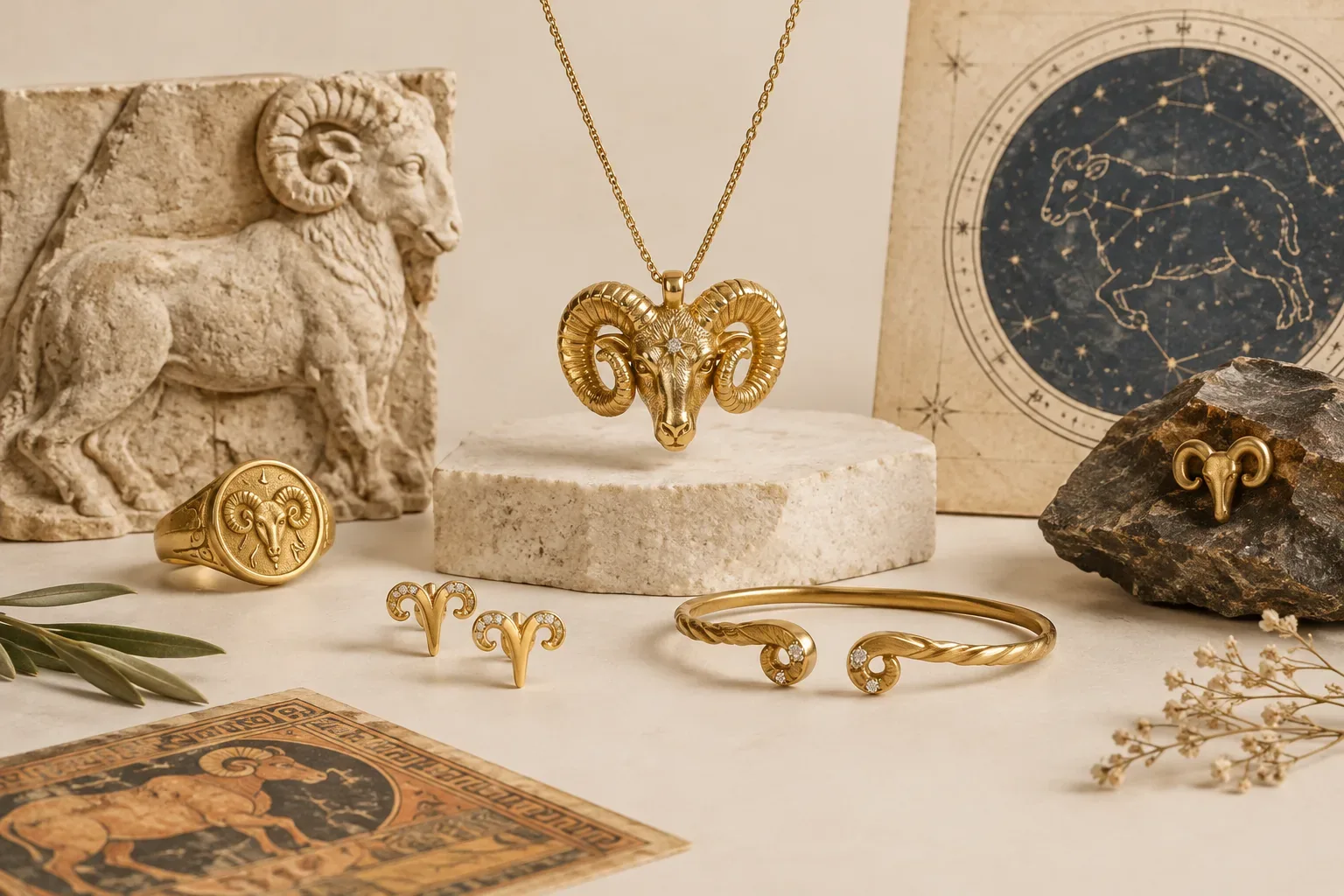
In practice, the ram or Aries motif appears in jewellery as literal ram heads, curled-horn profiles, stylised glyphs borrowed from astrological charts, or as part of composite designs combining plants, stars, and inscriptions. The specific form a maker chooses depends on the object type: lockets and brooches often carry narrative or emblematic scenes, rings and pendants may use a compact glyph or horn shape, and cufflinks or signet-style pieces can use an engraved or cast ram head.
Makers also use color, texture, and gemstones to signal associations. For example, warm-coloured gems and red or orange enamels are commonly chosen by contemporary designers to evoke the energetic qualities associated with Aries in modern astrology, while historical pieces might emphasize metalwork, carving, or portraiture over bright color.
The V&A’s resources on jewellery history show that motifs migrate between elite and popular wear, and that the same ram form can be used for different purposes: devotional, commemorative, fashionable, or playful.
Gemstones, materials, and what to know before you buy
The Victoria and Albert Museum’s A–Z of gemstones provides useful background on the physical identities and historical uses of stones that appear in jewellery. Gem choice affects durability, color palette, and cost, and different stones have had different reputations through time; museum documentation helps explain those reputations without turning them into universal meanings.
When selecting an Aries-themed piece, consider whether you want stones for their appearance, durability, or personal association. Modern makers often select stones with red, orange, or golden tones—such as garnet, fire opal, or citrine—to echo the traditional idea of Aries as a ‘fiery’ sign, but that is a contemporary aesthetic choice rather than a historical rule.
The U.S. Federal Trade Commission advises buyers to look for clear information about treatments, imitations, and origin when purchasing gemstones. Ask sellers whether stones have been heat-treated, dyed, irradiated, or otherwise enhanced, and request written disclosure for significant treatments or lab-created alternatives. These disclosures are practical consumer protections and do not affect the symbolic meaning of a piece but do affect value and care requirements.
Practical and respectful selection or gifting guidance
First, clarify the intent: are you buying an Aries piece as an astronomical motif, an astrological birthday gift, a family emblem, or simply because the ram form appeals visually? Stating that intent will guide material choices and inscriptions. If you are unsure about the recipient's beliefs, choose a piece with a clear aesthetic emphasis rather than explicit astrological claims.
Consider scale, lifestyle, and durability. Rings and bracelets require harder stones and secure settings; pendants and brooches can accommodate more delicate carving or enamels. The V&A’s discussions of jewellery forms emphasize that function and wearability shape design decisions across periods, a useful reminder for contemporary purchases.
When gifting, include provenance and care information. For gemstone pieces, provide any seller documentation about treatments and origin as the Federal Trade Commission recommends for transparency. If the piece references cultural or religious traditions outside your own experience, choose designs made by or curated with knowledge of that tradition, or select a more neutral motif to avoid unintended appropriation.
Personalisation adds meaning: simple engraved dates, initials, or short inscriptions explain why the motif was chosen. If giving something as a zodiac gift, phrase the card to make clear whether the significance is personal, astrological, or aesthetic so the recipient can receive it in the intended spirit.
Care, authenticity, and longer-term considerations
Take care instructions from retailers seriously: metal karat, stone hardness, and setting type determine cleaning methods and how often a piece can be worn. The V&A’s materials-oriented commentary and the FTC’s consumer guidance together underline that material knowledge protects value and appearance over time.
For investment or heirloom pieces, ask for documented provenance, condition reports, and any known restorations. Historical jewellery in museum collections often survives with documentation because those records matter to conservators and curators; asking similar questions of sellers helps you make an informed purchase.
Finally, remember that meanings change. A piece bought for a birthday today may become a family memento or a fashion staple tomorrow. Choosing craftsmanship and clear provenance helps ensure the object endures whatever meanings it later acquires.
Frequently asked questions
Is Aries jewellery historically linked to one fixed meaning?
No. Museum surveys such as those by the Victoria and Albert Museum show that motifs like the ram have been used in different contexts for decorative, religious, or personal reasons. Historical records read meaning in context rather than assigning a single fixed symbolism.
Does the ram motif always mean astrological Aries?
Not necessarily. The ram form predates or exists alongside astrological use in many contexts; in jewellery it can reference the animal itself, a family emblem, a classical motif, or the Western zodiac depending on the object's origin and maker.
What gemstones are appropriate for Aries-themed jewellery?
There are no historically mandatory stones for an Aries motif. Contemporary makers often choose warm-toned gems for aesthetic reasons, but from a practical standpoint you should select stones for color preference, durability, and budget. Consult the Victoria and Albert Museum’s gemstone guides for historical context and the FTC’s consumer guidance for information about treatments.
How can I verify a gemstone’s treatments or origin?
Ask the seller for written disclosure of treatments and for any certification on origin or lab creation. The Federal Trade Commission recommends that sellers clearly label enhancements and imitation materials so buyers can make informed decisions.
Is it appropriate to gift Aries jewellery as a zodiac present?
Yes, if you understand the recipient’s relationship to astrology and present the gift with clarity about your intent. If the recipient’s beliefs are unknown, choose a design focused on aesthetics or include a note explaining whether the piece is meant as a birthday, aesthetic, or symbolic gift.
How should I care for an Aries-themed heirloom piece?
Care depends on materials and settings. Harder stones and secure metal settings tolerate everyday wear better than soft carvings or fragile enamels. For long-term preservation, request provenance and condition details from the seller and follow conservator or maker care recommendations.
Sources and further reading
- Bedazzled: A History of Jewellery — Victoria and Albert Museum
- An A-Z of Gemstones — Victoria and Albert Museum
- Buying Gemstones, Diamonds, and Pearls — Federal Trade Commission