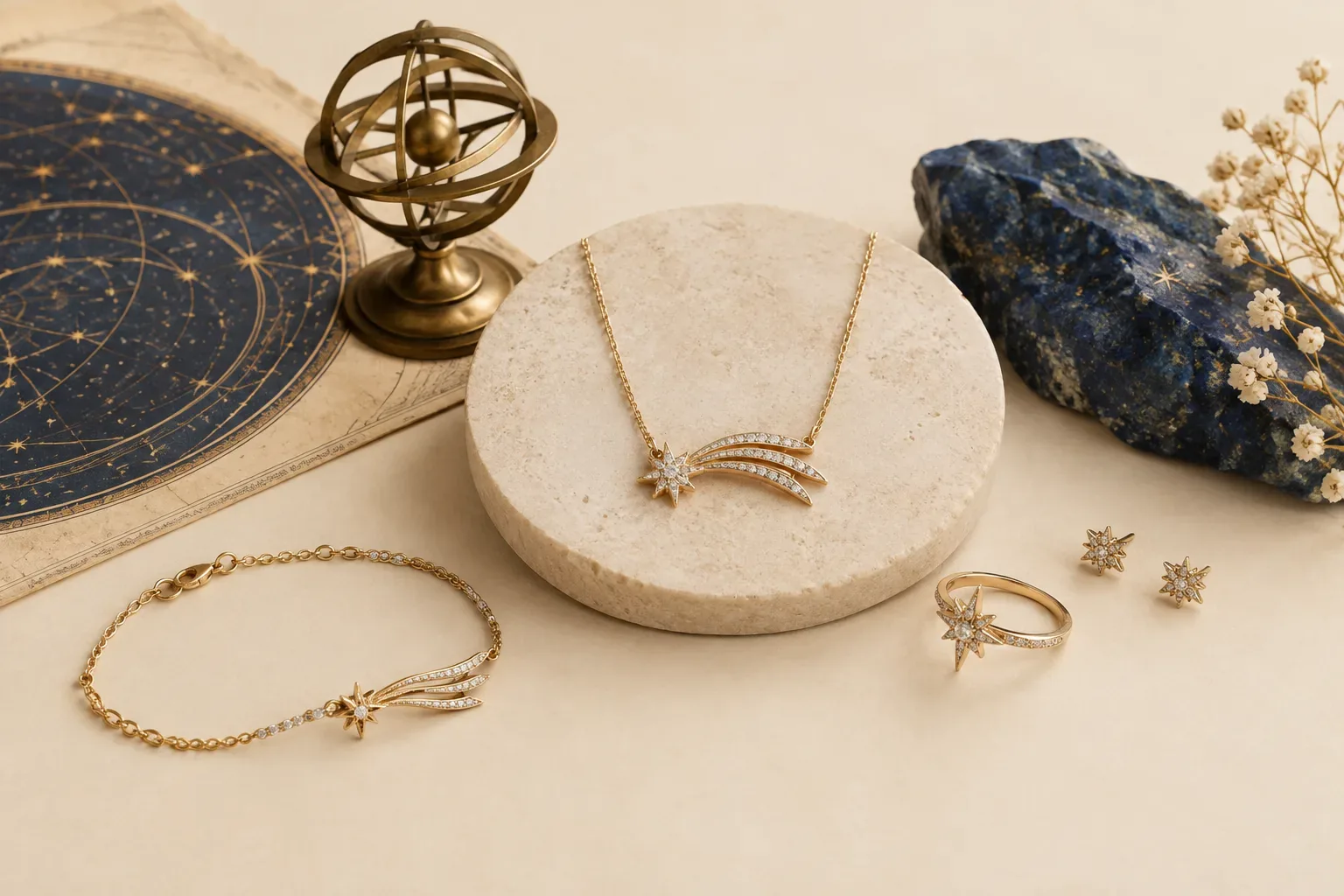
Meaning at a glance
Shooting star jewelry meaning combines a long visual tradition of astronomical motifs in decorative arts with many personal interpretations today; museum evidence shows the motif has recurred in jewelry history as a way to suggest light, speed, and the heavens, while modern wearers often attach hope, wish-making, or remembrance—choose materials, settings, and disclosures carefully and match the piece to the recipient’s values and style.
Historical evidence and contexts (what museums document)
Evidence for the shooting star and wider astronomical motif in jewellery comes primarily from museum collections and scholarship that track changing tastes, motifs, and technologies. The Victoria and Albert Museum’s overview of jewellery history places astronomical motifs among many recurring themes that jewelers adapted as styles and social meanings changed. Museums document examples in decorative arts where jewellers used starbursts, comets, and similar devices to suggest sparkle, divine light, or fashionable motifs rather than a single fixed meaning.
Museums and curators treat these motifs as part of broader visual vocabularies. Objects in collections show that jewellers used carved stones, faceted gems, metalwork and setting techniques to create star-like effects. The same visual language—rays, tails, and bright central stones—appears in different periods and contexts as designers borrowed astronomical imagery to evoke elegance, spectacle, exoticism, sentiment or novelty, depending on the time and audience. This approach to motifs is documented in general jewellery history surveys and exhibitions rather than as a single cultural or religious doctrine.
Separating documented historical meanings from modern interpretations
Documented historical meanings: Museum scholarship usually interprets shooting-star motifs in terms of style, technology and social context. When curators describe an object as featuring a comet or starburst, they are noting a motif that communicates brightness, prestige, or fashionable interest in science and the heavens. These interpretations are derived from object study and display history and reflect how motifs circulated in decorative practice, as discussed by the Victoria and Albert Museum.
Modern personal and popular interpretations: In contrast, many contemporary meanings—wishing on a shooting star, a sudden change in life, or a romantic wish—come from folk belief, literature and personal practice rather than direct continuity from historical jewellers’ intentions. These modern layers are legitimate ways people use symbols today, but they are not the same as museum-evidenced, period-specific meanings. It is important not to claim a single universal meaning; a piece may carry both a historically documented decorative lineage and a newer personal story chosen by the wearer or giver.
How the motif, gemstones, and traditions appear in jewelry
Motif and design language: Jewelers render shooting stars with a bright central element and radiating lines or a tapered tail. Designers use starbursts, rays, and comets to create movement in brooches, pendants, rings and earrings. The same stylized language can be engraved, pierced in metal, or assembled from multiple stones to suggest a streaking point of light.
Gemstones and materials: Museums’ gemstone guides show the historical use of gems to imitate or amplify star-like effects. Faceted diamonds, high-clarity white stones, and reflective metal surfaces have long been used to evoke brilliance. Stones with optical phenomena—such as star sapphires or star diopside that show asterism, or opals that give play-of-colour—have been chosen to enhance the celestial effect. Contemporary makers may also use small pavé diamonds or scattered accent stones to suggest a trail of light.
Settings and jewellery types: Shooting star motifs appear across object types. Pendants and lockets use a central motif that reads well at chest level; brooches and pins can be larger, allowing more detailed tails and ornament; rings concentrate the effect around a center stone; earrings pair symmetrical rays or asymmetrical falling motifs. The motif can be literal—an engraved comet tail—or abstract, where a cluster of gems and a diagonal arrangement evoke motion.
Practical guidance for selecting or gifting shooting star jewelry
Match the meaning to the recipient: If you are buying for someone who values documented history, choose pieces with museum-style references or vintage examples and mention the object’s provenance. If the gift is meant to carry a modern sentiment—hope, a new start, or a remembered moment—explain that the meaning is a contemporary personal layer, not a single historical fact. Respect the recipient’s beliefs and avoid assuming the symbol has the same meaning for them as it does for you.
Consider materials and wearability: Think about how often the recipient will wear the piece and choose materials accordingly. Durable metals and securely set stones suit everyday wear; more delicate filigree or fragile opals may be better for occasional use. Consider the design scale—pendants and studs are versatile; larger brooches may be more statement than practical for some lifestyles.
Check gemstone treatments and disclosures: The Federal Trade Commission requires sellers to disclose treatments, imitations, and whether stones are synthetic or enhanced. Ask the seller for clear information about whether gems are natural, lab-grown, heat-treated, irradiated, or simulants, and request written confirmation if the purchase is significant. This ensures the gift matches both aesthetic expectations and ethical or budgetary considerations.
Provenance and age: When buying vintage or antique shooting star pieces, ask about provenance and condition. Museum contexts show how motifs changed over time; a genuine period piece may have value as an example of where the motif appeared historically, but it will also require more careful handling and possibly conservation.
Personalization and presentation: Consider engraving a short note, choosing a lockets functionality for a keepsake, or pairing the piece with a card that explains the chosen modern meaning. That practice respects both the documented decorative lineage of the motif and the personal narrative you want to give the wearer.
Care, authenticity and further research
Caring for shooting star jewellery follows the same practical rules as other pieces: clean according to the metal and gemstone, avoid harsh chemicals, and store to prevent abrasion. For pieces with optical phenomena—opals, star sapphires—follow specialist care recommendations because some stones are sensitive to heat, solvents or impact.
Authenticity and buying notes: Use reputable dealers, ask for treatment disclosure and receipts, and when possible obtain an independent appraisal for high-value purchases. The Federal Trade Commission provides guidance on buying gemstones and pearls, including disclosure requirements that protect buyers from undisclosed treatments and imitations.
Researching the motif: If you want to trace a specific piece’s history or the motif’s use in a particular period, consult museum catalogues and specialist literature. The Victoria and Albert Museum’s general surveys and gemstone guides are useful starting points for understanding how motifs and materials have been used and displayed in historical contexts.
Frequently asked questions
What does shooting star jewelry traditionally symbolize?
Traditionally, museum scholarship treats shooting star motifs as decorative devices that suggest light, movement, or celestial association. Modern symbolic meanings such as wishes or sudden change are personal or cultural additions rather than universal historical facts.
Is a shooting star motif appropriate for an engagement or romantic gift?
It can be, if the symbolism you intend is communicated. Many people accept contemporary meanings like hope or a wish as romantic. If historical authenticity matters to the recipient, explain whether the piece is vintage or a modern design and what you intend the motif to represent.
Which gemstones give the best 'shooting star' effect?
Faceted white stones and diamonds produce sparkle. Stones that show optical effects—such as star sapphires with asterism or opals with play-of-colour—also support a celestial look. Choose based on the desired visual effect and the stone’s durability for everyday wear.
How can I be sure a gemstone is natural and not treated or a simulant?
Ask the seller for written disclosures and, for valuable purchases, request a grading report or independent appraisal. The Federal Trade Commission requires disclosure of treatments and imitations, so reputable sellers will provide this information.
Can a shooting star motif hold personal or cultural meaning?
Yes. Contemporary and personal meanings are common and meaningful to wearers. Bear in mind that such meanings are modern layers and may not reflect the original intentions of historical makers; respect the recipient’s cultural or religious context when gifting.
Where can I learn more about the motif’s history?
Start with museum overviews and gemstone guides to understand how motifs and materials were used. The Victoria and Albert Museum’s resources on jewellery history and gemstones are useful entry points for further research.
Sources and further reading
- Bedazzled: A History of Jewellery — Victoria and Albert Museum
- An A-Z of Gemstones — Victoria and Albert Museum
- Buying Gemstones, Diamonds, and Pearls — Federal Trade Commission