Meaning at a glance
This article explains the documented history and changing contexts of the evening star motif, separates cultural or religious evidence from later popular interpretations, and gives practical guidance for choosing and wearing the motif in modern jewelry.
Short answer (concise thesis)
Explain the documented history and changing contexts of the evening star motif, separate cultural or religious evidence from later popular interpretations, and give practical guidance for choosing and wearing the motif in modern jewelry.
Historical evidence and where it comes from
The phrase "evening star" historically refers to the planet Venus seen shortly after sunset. References to that astronomical object appear in literature and science across many cultures, but the direct evidence for a distinct, named "evening star" motif in jewelry is more diffuse. The museum record shows that celestial motifs—stars, suns, crescents and other astronomical imagery—have been used repeatedly in jewellery design, adapting to fashion and changing meanings over time. The Victoria and Albert Museum presents this long view of changing decoration and social context within jewellery history, and notes how makers borrow astronomical imagery when it suits aesthetic or symbolic needs.
Because the archaeological and museum literature catalogues motifs rather than a single unified symbolic taxonomy, it is important to treat claims about a single, universal "evening star" meaning with caution. Where specific, documented practices exist—such as the use of star patterns or asterism in particular gemstones—those are described in gemological and museum sources rather than in a single cultural origin story. For guidance on gemstones and how they have been presented in historical collections, the Victoria and Albert Museum's A–Z of Gemstones provides context about how particular stones and optical effects have been used in jewellery.
Which cultures or periods used celestial motifs (and what the evidence shows)
Museum collections and catalogue entries show that celestial imagery appears in many periods: for example, stars and suns appear in decorative metalwork, inlaid jewellery, and portrait miniatures from different eras. The V&A documents that motif choices are shaped by fashion, technology, and social meanings rather than by a single constant symbolism, so the presence of a star motif in a Victorian brooch is not necessarily evidence that it carried the same cultural meaning as a star motif on an earlier or later object.
In other words, the historical evidence supports a history of recurrent interest in celestial forms in jewellery rather than a single, continuous tradition labelled "evening star". When researching a particular historic object, museum records and provenance statements are the best sources for firm claims about who made it, when, and what meaning the maker or patron likely intended. The V&A's exhibition and catalogue material emphasize these changing contexts rather than offering a single interpretation.
Documented historical meanings versus modern interpretations
Documented historical meanings come from makers' records, inscriptions, provenance, and contemporary texts or catalogues. Museums such as the Victoria and Albert Museum present those documents and objects so researchers can see how meanings shift. For many historical pieces, the maker or patron left no explicit statement, and modern writers have layered new interpretations onto older designs.
Modern interpretations of the evening star motif tend to be personal, romantic, or spiritual. Contemporary wearers may associate an "evening star" design with guidance, a loved one, hope, or a remembered evening sky. Those are valid personal meanings but they are not necessarily documented historical meanings. Distinguishing the two is important: museum evidence supports the recurrence of celestial imagery, while modern symbolic claims are often contemporary re-readings rather than direct continuations of a documented historical belief.
How the motif, gemstone, or tradition appears in jewellery
Designers render the evening star idea in several technically distinct ways. One approach is literal depiction: an engraved or pierced star motif in metalwork or inlays that evokes a star in the sky. Another approach is optical: certain gemstones show star-like optical phenomena—most famously asterism in star sapphires and star rubies—where light forms a star-shaped reflection across the stone's surface. The V&A's gemstone overviews explain how particular stones and cuts have been prized for these visual effects and used accordingly in jewellery.
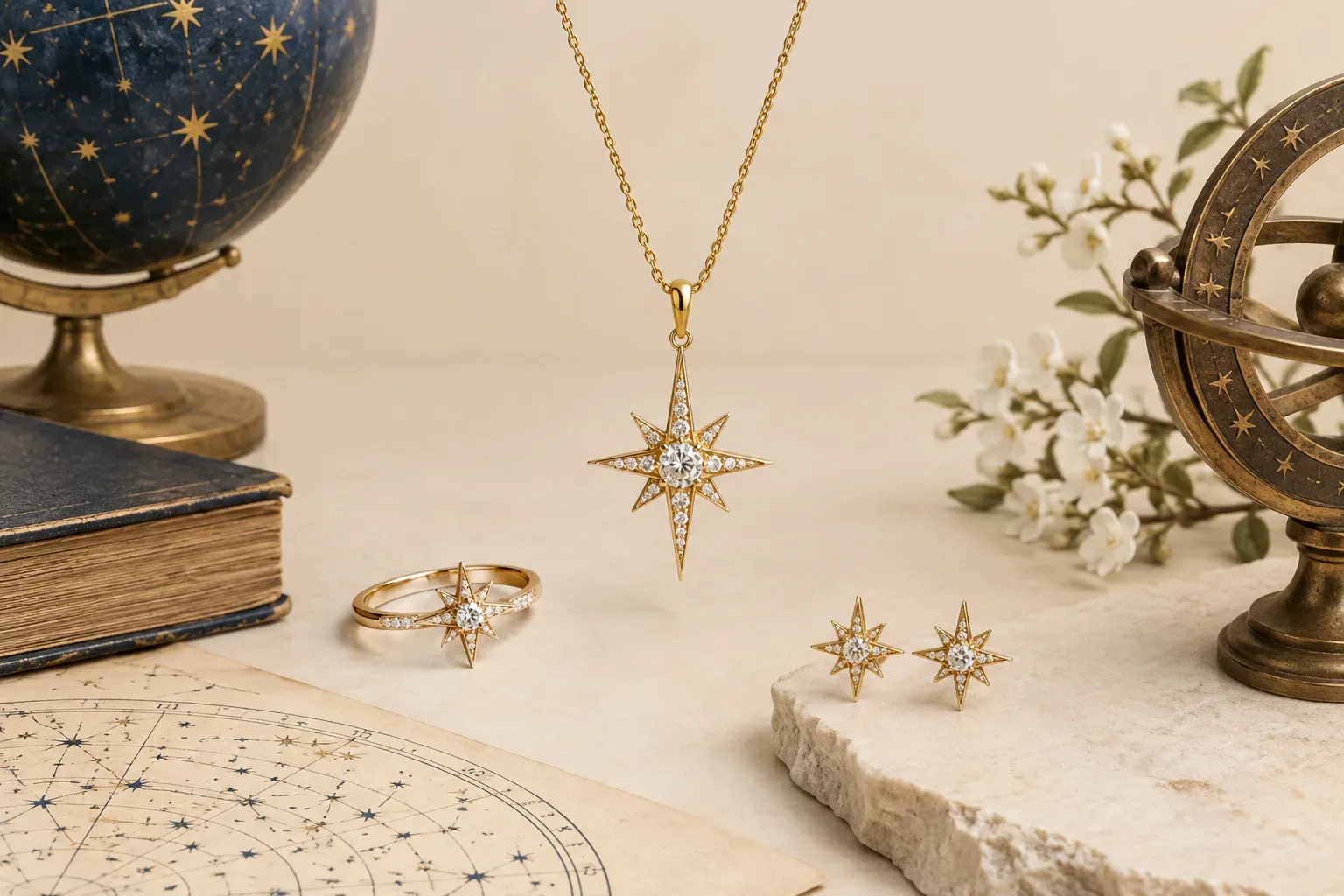
A third method is stylistic: jewelers set a central gem and surround it with radiating small stones or metal points to suggest a starburst. Star settings, star cuts, or engraved star patterns can be combined with other celestial motifs such as crescents or suns. Historically recorded pieces in museum collections demonstrate these technical methods, while modern makers continue to adopt them to express celestial themes in rings, pendants, brooches, and lockets.
Practical guidance for selecting, buying, and gifting evening star jewellery
Decide whether you want a piece grounded in historic technique or a contemporary design with personal symbolism. If the buyer or wearer values historical authenticity, look for documented provenance or museum-quality making techniques described by reputable sellers. If personal meaning is the priority, choose a design and gemstone that resonate emotionally with the recipient.
When buying gemstones or items advertised as asterism (star sapphires, star rubies, or star-cut stones), ask the seller about the stone's origin, whether it has been treated, and whether any synthetic or imitation stones are involved. The Federal Trade Commission provides consumer guidance about disclosures for gemstone treatments, imitations, and other alterations; asking for written confirmation or a report from a recognized gemological laboratory is sensible for higher-value purchases.
Be culturally respectful when assigning symbolic meanings. Because star imagery is used across cultures with different associations, do not assume a single interpretation is appropriate for every wearer. If the piece references a specific cultural or religious symbol, research its meaning or ask the recipient whether that association would be welcome.
Consider practical aspects of wear: asterism is best seen under directional light, so star-sapphire rings and pendants show their effect differently in everyday light than in photograph or display cases. Evaluate metal and setting choices for the recipient's lifestyle: closed back settings preserve some gemstones but limit light interaction, while open settings expose the stone and can show more optical effects but may require more care.
For gifting, pair the jewellery with a short note that distinguishes historical facts from personal sentiment. If you want to highlight a historical connection, reference the object provenance or maker where available. If your gift is meant to convey a personal message—guidance, memory, or hope—explain that your meaning is a contemporary, personal choice rather than an assertion of a universal symbolic history. For more on choosing meaningful jewellery and researching symbols, see our related guides on How to Choose Meaningful Jewelry: A Practical Gift Guide and How to Research the Meaning of a Jewelry Symbol.
Where to look next (research and authentication)
When you need authoritative information about a particular historic piece, consult museum catalogues and exhibition notes that describe provenance and interpretation. The Victoria and Albert Museum's resources on jewellery history and gemstones are useful entry points for understanding technical methods and how meanings have changed over time.
For transactions, use gemological reports and understand the seller's disclosure practices. The Federal Trade Commission advises consumers to request clear information about treatments and imitations; for significant purchases, obtain independent grading or a lab report. When in doubt about whether an apparent star effect is natural, enhanced, or synthetic, ask for a lab certificate that notes treatments and the stone's nature.
Frequently asked questions
What exactly is the "evening star" in historical terms?
Historically, the phrase "evening star" most commonly denotes the planet Venus when it appears after sunset. References to the evening star are astronomical and literary; the specific use of an "evening star" motif in jewellery is part of a broader tradition of celestial decoration rather than a single documented symbolic practice.
Are star gemstones like star sapphires the same as an evening star motif?
Star gemstones show an optical effect called asterism, which creates a star-like appearance in the stone. These gems are a material way designers evoke star imagery. The descriptive connection to an "evening star" is modern and aesthetic; the gem's optical property is an independent phenomenon described in museum gemstone references.
Is evening star jewelry linked to a specific religion or culture?
No single, universal religious or cultural meaning for "evening star" jewellery is documented. Celestial motifs occur in many cultures with different associations. If a piece references a specific cultural symbol, consult provenance or scholarly sources; otherwise treat modern symbolic readings as personal interpretations.
How can I be sure a star-effect gemstone is natural and not treated or synthetic?
Ask the seller for full disclosure about treatments and for a report from an accredited gemological laboratory. The Federal Trade Commission recommends consumers request written information about treatments, enhancements, and whether a stone is natural, synthetic, or an imitation.
How should I choose an evening star piece as a gift?
Consider whether you want historical authenticity or a contemporary symbolic gift. Ask about provenance for antique pieces and treatments for gemstones. Think about the recipient's cultural and aesthetic preferences and include a note that clarifies whether the gift's meaning is historical or personal.
Sources and further reading
- Bedazzled: A History of Jewellery — Victoria and Albert Museum
- An A-Z of Gemstones — Victoria and Albert Museum
- Buying Gemstones, Diamonds, and Pearls — Federal Trade Commission