Meaning at a glance
The morning star jewelry meaning has documentary roots in the long use of star and radiating motifs in decorative arts, as preserved in museum collections; later astronomical and personal interpretations layered new meanings, and modern selection should respect documented history, material realities, and the recipient's beliefs.
Quick answer — concise and direct
In short: morning star jewelry meaning arises from a longstanding decorative motif — starbursts and radiant stars — documented across multiple historical periods, and more recent astronomical and personal readings (for example, associations with the planet Venus, new beginnings, or spiritual light) are modern interpretations layered onto that visual tradition. This article explains what museums record about the motif, separates documented historical uses from later symbolism, describes how the motif appears in jewelry, and offers practical guidance for choosing and gifting pieces.
What the historical evidence shows (and where it comes from)
The visual idea of a star or radiating burst appears repeatedly in jewelry as recorded in museum collections and catalogues. The Victoria and Albert Museum describes how jewellery styles and motifs change with technology, fashion, and social context, and its holdings illustrate star-shaped and radiating decorations from many periods and regions.
Collections documented by the Victoria and Albert Museum include examples from ancient and classical periods, medieval and Renaissance Europe, Ottoman and Islamic decorative traditions, and later European revivals, including the 19th century. In each period the star motif functioned primarily as an ornamental device whose exact meaning depended on context: it might be a purely decorative emblem, a heraldic or devotional device, or part of a fashionable vocabulary revived from earlier styles.
The V&A’s surveys of gemstones and mounting traditions also show how artisans exploited optical effects to suggest stars: for instance, gem asterism (a star-like reflection) and carefully cut stone settings that create starbursts were technical means to achieve the motif in wearable form. These technical and stylistic continuities are what permit us to trace a material history of 'morning star' imagery without conflating later symbolic interpretations with earlier artifact use.
Separating documented historical meanings from modern interpretations
Documented historical meanings: Museum evidence supports that star and radiating motifs were widely used as ornament and occasionally as elements in religious or civic symbolism. The V&A’s work on jewellery history emphasises changing social contexts — for example, how styles were adopted, adapted, or revived — but does not reduce every star-form to one single, unchanging meaning. Where a star motif served a clear ritual or heraldic role, that function is evidenced by the object’s provenance, associated inscriptions, or its use within a known ceremonial ensemble.
Modern personal interpretations: Over the 19th and 20th centuries, astronomical discoveries, popular culture, and individual spirituality prompted fresh associations for star imagery. People today may read the term 'morning star' as a reference to the planet Venus, as a metaphor for hope or new beginnings, or as an emblem of spiritual light. Those are contemporary layers of meaning—useful for personal symbolism but not necessarily supported as universal or original meanings by museum documentation. It is important to note that museums like the Victoria and Albert Museum describe motifs and their historical contexts; they do not prescribe the modern symbolic readings that individuals may bring to a motif.
How the 'morning star' motif, gemstones, and techniques appear in jewelry
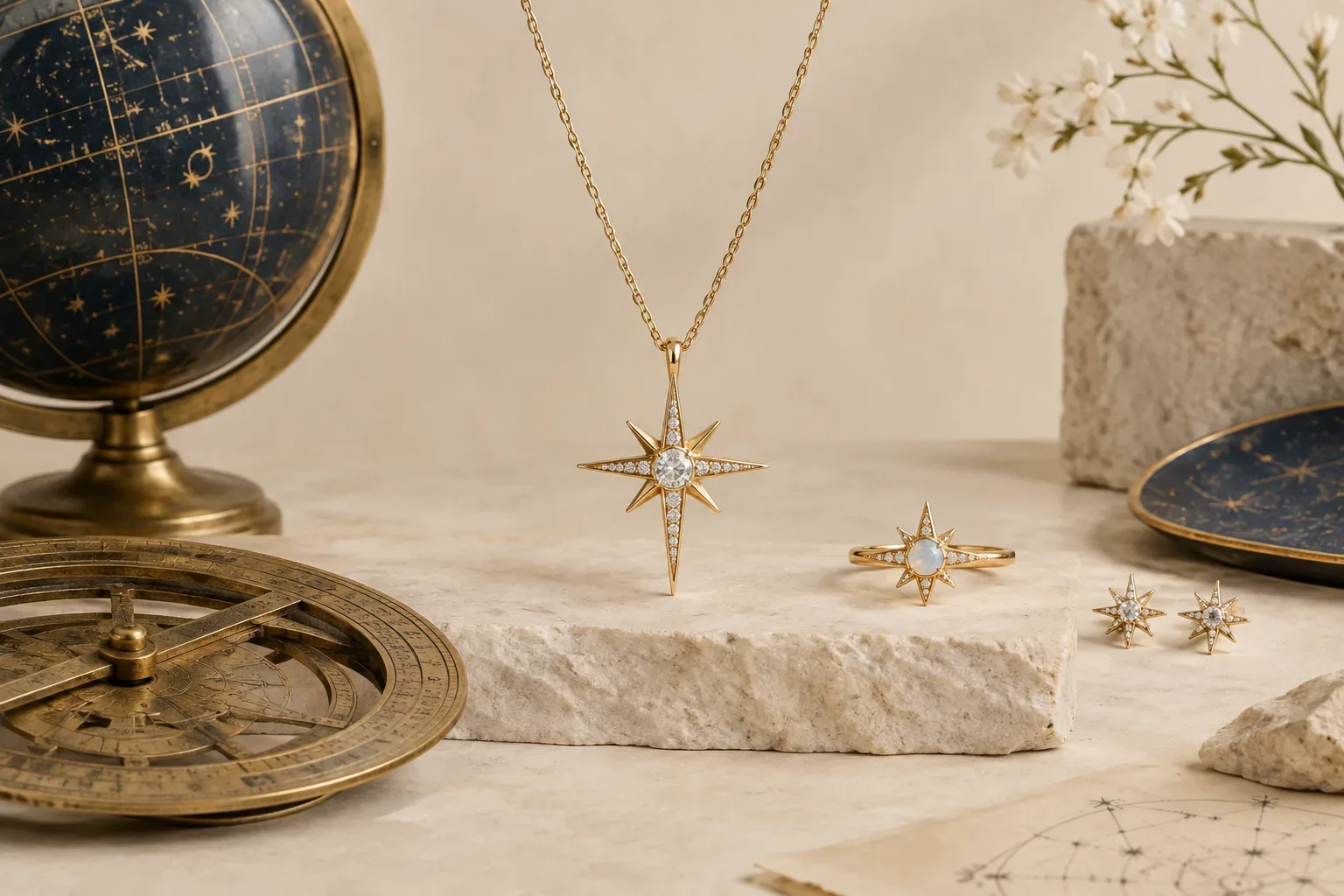
Design motifs: Jewelers create the morning star look either by shaping metal into star forms and rays, by arranging stones in a radiating pattern around a central gem, or by using settings that emulate a starburst. Star motifs also appear on engraved lockets, brooches, pendants, and signet-like devices where a small star is used as a decorative accent.
Gemstone use and optical effects: Gemstones themselves can produce star-like effects. The phenomenon of asterism — a four- or six-rayed star visible on the surface of some cabochon-cut gems — is an example described in gemstone reference material compiled by institutions such as the Victoria and Albert Museum. Star sapphires and other asteriated stones have been used historically when a natural 'star' in the gem was desired. Separately, cutters and setters use faceting, brilliant arrangements of small stones, and metalwork to create artificial starbursts in diamond and gem-set jewellery.
Settings and metalwork: Metal rays, milgrain, and pavé or cluster settings are traditional ways to suggest radiance. In some 19th-century and early 20th-century pieces in museum collections, jewelers combined central stones with radiating diamonds or metal rays to evoke celestial imagery; later designers have adapted the same vocabulary for contemporary fashion and personal symbolism.
Choosing and gifting morning star jewelry: practical and respectful guidance
Know what you want the symbol to convey. If you intend the piece to carry a specific meaning — for example, hope, guidance, remembrance, or an astronomical reference to Venus — be explicit when you choose and when you give. Modern interpretations are personal; speaking about your intention ensures the recipient understands the sentiment rather than inferring unintended associations.
Match the material to the intended use. For everyday wear choose durable stones and metals. If you’re interested in asteriated gems (star sapphires or similar), be aware these are typically cut as cabochons and have different hardness and care needs than faceted diamonds. Consult gemstone guides like the Victoria and Albert Museum’s A–Z of Gemstones for historical context and basic identification and check durability ratings where relevant.
Ask dealers about treatments and imitations. The Federal Trade Commission advises consumers to ask whether a gemstone has been treated, enhanced, or simulated and to seek written disclosure. For significant purchases request documentation or certification and prefer reputable sellers who disclose treatments, provenance, and care recommendations.
Respect cultural and religious context. Because star imagery can acquire particular meanings in different communities, avoid assuming a single universal interpretation. If the piece references a specific cultural motif or religious symbol, be sensitive to whether that usage is appropriate for a gift. When in doubt, ask or choose a more neutral starburst or celestial motif.
Budget and repairability. Decide whether you prefer historic or vintage pieces or new designs. Antique starburst or star-set jewellery can have charm and patina but may need restoration. New pieces can be made with modern alloys and settings that are easier to repair and maintain. Ask about warranties, resizing, and repair policies when buying.
Practical care and verification tips
Care depends on materials. Cabochon-cut star sapphires require different cleaning than faceted diamonds; softer stones and intricate pavé work need gentle handling. The Victoria and Albert Museum’s resources on gemstones and mounting traditions provide context for how stones were historically handled, which can inform modern care routines.
Verify treatments and authenticity. Follow the Federal Trade Commission’s guidance: ask sellers whether gemstones are natural, treated, lab-grown, or simulants, and request written confirmation. For higher-value items, consider third-party certification to document gemstone identity and treatments.
Consider insurance for significant pieces. If the piece has emotional and monetary value, insure it and keep photographic records and receipts. Ask the seller for a full description of materials and any existing repairs so an insurer can assess replacement value accurately.
Final thoughts
The morning star jewelry meaning is best understood in two layers: a material and design history documented in museum collections, and a set of modern, personal or cultural interpretations that command meaning for individual wearers. Use museum scholarship such as the Victoria and Albert Museum’s studies to ground your understanding of motif and technique, and rely on consumer guidance like the Federal Trade Commission’s advice when evaluating materials and purchase claims.
When selecting or gifting a morning star piece, be deliberate about whether you prize historic authenticity, gemstone phenomena such as asterism, or the contemporary symbolism you wish to convey. Clear communication about intention, attention to materials and treatments, and respect for cultural contexts will make the motif meaningful and appropriate for its wearer.
Frequently asked questions
What does 'morning star' mean on a piece of jewelry?
Historically, a star or radiating motif in jewelry functioned primarily as ornamentation; museum documentation shows the motif across many eras without a single, universal meaning. Modern wearers may interpret 'morning star' as referring to Venus, hope, guidance, or spiritual light, but those are contemporary personal readings rather than uniform historical definitions.
Are star sapphires the same as 'morning star' gemstones?
Star sapphires exhibit asterism — a star-like reflection — and have been used where a natural star effect is desired in a gem. They are one technical way to achieve a 'star' appearance, but 'morning star' jewellery can also be accomplished with metal rays, faceted stone arrangements, or pavé settings rather than asteriated gems.
How should I ask a seller about treatments or imitations?
Follow Federal Trade Commission guidance: ask whether the gem is natural, treated, lab-grown, or a simulant; request written disclosure of any treatments; and seek certificates or other documentation for high-value items.
Is it appropriate to give morning star jewelry as a religious gift?
It can be appropriate, but be mindful that star imagery may have specific meanings in some communities. If the piece references a particular religious or cultural symbol, check that the recipient will welcome and understand that usage; when unsure, choose a neutral starburst design or discuss the intention before gifting.
How do I care for a starburst necklace with pavé diamonds?
Care depends on materials: delicate pavé settings can loosen if struck, so avoid rough wear and clean gently with appropriate solutions for diamonds and metal. For specific stones like star sapphires, check care recommendations due to different cuts and hardness. Sellers and reputable references can advise on cleaning and maintenance.
Where can I learn more about the motif's history?
Museum resources such as the Victoria and Albert Museum’s publications and collections provide reliable historical context for jewellery motifs and gemstones; their overviews of jewelry history and gemstones are a good starting point.
Sources and further reading
- Bedazzled: A History of Jewellery — Victoria and Albert Museum
- An A-Z of Gemstones — Victoria and Albert Museum
- Buying Gemstones, Diamonds, and Pearls — Federal Trade Commission