Meaning at a glance
Documented museum studies show star motifs and celestial jewellery have shifted meaning across historical periods; modern 'North Star' jewellery often blends historical motifs, gemstone traditions, and personal symbolism. Separate historical evidence from later interpretations and follow practical buying and gifting guidance, including disclosure and treatment concerns described by the FTC.
Brief answer
The North Star motif in jewelry is historically rooted in broader traditions of celestial decoration recorded in museum collections and in the long use of star-shaped forms and bright gemstones; modern 'North Star' pieces layer that visual history with personal meanings of guidance, constancy, and hope. This article explains what is documented by museum scholarship, distinguishes those records from later popular or personal interpretations, and gives practical guidance for choosing and gifting North Star jewellery.
Historical evidence and precise cultural or period attributions
Surveying jewellery history collections shows that star and celestial motifs recur across many periods and regions rather than originating with a single culture. The Victoria and Albert Museum describes the changing social contexts of jewellery over centuries and documents how motifs, materials and meanings shift with fashion, technology and cultural exchange. Museum surveys note strong European examples of celestial and star forms appearing in fashionable jewellery collections, particularly in the eighteenth and nineteenth centuries when gem cutting and jewellery techniques made bright, faceted gems and complex settings more widely available.
Within those European contexts, jewellers used star-shaped settings, star-point motifs and clusters of small gemstones to suggest light and brilliance. The V&A's studies also link gemstone choices and cutting practices with available technology and taste, showing how diamonds, sapphires and other stones were deployed in different eras to achieve a sparkling, star-like effect. Those are documented observations about style, technique and material presence in museum collections rather than claims about universal or single-culture symbolic meanings.
Because museum research treats material culture as evidence of fashion and social practice, the presence of star motifs in a collection should be read as part of a changing visual vocabulary. The V&A emphasizes that jewellery has been used to signify status, memory, sentiment and identity in different ways across periods, and that motifs are often reinterpreted as tastes change.
Documented historical meanings versus modern personal interpretations
The historical record preserved in museums and catalogues tends to describe what motifs and materials were used and the social contexts in which they circulated rather than a single fixed symbolic meaning. For example, the V&A records show that star motifs were fashionable at particular moments and associated with the desire for brilliance, romantic sentiment or celestial fashion. Those are evidence-based claims about practice and context.
By contrast, contemporary explanations that present the North Star as an unequivocal symbol of guidance or destiny are usually modern interpretations or marketing narratives built on the star's broader astronomical reputation as a navigational reference. While it is entirely valid for wearers to adopt the North Star as a personal emblem of guidance, resilience, or a steady relationship, those meanings are contemporary and personal rather than universally documented across the historical record preserved in museum collections.
When assessing a claim about symbolic meaning, distinguish provenance-based evidence (what a piece was, where and when it was made, which materials are present) from later statements about what it was intended to mean emotionally. Museum documentation supports provenance and context; modern sellers, designers and wearers supply the emotive layer that gives the motif its current popularity.
How the North Star motif, gemstones, and traditions appear in jewellery
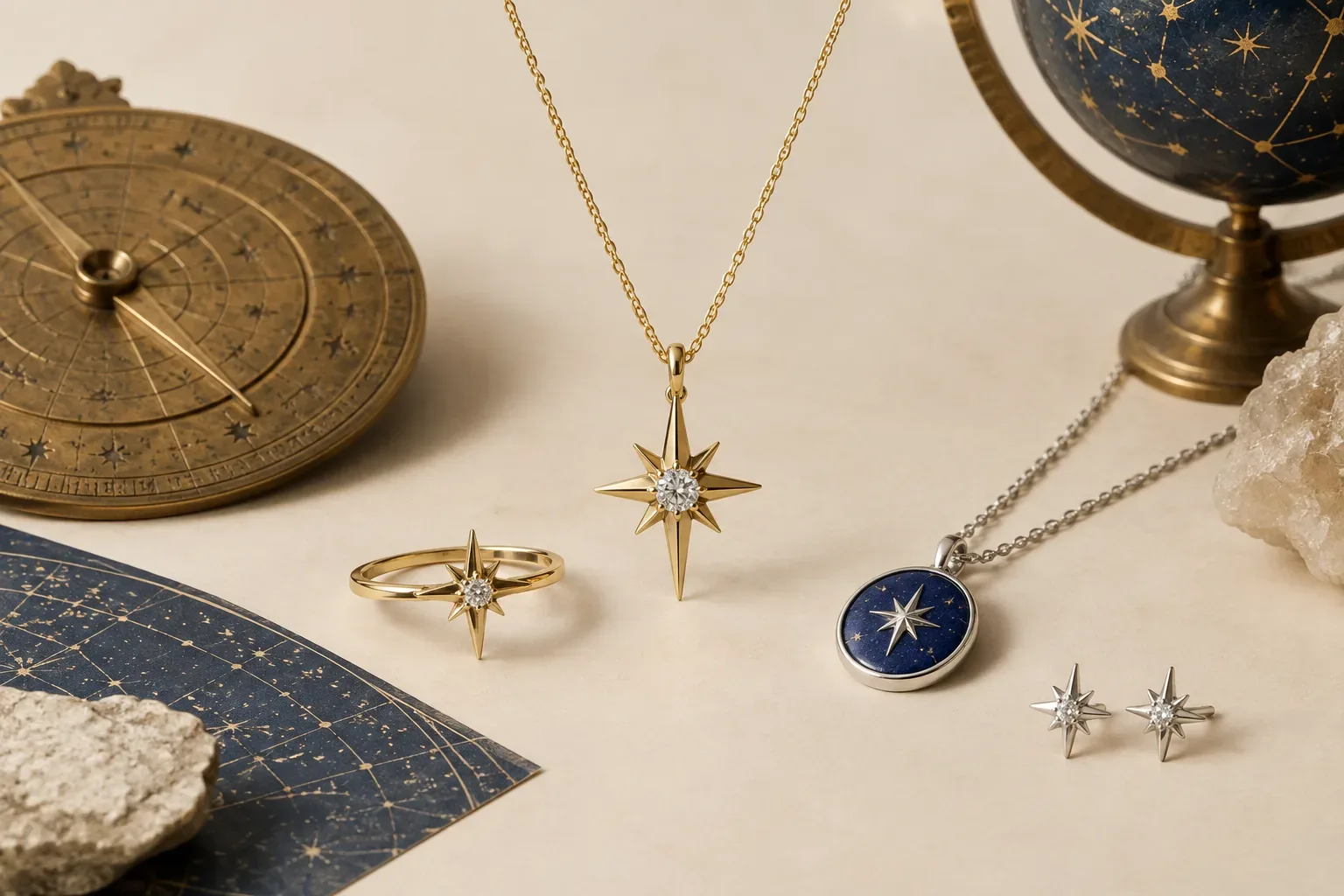
As a motif, the North Star appears in jewellery in a few consistent visual forms: as a stylised multi-point star pendant or brooch, as an eight-point or similar star setting around a central stone, and as a cluster of small stones arranged to read as a starburst. These forms can be traced in museum collections and contemporary design—historical examples often use star-shaped metalwork or small gemstones set to simulate rays.
Gemstones commonly used to suggest a North Star effect are diamonds for brightness and white light, blue stones such as sapphire to reference the night sky, and pearls for their soft glow. The V&A's reference work on gemstones explains the historical contexts in which various stones were prized and how cutting and setting practices influenced visual effect; for instance, the development of faceting produced more scintillation and made star-like designs more effective.
Technical traditions—such as star settings, pavé arrangements and cluster mounts—allow jewellers to create a center 'point' of light surrounded by radiating smaller stones. In modern systems, designers also use laser-cut metal, enamel, and mixed metals to make stylised North Star motifs that are lighter and more graphic than historic pieces.
Selecting and gifting North Star jewellery: practical and respectful guidance
First, be clear about whether you want a historically influenced piece, a contemporary design, or a personalised talisman. If you seek an item with historical provenance or antique value, rely on museum-quality documentation and reputable dealers; museum catalogues and specialist descriptions can help you verify typology and period. If you choose a modern design, focus on the quality of metalwork and stone settings rather than assuming meaning from age.
Respect the recipient's beliefs and tastes. The North Star can resonate as a secular emblem of guidance or a spiritual symbol in some personal contexts, but it is not a universal religious symbol. Asking how the recipient relates to celestial imagery avoids unintended cultural assumptions and ensures the gift is meaningful rather than presumptive.
Consider scale, metal and chain length in relation to the wearer’s normal jewellery. A simple star pendant in sterling silver can be an everyday token, while a diamond-set cluster ring will carry different cost and care commitments. If the design references historical styles, mention that provenance so the receiver understands whether the piece is an antique, vintage-inspired or newly made creation.
Care, materials and buying safely
Check disclosures about gemstone treatments, synthetics and imitations. The Federal Trade Commission provides specific guidance for buying gemstones, diamonds and pearls that stresses the importance of clear, honest disclosure about treatments and whether a stone is natural, synthetic or an imitation. Ask for written confirmation of a stone's treatment history and, for higher-value purchases, a laboratory report when appropriate.
Consider the metal and its maintenance. Sterling silver offers everyday affordability but requires more frequent polishing than gold. If a piece includes delicate pavé or small stones, ask about manufacturing quality and settings to avoid future loss of stones. For antique pieces, verify any restoration or repolishing work that might affect value and appearance.
If ethical sourcing is a concern, ask sellers about supply chains and sourcing policies. While museum documentation can confirm a historical piece’s age and provenance, sellers of modern work should be able to explain whether diamonds are certified, whether gemstones are responsibly sourced, and whether treatments are fully disclosed. Keeping documentation with the piece helps future resale or appraisal.
Conclusion
The North Star motif in jewellery sits at the intersection of long-standing visual traditions and modern personal symbolism. Museum scholarship, as summarised by institutions such as the Victoria and Albert Museum, documents that star motifs and the choice of bright gemstones appear repeatedly in jewellery history and that meanings shift with social fashion and technique. Contemporary wearers and designers layer personal and cultural meanings—guidance, constancy, hope—on that historical visual vocabulary. When selecting or gifting North Star jewellery, combine respect for the recipient’s views with practical buying habits: verify materials and treatments following FTC guidance, clarify provenance when antiques are claimed, and choose scale and materials that match the wearer’s life and style.
Frequently asked questions
Is the North Star a traditional religious symbol?
No single, universal religious meaning for the North Star is documented across jewellery history. Museum records show star motifs were used for fashion, sentiment and visual effect. Individual religious or spiritual groups may attach their own meanings, but those are contemporary or community-specific interpretations rather than a universal historical fact.
What gemstones are commonly used in North Star jewellery?
Historically and today, diamonds are common for their brightness, and blue stones like sapphire are used to reference the night sky; pearls and other bright or iridescent stones can also be chosen. The Victoria and Albert Museum's gemstone studies explain how stone choice and cutting affect visual impact.
How can I be sure a North Star piece is authentic or honestly described?
Ask the seller for clear written disclosure about whether stones are natural, synthetic, treated or imitations. The Federal Trade Commission recommends requesting documentation for significant purchases and seeking laboratory reports for high-value gemstones when appropriate.
Is it appropriate to give North Star jewellery after a loss?
Gifting a North Star piece as a token of remembrance or guidance can be thoughtful if the recipient is comfortable with celestial symbolism. Because meanings are personal, check gently whether the symbol resonates with them to avoid assumptions.
Should I choose antique or modern North Star jewellery?
Choose based on the recipient's style, your budget, and whether you value historical provenance. Antique pieces may need conservation and carry higher costs; modern designs can offer contemporary materials, ethical sourcing claims, and easier wearability.
Sources and further reading
- Bedazzled: A History of Jewellery — Victoria and Albert Museum
- An A-Z of Gemstones — Victoria and Albert Museum
- Buying Gemstones, Diamonds, and Pearls — Federal Trade Commission