Meaning at a glance
Waning crescent jewelry meaning blends a basic astronomical image—the crescent moon approaching new moon—with many later cultural and personal interpretations. Museum evidence shows crescent motifs have appeared in jewelry across periods and contexts but specific cultural meanings vary; modern uses often emphasize endings, transition, and introspection. Choose materials and sellers carefully, and distinguish documented history from contemporary symbolism when gifting.
Direct answer — the short thesis
Waning crescent jewelry meaning combines an astronomical motif—a thin crescent of the Moon visible just before the new moon—with a long history of crescent-shaped ornament recorded in jewelry collections; museums document changing uses of crescent motifs across periods, while modern wearers often apply personal meanings such as transition, endings, or quiet renewal. The documented record shows use of crescent shapes in decorative and symbolic jewelry, but modern symbolic attributions are contemporary and not universal.
Astronomy in brief: what a waning crescent is
Astronomically, the waning crescent is the phase that comes late in the lunar cycle as the illuminated portion of the Moon shrinks toward the new moon. Visually it is a thin crescent that appears shortly before sunrise. Designers and makers borrow this simple optical image to create a clear, recognizable silhouette for pendants, brooches, and motifs on rings and earrings.
What museums document about crescents and jewelry
Museum collections and catalogues provide the clearest, documented evidence for how crescent shapes have been used in jewelry. The Victoria and Albert Museum (V&A) discusses the long and changing history of jewellery, showing that shapes and motifs—including various forms of the crescent—have been adapted for decorative, status, and personal uses across many periods rather than holding a single fixed meaning. The V&A's curatorial work emphasises how fashion, technology, and social context influence jewelry design and symbolism over time.
That museum-based approach cautions against assuming a single historical meaning for a crescent motif. In other words, while crescents appear repeatedly in collections, their precise significance has depended on time, place, and the social role of the object as recorded in museum descriptions and scholarship.
Separating documented historical meanings from modern interpretations
Documented historical meanings are the ones supported by museum records, inscriptions, provenance, or contemporaneous texts. For crescent motifs, museums like the V&A show that crescents were used decoratively and as fashionable motifs; where curators have documentary evidence tying a crescent to a particular belief or ritual, they note that context explicitly. Those documented contexts differ by period and collection.
Modern personal interpretations—popular ideas about the waning crescent standing for endings, release, solitude, or spiritual retreat—are contemporary readings that many wearers adopt today. These modern meanings can be meaningful to the wearer but are not the same as a single historical, cross-cultural meaning supported by museum documentation. Treat modern symbolism as a layer added by contemporary culture and personal choice rather than as a direct continuation of one historical meaning.
How the waning crescent motif appears in jewelry
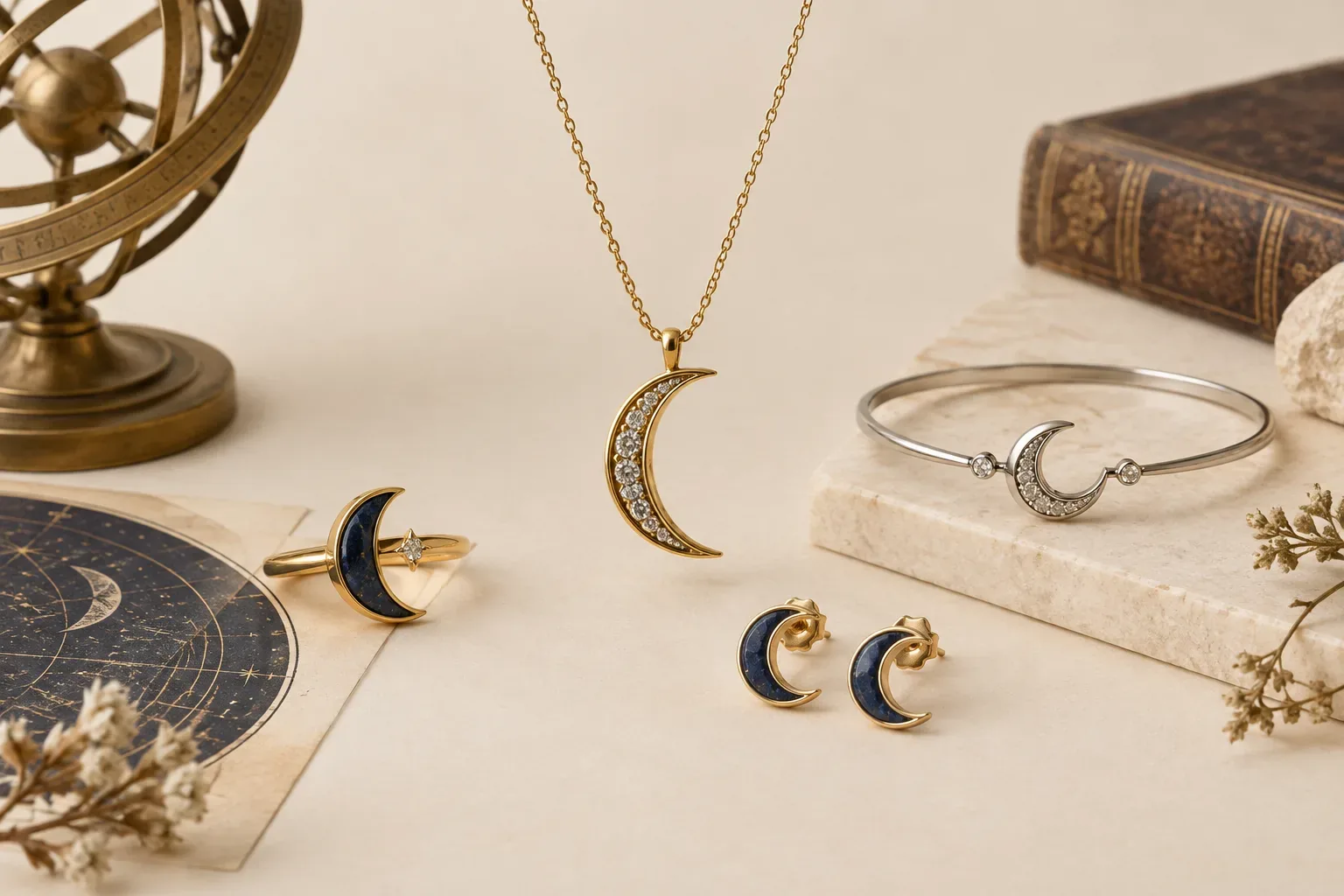
The waning crescent appears in jewelry as a silhouette, an openwork crescent, a recessed carving, or as a setting shape for stones and enamel. Designers use metal work to capture the thin, curved outline, and small accent stones or pearls are sometimes set along the rim to suggest the Moon’s sparkle. The motif is adaptable: it can be small and delicate on a ring or earring, or larger and sculptural in a pendant or brooch.
Gemstones and materials matter. Historical and modern makers have combined crescent forms with moon-associated stones—such as pearls or moonstone—or with any gemstone chosen for its color and symbolism. The V&A’s A–Z of Gemstones provides context for how specific gems were valued and used in jewellery historically, which helps explain why certain stones may be paired with lunar motifs in revival or contemporary designs.
Practical guidance for choosing or gifting waning crescent jewelry
Decide whether your priority is historical authenticity, visual style, or personal symbolism. If you are seeking a piece with historical grounding, consult reputable museum catalogues or makers who reference specific historical styles; the V&A’s work on jewellery history is a useful starting point for understanding period styles and context. For contemporary pieces intended to carry personal meaning—such as a gift symbolising transition or comfort—focus on design, finish, and how the motif will be received by the recipient.
When buying gemstones or older pieces, pay attention to material disclosure and treatment. The U.S. Federal Trade Commission (FTC) provides consumer guidance about buying gemstones, diamonds, and pearls, including the importance of knowing whether a gem has been treated or is an imitation. Ask sellers for written details about treatments, provenance, and any restoration work, and request clear photos or an in-person inspection when possible.
Consider scale, wearability, and lifestyle. A delicate crescent pendant suits everyday wear and layering; a larger, sculptural brooch may be more seasonal or occasion-specific. If gifting, consider how the recipient dresses and whether they prefer subtle symbols or bold statements. Pair a piece with a short note that explains why you chose the waning crescent motif if the symbolism is personal—this helps distinguish your contemporary intention from historical associations.
Care, authenticity, and ethical considerations
For antique or vintage crescent pieces, ask for any conservation records and disclosure of repairs. For gemstone-set crescent motifs, follow care instructions appropriate to the gem and metal. The FTC guidance on buying gemstones recommends asking about enhancements, treatments, and the seller’s return policy to avoid surprises.
If a piece is marketed as culturally significant, ask the seller for specific documentation. Museums and reputable dealers will explain the basis for cultural or historical claims; if a seller cannot document the provenance or is vague about claims linking a motif to a particular belief system, treat such claims with caution. Respectful use and gifting mean understanding what meanings are documented and acknowledging when meanings are modern or personal.
Final thoughts
The waning crescent is a visually simple motif with a complex set of uses across time. Museum documentation—exemplified by the Victoria and Albert Museum’s approach to jewellery history—shows that crescent shapes have been repeatedly adapted to changing fashions and social meanings rather than acting as a single, unchanging symbol. Contemporary wearers layer new personal meanings onto that history. Choose and gift with attention to materials, clarity about provenance, and respect for differing cultural contexts.
Frequently asked questions
Is the waning crescent a universal symbol for endings?
No. While many modern wearers associate the waning crescent with endings, release, or transition, that interpretation is contemporary and personal. Museum evidence shows crescents have been used in many different ways across time and across cultures, so there is no single, universal historical meaning.
What gemstones traditionally pair well with moon motifs?
Historically and today, gems commonly associated with lunar motifs include pearls and moonstone because of their visual qualities, but designers pair any gemstone to suit color or symbolic intent. The Victoria and Albert Museum’s A–Z of Gemstones explains historical preferences and usages that can inform choices.
How can I verify the authenticity of a vintage crescent piece?
Ask for provenance and any conservation records, request clear images or an in‑person viewing, and ask whether the piece has been repaired or altered. For gemstone settings, request information about treatments or enhancements—FTC guidance recommends written disclosure of such treatments.
Is it appropriate to gift a waning crescent to someone who is grieving?
Gifting a waning crescent to someone who is grieving can be appropriate if the giver and recipient share an understanding of the intended meaning. Because contemporary meanings are personal, explain why you chose the motif. Avoid assuming a receiver interprets the symbol the same way you do, and be respectful of their beliefs and preferences.
Should I be concerned about cultural appropriation when wearing crescent motifs?
If a specific design is claimed to have particular cultural or religious significance, ask the maker or seller for documentation and use respectful judgment. Museum collections show that crescents have many historical uses; if a piece is presented as culturally specific, ensure the claim is accurate and consider the context before wearing or gifting it.
Sources and further reading
- Bedazzled: A History of Jewellery — Victoria and Albert Museum
- An A-Z of Gemstones — Victoria and Albert Museum
- Buying Gemstones, Diamonds, and Pearls — Federal Trade Commission