Meaning at a glance
The moon phases motif in jewelry has documented historical presence in decorative arts collections and changed meanings across time; museums such as the Victoria and Albert Museum document its use in different periods, gem guides record commonly paired materials like moonstone and pearl, and modern meanings are largely personal or revivalist rather than universal. Practical buying and gifting should consider materials, disclosure of treatments, and respectful cultural awareness.
Short answer
The moon phases jewelry meaning is not a single, universal symbolism but a layered one: historical objects and museum records show the motif has appeared in different periods and contexts, modern wearers attach a range of personal and cultural meanings to crescents, discs and phase-sequence designs, and practical decisions about materials and disclosure matter when buying or gifting. This article explains what is documented, what is modern interpretation, how the motif appears in jewelry, and how to choose or present it respectfully.
What the documented history shows
Surveys of jewellery history held and interpreted by major museums record that lunar imagery appears repeatedly across European decorative arts and jewellery traditions. The Victoria and Albert Museum, in its overview of jewellery history, discusses how motifs—including celestial forms such as moons and stars—move in and out of fashion as tastes, technologies and symbolic frameworks change. Museum documentation therefore supports a history of use and changing context rather than a single, continuous meaning.
Museum work also emphasises social context: the same motif can signify different things in different periods depending on fashions, material availability, and broader symbolic systems in use at the time. That is why it is important to treat historical examples as evidence of changing contexts rather than proof that one symbolic interpretation has always been intended.
Which periods and contexts are documented
Collections and exhibitions that survey jewellery make clear that moon-related motifs appear in a variety of European periods, including costume and high jewellery from the Georgian, Victorian and later 19th-century collections highlighted by institutions such as the Victoria and Albert Museum. These records show crescent shapes, moon-faced medallions and decorative discs appearing as ornamental elements, often combined with stars or floral motifs.
Because museum catalogues and exhibitions focus on objects and provenance, they are strong sources for where and when a motif was used, and weaker as evidence for universal symbolic meanings ascribed by wearers across time. Where a specific object has documentation about its intended symbolism that information should be read as particular to that object or commission rather than as a universal claim.
Separating documented historical meanings from modern interpretations
Documented historical meanings are those explicitly recorded in provenance notes, maker statements, patron correspondence, or contemporary literature tied to an object. Museum descriptions often point to such documentary evidence when available. The absence of explicit documentation, however, leaves room for modern interpretation.
Modern symbolism around moon phases—such as associations with cycles, femininity, intuition, new beginnings, or astrology—mostly stems from contemporary cultural movements, revival aesthetics, and personal meaning-making rather than consistent historical attribution. These modern meanings are legitimate as personal or community symbolism, but they should not be presented as historically universal unless supported by documentary evidence.
A concise astronomy note (how the motif maps to the sky)
In jewellery the moon phases motif usually refers visually to familiar lunar shapes: crescent, first or last quarter, gibbous and full discs. Designers use these shapes as a shorthand to suggest change, rhythm or the passage of time. Treat references to phases in jewellery as symbolic depictions rather than scientific diagrams; the motif's strength in jewellery is visual and cultural, not technical.
Materials and gemstones associated with lunar motifs
Gemstone guides and museum resources note a historic and aesthetic pairing between lunar motifs and certain gems. The Victoria and Albert Museum's A–Z of Gemstones highlights gems that have been associated with lunar imagery—moonstone, for example, which owes its name and appeal to a pearly sheen, and pearls, which have long been used for their luminous quality. Museums and gem guides explain these connections in terms of appearance and cultural preference rather than as a single symbolic code.
When choosing a moon-themed piece, makers historically used the visual qualities of materials—iridescence, nacreous glow, and pale color—to reinforce the lunar idea. In contemporary work, designers continue to select moonstone, opal, pearl and white or pale sapphires for that reason, but many other stones and metals are used to create contrast and personal expression.
How the motif appears in jewellery design and form
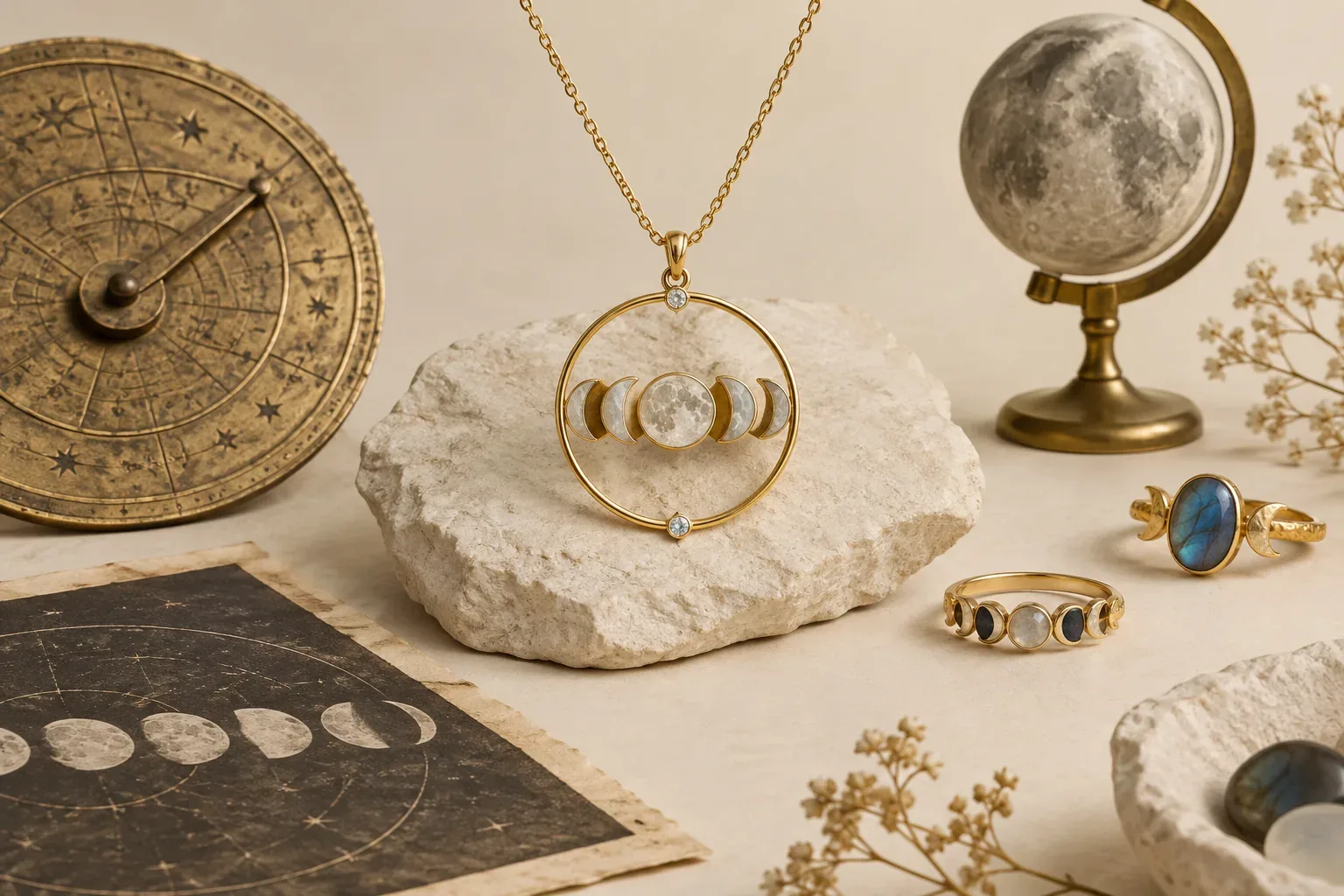
Jewellery designers use the moon phases motif in a variety of formats: single crescent pendants, necklaces that show an arc of phases, rings engraved or set with stones to represent sequential phases, brooches with full moon discs, and lockets or charm bracelets that incorporate lunar imagery alongside other symbols. The motif functions both as a focal element and as a repeating pattern for rhythm and movement.
Historically, the motif could be rendered in metalwork alone or combined with gemstones and enamel. Modern craft and production methods allow for finely graduated phase sequences set with small stones or depicted in mixed media. The same visual vocabulary is adapted across styles from minimalist to ornate.
Material integrity and buyer protection
If you are buying moon phases jewellery for its materials as well as its symbolism, be aware of treatments, imitations and disclosure practices. The Federal Trade Commission provides consumer guidance on buying gemstones, diamonds and pearls and emphasises that dealers should disclose treatments and the presence of imitations. Ask for clear information on whether a stone is natural, treated, synthetic or an imitation and obtain a receipt that records those statements.
Museums and gem guides are useful for learning about typical materials associated with lunar motifs, but when authenticity or treatment is important to you, rely on up-to-date seller disclosure and, where appropriate, independent gemological reports.
Practical and respectful selection or gifting guidance
Begin with the recipient: consider whether they prefer literal or stylised motifs, understated or statement pieces, and whether they value traditional materials such as pearls and moonstone or prefer modern metals and mixed media. If the symbolism matters to them, ask subtly or choose a design that invites the recipient to interpret the meaning themselves.
If you are drawing on a cultural or religious meaning associated with lunar imagery, take a moment to research whether the symbol has sacred or community-specific uses and whether wearing or gifting such a symbol could be sensitive. Museums and reliable cultural histories are a good starting point for that research. If you are unsure, choose a broadly aesthetic or nature-inspired piece rather than one that carries tightly bound religious meaning.
Practical checks at purchase include asking about metal quality, hallmarks, stone treatments and return policies, and requesting written disclosure about any enhancements. For higher-value stones, insist on laboratory reports or reputable third-party verification. These steps protect both buyer and recipient and are consistent with consumer guidance from authorities such as the Federal Trade Commission.
Care and longevity
Care needs depend on the materials used. Pearls and moonstone have different hardness and sensitivity profiles than sapphires or diamonds, so ask the maker or seller for care guidance specific to the piece. Gentle cleaning, avoidance of harsh chemicals, and proper storage will extend the life of most jewellery.
If you plan to wear a moon phases piece daily, select durable settings and stones suitable for everyday wear. If the piece is intended as a keepsake, consider a locket or a well-crafted pendant that can be worn occasionally and stored carefully.
Putting it together: meaning, maker and wearer
The moon phases motif works because it is visually strong and flexible in meaning. Museums document its repeated appearance and shifting context; gem guides explain the material affinities; and consumer agencies advise on disclosure and treatment. That combination of evidence suggests a responsible approach: respect the historical record, recognise modern personal meanings as valid but not universal, verify material claims when they matter to you, and choose or gift with attention to the recipient's values and cultural context.
If you want to learn more about related symbols or research a particular object, consider resources on symbols and the history of sentimental jewellery or consult museum catalogues and trade guidance. Useful internal starting points include our Symbols category and related guides on choosing meaningful jewellery and researching jewelry symbols.
Frequently asked questions
What does a crescent moon in jewelry typically mean?
A crescent moon in jewelry is a flexible motif. Historically it has functioned as an ornamental element in different periods and collections; today wearers may ascribe meanings such as change, growth, or a personal connection to cycles. These modern interpretations are individual or community-based rather than universally historic.
Are moonstone and pearls the traditional choices for lunar-themed pieces?
Yes, guides and museum resources such as the Victoria and Albert Museum's A–Z of Gemstones note that moonstone and pearls have long been associated with lunar imagery because of their luminous qualities. Designers continue to use these materials, but many other stones and metals are also used to express the motif.
How can I verify whether a moon-themed gemstone has been treated or is an imitation?
Follow consumer guidance from the Federal Trade Commission: ask the seller directly about treatments, require written disclosure, and for high-value stones request independent gemological reports. Sellers should state whether a gem is natural, treated, lab-grown or an imitation; insist on that information before purchase.
Is it culturally insensitive to wear moon phases jewelry?
Wearing moon phases jewelry is usually acceptable, but sensitivity depends on context. If a particular design is clearly tied to a living religious or cultural practice, research or ask respectfully before wearing or gifting. When in doubt, choose a design that emphasises aesthetics and personal meaning rather than appropriating sacred symbols.
How should I care for moonstone or pearl jewellery?
Care depends on the material. Pearls and moonstone are more delicate than many faceted gems: avoid harsh chemicals, store them separately to prevent scratching, and clean them with a soft cloth and mild soap when necessary. Ask the maker or seller for specific care instructions for your piece.
Sources and further reading
- Bedazzled: A History of Jewellery — Victoria and Albert Museum
- An A-Z of Gemstones — Victoria and Albert Museum
- Buying Gemstones, Diamonds, and Pearls — Federal Trade Commission