Meaning at a glance
Documented evidence shows globe and spherical forms have appeared in jewelry across many periods; the Victoria and Albert Museum emphasizes changing social contexts for such motifs. This article separates historical evidence from later or personal symbolism, explains common jewellery forms and gemstones that use a globe motif, and gives practical guidance for choosing and gifting modern globe jewelry with consumer-protection notes from the Federal Trade Commission.
What the historical evidence shows (and who says so)
The most direct, trustworthy source for the long sweep of jewelry history used here is the Victoria and Albert Museum’s material on jewellery history. The V&A’s exhibition materials and essays present jewelry as a changing language of forms and materials across antiquity, the medieval period, the Renaissance, and later eras, rather than as a set of fixed symbols. From that perspective, spherical forms appear repeatedly: as beads in ancient personal adornment, as rounded gem cuts, and as ornamental roundels and finials in later European objects.
Because the primary V&A resources emphasize how social context shapes meaning, they support a careful statement: globe-like forms in jewelry are documented in the archaeological and museum record as design choices and markers of status or skill at different times, but the explicit symbolic readings attached to those forms have varied by culture and era. In other words, the physical presence of an orb or sphere is well documented, while any single symbolic meaning must be tied to a specific cultural or historical context described in a primary source.
Separating documented historical meanings from later or popular interpretations
Documented historical meanings are those that can be tied to a particular culture and time using reliable records or museum provenance. For example, museum catalogues and historical inventories sometimes record objects—such as beaded necklaces, spherical gem settings, or orb-like regalia—that functioned as markers of wealth, technology, or office. The V&A’s historical overview shows that jewelry often signaled social rank, trade connections, or devotional practice, depending on period and place.
Modern, popular, or personal interpretations are different. In the 20th and 21st centuries, people commonly read a globe motif as representing the Earth, global citizenship, travel, or environmental concern. Those are contemporary symbolic layers: meaningful and valid for wearers today, but not automatically documented as the original intention behind historic objects. Treat modern meanings as additions to — not replacements for — historical functions, unless a specific historical source connects a globe image to that meaning.
How the globe motif appears in jewelry and which gemstones or techniques are used
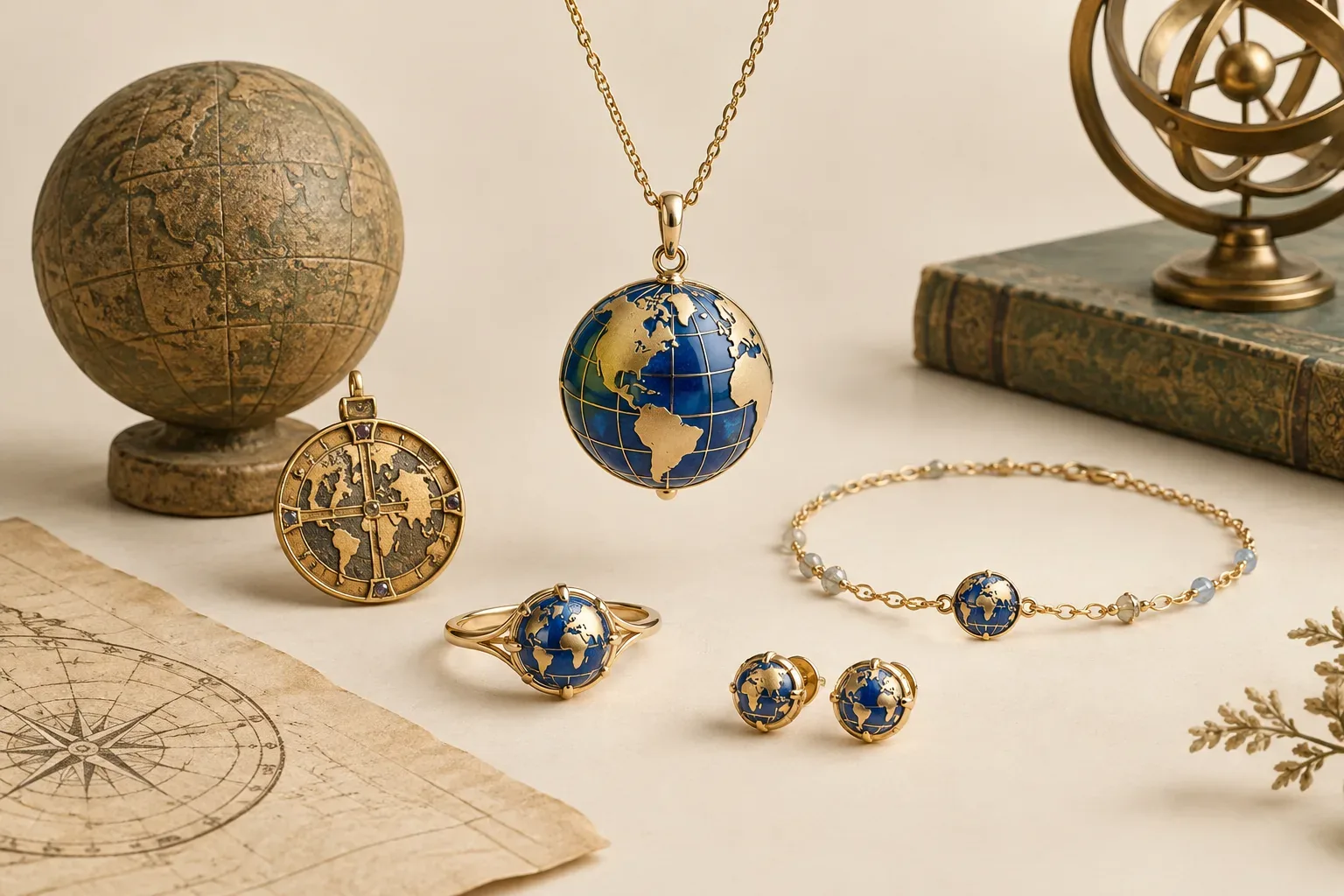
The globe motif appears in jewelry in several recurring forms. A basic form is the spherical bead or ball pendant, made from metal, carved stone, enamel, or glass. Spherical gemstones, cabochons, and rondelles offer natural globe-like shapes; in some designs the entire pendant is a polished sphere or an enclosed sphere (for example, a miniature locket or keepsake orb).
A related approach is representational work: engraved or enameled miniature maps and planetary motifs that explicitly depict the Earth or planets. Designers also use constructions such as armillary-style pendants (concentric rings suggesting celestial spheres) to evoke cosmological ideas. In decorative regalia and historic objects, orb finials and roundels are another expression of the same visual theme.
Gemstones often used for globe-like pieces include polished agates, onyx, quartz, and other stones suited to spherical cutting, as well as faceted round brilliant gemstones that read as tiny globes at a distance. The Victoria and Albert Museum’s guide to gemstones explains how different materials have been used historically for their color, translucency, or technical suitability for cutting and setting, which shapes how a globe motif is executed in practice.
Interpreting materials and treatments: a consumer-protection note
When choosing globe jewelry that features gemstones, understand that gemstones can be natural, treated, synthetic, or simulated. The Federal Trade Commission’s guidance on buying gemstones, diamonds, and pearls emphasizes that sellers should disclose treatments or imitations. If a sphere is a dyed agate, a composite, or a glass imitation, that affects both value and care. Ask the seller for clear disclosure and any available certification or testing information before purchase.
Also consider workmanship and setting. An enamelled globe or an articulated sphere requires different care than a single polished stone; hollow metal spheres may be lighter and more affordable but less durable than solid stones or metalwork. Use reputable dealers and confirm return and repair policies so the piece’s physical qualities match your expectations and the meaning you intend it to carry.
Choosing and gifting globe jewelry with respect and intention
First, be explicit about the meaning you intend. If you want to give a globe motif as a gift that signals travel, global friendship, or concern for the environment, tell the recipient why you chose that motif so the modern symbolism is shared rather than assumed. If the gift is meant to reflect a specific cultural or religious symbolism, verify that meaning with reliable sources or with a culturally informed expert before giving the piece.
Second, match style and materials to the recipient. For everyday wear choose durable settings and stones that suit the wearer’s lifestyle; for a symbolic keepsake consider a small locket-style orb or a pendant that can hold a tiny memento. If the recipient cares about provenance or sustainability, prefer sellers who disclose gemstone treatments, ethical sourcing, and repair options, as recommended by the Federal Trade Commission’s consumer guidance.
Third, respect cultural specificity. Because the same visual form can mean different things in different cultures, avoid assuming a globe motif carries a universal spiritual or political meaning. When giving a globe motif that references a particular culture’s symbol, learn and convey its documented context rather than relying on contemporary generalizations.
Practical care and styling tips
Treat spherical stones and enamels with routine but appropriate care: clean with mild soap and water for most stones and metals unless the maker advises otherwise, and avoid ultrasonic cleaners for porous or treated materials. Be mindful of hollow metal spheres and delicate enamel work that may dent or chip with rough use.
Styling-wise, globe pendants are versatile. A small polished sphere reads as minimalist and modern on a short chain; a detailed miniature map or armillary pendant works as a focal piece on a longer chain. Pair metallic or stone globes with complementary textures—smooth metals with matte stones, or bright enamel with plain settings—for a balanced look.
Final note: meaning accumulates
The globe motif in jewelry demonstrates how form and context work together. Museum resources like those at the Victoria and Albert Museum show that forms recur across eras while meanings shift with social context and wearer intention. Today’s meanings—globalism, travel, unity, personal worldview—are legitimate contemporary layers, but they sit atop a longer history of decorative, technical, and social uses documented in museum collections. Use that layered understanding when you choose, wear, or give globe jewelry so the piece’s practical qualities and symbolic messages align with your intention.
Frequently asked questions
What does globe jewelry symbolize?
Globe jewelry can symbolize many things depending on context. Historically, spherical forms have functioned as decorative and status objects; contemporary wearers often read the motif as representing travel, global citizenship, unity, or a personal worldview. The specific meaning should be tied to the cultural or personal context rather than assumed universal.
Is globe jewelry a religious symbol?
Not inherently. While some cultures and traditions may use orb-like forms in religious or regalia contexts, the globe motif in secular jewelry typically serves decorative or personal symbolic roles. If you are interested in a piece with a claimed religious meaning, verify that meaning through reliable cultural sources or museum documentation.
How can I be sure a spherical gemstone or globe pendant is authentic?
Ask the seller for clear disclosure about whether a stone is natural, treated, synthetic, or simulated. The Federal Trade Commission advises that treatments and imitations should be disclosed. For higher-value purchases, request written documentation or a professional appraisal.
How should I care for globe-shaped jewelry?
Care depends on materials. Clean most solid stones and metals with mild soap and water and dry thoroughly. Avoid ultrasonic cleaning for porous or treated stones and be cautious with hollow metal spheres or enamel that can dent or chip. Follow any care instructions provided by the maker.
What kind of globe jewelry makes a good gift?
Choose a style that matches the recipient’s taste and lifestyle. For daily wear, prefer durable metals and secure settings. For symbolic gifting, choose a design whose contemporary meaning you can explain to the recipient. If the gift references a particular culture or environmental cause, ensure your understanding of that symbolism is accurate and respectful.
Sources and further reading
- Bedazzled: A History of Jewellery — Victoria and Albert Museum
- An A-Z of Gemstones — Victoria and Albert Museum
- Buying Gemstones, Diamonds, and Pearls — Federal Trade Commission