Meaning at a glance
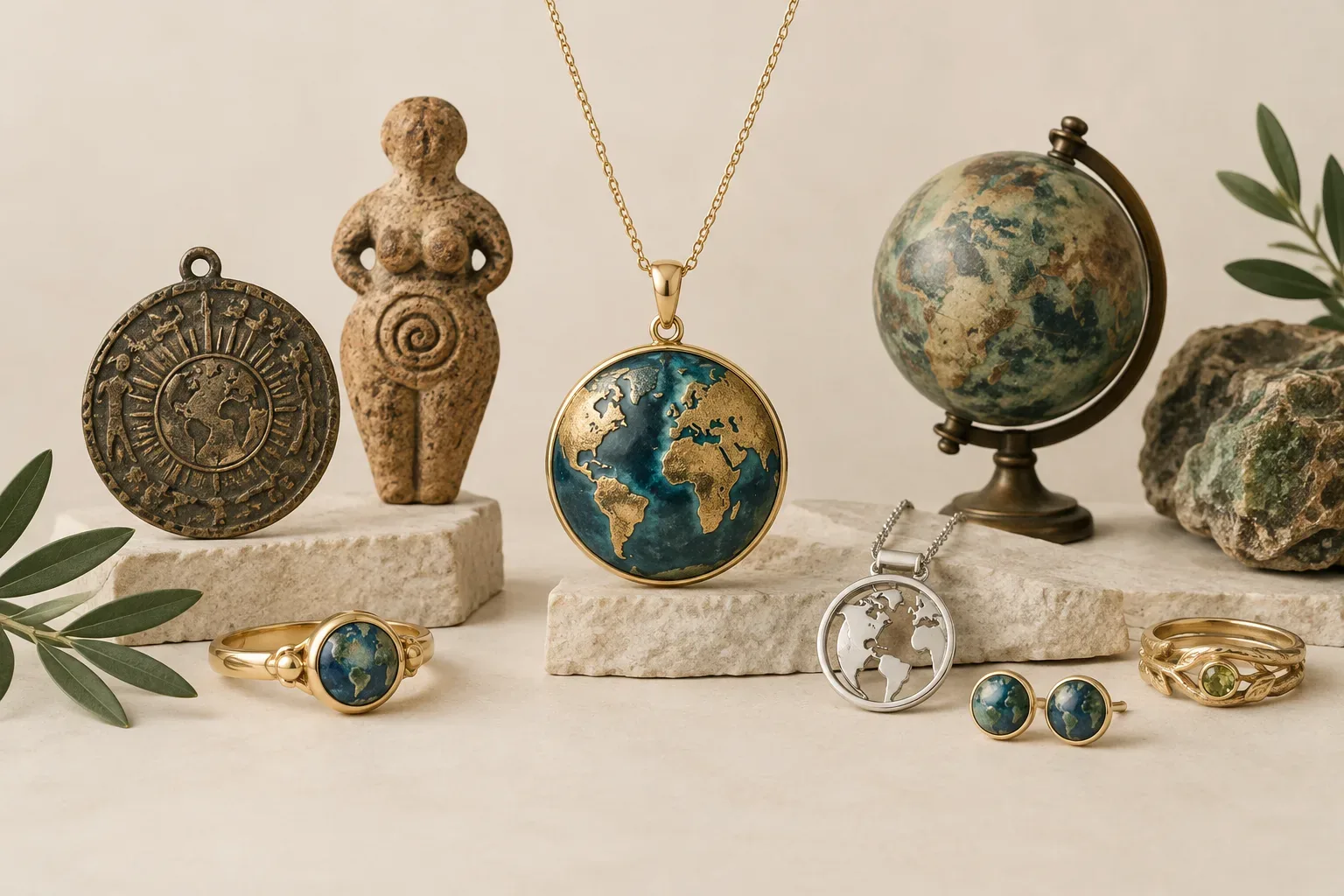
Documented evidence shows earth motifs and earth-associated gemstones have been used in jewelry for different social, religious, and decorative reasons across periods; modern meanings such as grounding or environmental identity are contemporary interpretations, and choosing or gifting earth jewelry benefits from material transparency, cultural respect, and attention to wearer preference.
Documented historical evidence, by culture and period
Museums trace jewelry’s motifs and materials across a long history and show that the reasons people wore particular signs or stones changed from era to era. The Victoria and Albert Museum’s overview of jewellery history emphasises that motifs drawn from nature and the elements appear repeatedly and that their meanings depend on time and social context rather than on a single, unchanging symbolism.
Prehistoric and ancient societies used materials taken directly from the earth—bones, shells, stones and amber—to make personal ornaments. In many cases the surviving evidence shows these pieces functioned as adornment and markers of social identity or trade rather than as a fixed symbol of a single abstract idea. The V&A’s collections and interpretive material place these early items in contexts of craft and exchange.
In antiquity and the classical world, gemstones and carved stones appear in engraved gems, beads and insets. The specific social meanings depended on local belief and practice: some stones were prized for rarity or color and indicated status; others were used in amulets and personal reliquaries. The V&A’s materials on gemstones note long histories of certain stones—those that are often described as "earthy" such as jasper, malachite and amber—appearing across cultures for decorative and occasionally protective functions.
Through the medieval and Renaissance periods in Europe, jewelers layered symbolic meanings—religious, dynastic and allegorical—on motifs and on the choice of materials. The same physical motif could mean different things when set into a coronation piece, a devotional object, or a sentimental ornament. The V&A frames these shifts as part of broader changes in fashion, technology and symbolism.
In the 18th to 20th centuries, industrial changes, wider trade networks, and new aesthetic movements altered how earth-associated motifs and materials circulated. Naturalistic motifs (leaves, seeds, landscapes) became fashionable in particular periods, and mass-produced or artisanal approaches affected who wore those motifs and why. The V&A’s historical surveys make clear that jewelry’s social function—status, sentiment, identity—evolves with technique and taste.
Documented meanings versus modern interpretations
What is documented: museum analysis and historical scholarship show that stone choice and natural motifs served a range of documented purposes: aesthetic display, trade value, social signalling, religious devotion, or use as amulets in specific cultural contexts. These are empirical claims about how objects were used and understood in particular places and times, as presented in the Victoria and Albert Museum’s summaries of jewellery history and gemstones.
What is modern interpretation: in the late 20th and 21st centuries, many people and brands have adopted earth imagery to express contemporary ideas such as grounding, ecological concern, or new-age spirituality. Those meanings are modern, plural, and personal. They reflect present-day values and identity work rather than a single historical continuity. It is important not to conflate contemporary marketing or spiritual language with the historically documented uses of a motif or stone.
How the earth motif and earth-associated materials appear in jewelry
Motifs that evoke "earth" appear in a range of visual forms: stylised globes or circles, botanical images such as leaves and seed pods, landscape microcarvings, and geometric signs that have been read as elemental. Jewelers use metals and settings to suggest solidity and grounding, and designers often pair those motifs with stones and materials that carry an "earthy" aesthetic—matte or opaque gemstones, unpolished or tumbled stones, and organic materials such as amber or wood.
Gemstones historically associated with earth-like qualities—examples frequently noted in museum gemstone guides include jasper, malachite and amber—are used for color, texture and cultural association. The Victoria and Albert Museum’s A–Z of Gemstones explains how particular gems were chosen and worked in different periods, and this history informs why contemporary makers might select certain stones to convey an "earth" feeling.
Techniques matter too: carved intaglios and cameos, inlaid scenes, and hand-hammered metal treatments create tactile, visually "grounded" pieces. Contemporary makers sometimes intentionally leave a stone unpolished or set rough-cut specimens to emphasize natural origin; historically, by contrast, polished and highly finished gemstones were often valued for different reasons, including status displays, so finish itself carries changing meanings across time.
Practical and respectful selection or gifting guidance
Begin with the recipient. Ask (or consider) whether the wearer prefers literal nature motifs, subtle symbolic references, raw materials, or polished fine jewelry. A meaningful gift aligns with the recipient’s style and relationship to the motif—some people prefer overt symbolism; others see the motif as a private reminder.
Verify materials and disclosures. When purchasing gemstones or treated materials, check for clear information about treatments, synthetics and imitations. The United States Federal Trade Commission advises buyers to expect accurate disclosures about treatments, synthetic stones and imitations, so prioritize sellers who provide honest provenance and treatment details.
Choose quality appropriate to use. If the wearer wants to wear the piece daily, select durable metals and securely set gemstones. If you select porous or softer materials to emphasize "earthiness"—for example, certain soft stones or organic materials—note that they may require more care and are less suitable for vigorous daily wear.
Respect cultural origins. If a motif or technique is closely associated with a specific cultural or religious tradition, learn enough to avoid misuse. A respectful approach includes asking whether the imagery is sacred to the recipient’s community, choosing pieces made by makers from that culture where possible, and avoiding commodifying objects that are still regarded as sacred.
Consider sustainability and ethical sourcing. If environmental concern is part of the intended meaning, inquire about sourcing practices. Sellers who can explain their supply chains and treatment policies will better support an ecological message than items with opaque provenance.
Personalize thoughtfully. An engraved note, a pairing with a stone that has meaning to the recipient, or a card explaining why you chose the motif can make the gift feel intentional rather than generic. Keep explanations grounded and specific—describe why the piece reminded you of the person rather than asserting universal symbolic meanings.
Putting it on: wearing earth jewelry today
Wearing earth-themed jewelry can be fashionable, ceremonial, or sentimental. It’s common to layer elemental pendants with other pieces to create a personal narrative, and many modern makers design minimalist symbols that reference ancient motifs without claiming continuity. Remember that contemporary wearers often assign private meaning to a piece; the same motif can be an environmental statement for one person and a style preference for another.
If you collect historic pieces, documentation matters. Provenance and condition reports from reputable museums, auction houses or dealers help establish a piece’s context. For modern purchases, favor retailers who disclose materials and treatments and can answer provenance questions.
Frequently asked questions
What does earth jewelry mean?
Historically there is no single "earth jewelry meaning." Museums document that earth-related motifs and materials were used for many reasons—status, decoration, religious or protective functions—depending on time and place. Contemporary uses that emphasize grounding, environmental identity or spirituality are modern interpretations and personal choices.
Which stones are considered "earth" stones?
Stones often described as "earthy" in style include opaque or variegated gems such as jasper, malachite and organic materials like amber. The Victoria and Albert Museum’s A–Z of Gemstones provides historical context for many commonly used stones.
How can I tell if a gemstone is treated or synthetic?
Buy from sellers who disclose treatments and origins. The U.S. Federal Trade Commission recommends expecting clear disclosures about enhancements, synthetics and imitations; request written information when necessary.
Is it cultural appropriation to wear earth symbols from another culture?
It can be problematic if an item is sacred or holds contemporary cultural significance for a living community. To be respectful, learn the symbol’s context, prioritize pieces made by makers from that culture, and avoid using sacred objects as casual fashion without permission.
How should I care for jewelry made with natural or porous materials?
Porous or organic materials often need gentle care: avoid prolonged water exposure, harsh chemicals and rough wear. If a piece combines delicate materials with metal, ask the seller for specific care instructions and consider reserving it for occasional wear.
Sources and further reading
- Bedazzled: A History of Jewellery — Victoria and Albert Museum
- An A-Z of Gemstones — Victoria and Albert Museum
- Buying Gemstones, Diamonds, and Pearls — Federal Trade Commission