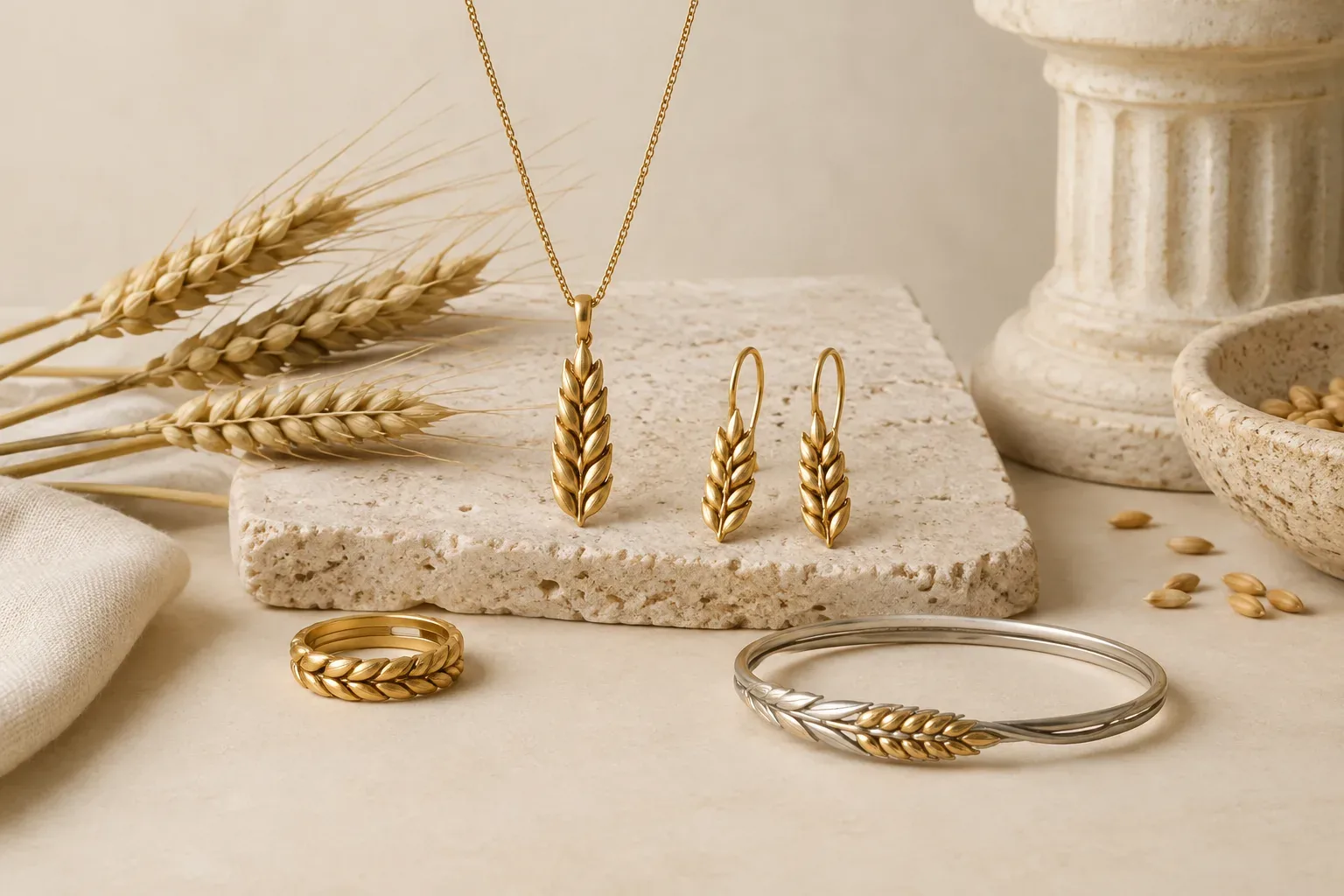
Meaning at a glance
Wheat jewelry has documented roots as an agricultural and seasonal emblem in many historical periods; museum scholarship shows the motif appearing across classical, medieval, Renaissance, and Victorian contexts. Modern wearers layer personal meanings—from abundance to remembrance—on top of that documented history. When choosing or gifting wheat jewelry, consider the recipient's cultural background, the piece's maker and materials, and ask sellers about gemstone treatments and verifications.
Historical evidence and cultures
The evidence for wheat as an ornamental motif in jewellery and decorative arts comes largely from museum scholarship that traces jewellery’s changing social contexts. The Victoria and Albert Museum (V&A) presents this long view in its survey of jewellery history and in its materials and gemstones overviews, showing how motifs shift meaning as they move between societies and periods.
According to the V&A’s historical framework, wheat or sheaf imagery appears in the visual record in the classical and late classical world where agricultural symbols were part of civic and domestic ornament, and in later medieval European contexts where agricultural motifs entered ecclesiastical and secular art. The motif reappears in Renaissance decorative vocabulary and again with particular prominence in nineteenth‑century European jewellery, including the Victorian era, when naturalistic motifs were widely used in sentimental and domestic forms of jewellery.
These appearances are not a single continuous symbolic meaning but discrete uses in specific places and times: in classical antiquity the motif is part of civic and mythic imagery, in medieval Europe it could be incorporated into liturgical or agricultural iconography, and in Victorian practice natural motifs including wheat were employed in sentimental, commemorative, and fashion jewellery. The V&A’s curatorial materials emphasize that the context—who commissioned the object, its function, and its textile or ceremonial associations—matters for interpretation.
Documented historical meanings versus modern interpretations
Documented historical meanings derive from the object's original context and accompanying records. For example, when a wheat motif is found on a reliquary or on church architecture, its meaning is best read in relation to liturgical symbolism and local agricultural economics as informed by museum and archival study. The V&A’s approach to jewellery history stresses reading motifs against the object’s date, owner, and function rather than assuming a single, unchanging meaning.
Modern personal interpretations are common and legitimate, but they should be kept distinct from the historic record. Contemporary wearers may choose wheat jewellery to symbolize fertility, abundance, resilience, home, family farming roots, seasonal change, or simply an affinity for natural forms. Those are modern, subjective layers of meaning and not universal translations of historical symbolism. Not every historic wheat ornament signified abundance in the way a modern wearer might intend, and conversely, a piece made today with a wheat motif may intentionally invoke a specific personal story rather than referencing any historical usage.
How the wheat motif and related traditions appear in jewelry
The wheat motif appears in jewellery through shape, relief, and pattern. Museum collections and exhibitions documented by the V&A show wheat rendered as a stylized sheaf or single ear in metalwork, engraving, relief carving, and enamel. Jewelers have used the motif as a central pendant, brooch, hair ornament, or repeated border pattern on lockets and bangles, adapting the motif to prevailing fashions and techniques of each period.
Materials and gemstones have been combined with the wheat motif to achieve texture and color contrasts. The V&A’s resources on gemstones and materials explain how gem and metal choices historically reinforced a motif’s visual effect: warm colored stones can echo the golden tone of ripe grain, seed pearls or small cabochons can suggest seeds, and fine metalwork can render the delicate striations of an ear of wheat. These are stylistic strategies rather than fixed symbolic rules; craftsmen selected materials for visual and social effect as much as for symbolic resonance.
Traditions connected to wheat imagery also influenced jewellery forms. In periods when agricultural cycles dominated social life, seasonal festivals and harvest gifts could include decorative objects with harvest motifs. Later, in the nineteenth century, the domestic and sentimental jewelry market adapted floral and agricultural motifs into personal accessories and mourning pieces, where wheat might appear alongside inscriptions, lockets, or hairwork, again depending on the piece’s intended function as documented by museum studies.
Practical guidance for choosing or gifting wheat jewelry
When selecting or gifting wheat jewellery, begin with the recipient’s relationship to the motif and their cultural background. If the intended meaning is personal (for example, a family farming heritage), make the connection explicit in a card or conversation rather than assuming the symbol will be read that way. If the piece is meant as a religious or culturally specific emblem, research the local practices and, when appropriate, consult someone from that tradition to ensure respect and accuracy.
Assess the object’s maker, materials, and condition. Provenance and maker information contribute both to an object’s monetary and sentimental value and to how the motif should be contextualized. If gemstones are present, the United States Federal Trade Commission (FTC) recommends asking sellers about treatments, synthetic stones, and imitations and that these disclosures be made clearly; this is practical consumer guidance rather than a commentary on meaning, but it affects value and longevity.
Consider practical details: choose a scale that suits the wearer’s style and activity level, pick metals compatible with skin sensitivity, and think about lifestyle factors such as whether the piece will be worn daily or reserved for special occasions. For heirloom or vintage items, request condition reports and, if relevant, conservation advice from a reputable jeweller or museum conservator to avoid damage. If gifting to mark a specific life event, pair the motif’s contemporary meaning with clear wording so the recipient understands the giver’s intention.
Finally, buy from reputable dealers or makers and keep documentation. For contemporary designers, a statement about the artist’s inspiration can help distinguish a piece made to evoke family or harvest meanings from one that is primarily decorative. For older objects, museum catalogues and dealer records help place a piece in its historical context in line with the V&A’s practice of reading jewellery within social and material histories.
Frequently asked questions
What does wheat jewelry symbolize?
Historically, the wheat motif could mark agricultural life, seasonal harvests, or appear in religious and civic ornament; museum scholarship shows these meanings vary by period and place. In modern use, people commonly interpret wheat as a symbol of abundance, home, fertility, or continuity, but those are contemporary, personal meanings rather than universal historical translations.
Is wheat jewelry a religious symbol?
Sometimes. In contexts where wheat appears on liturgical or ecclesiastical objects, it may have been related to religious imagery or sacramental associations. Whether a particular piece is religious depends on its origin, use, and inscriptions; museum records and provenance help determine that context.
Can wheat jewelry be appropriate for a wedding or new baby gift?
Yes, if the giver and recipient share the intended meaning. Modern interpretations often link wheat with fertility, prosperity, and new life, making the motif a popular choice for weddings or birth gifts. To avoid misunderstanding, make your intent clear when you gift the piece.
How should I care for vintage wheat jewellery?
Care depends on materials and condition. For vintage or antique pieces, seek a condition report and, if necessary, conservation advice from a qualified jeweller or conservator. Avoid harsh cleaners on fragile enamels or inlaid materials, and store items flat or in padded boxes to protect delicate metalwork.
What should I ask a seller before buying wheat jewellery with gemstones?
Ask about provenance, maker, condition, and any treatments or enhancements to gemstones. Follow the FTC’s guidance by requesting clear disclosure on treatments, synthetics, or imitations, and obtain written documentation when possible.
How can I research the historic meaning of a specific wheat motif piece?
Begin with the object’s provenance, maker’s marks, and any inscriptions, then consult museum catalogues, specialist publications, and reputable dealers. Jewelry history resources such as the V&A’s collections provide context on how motifs were used in specific periods and regions.
Sources and further reading
- Bedazzled: A History of Jewellery — Victoria and Albert Museum
- An A-Z of Gemstones — Victoria and Albert Museum
- Buying Gemstones, Diamonds, and Pearls — Federal Trade Commission