Meaning at a glance
The acorn motif has been used as a botanical decorative element in European jewellery history and is interpreted in many ways today; museums document its use among broader naturalistic trends, while modern wearers add personal meanings—choose pieces based on style, materials, provenance, and the recipient's cultural context.
What the historical evidence shows
The most reliable published documentation available for jewellery history is institutional curatorship and museum interpretation. The Victoria and Albert Museum (V&A) presents botanical motifs as a recurring theme across jewellery history and places those motifs in changing social and material contexts. The V&A's exhibition and catalogue material explain how naturalistic imagery—leaves, flowers, seeds, and related forms—appeared repeatedly in European jewellery and reflected tastes, technologies, and fashions of particular periods rather than a single, fixed symbolic claim.
That museum perspective supports two facts you can rely on: first, acorn and other botanical motifs have been used as decorative elements in jewellery; second, their meanings and prominence shifted with fashion, technique, and cultural context. The V&A frames these changes through documented objects and their contexts rather than through a single invariant symbolic dictionary.
Cultures and periods: what is documented (and what is not)
The available institutional evidence documents botanical motifs prominently in European decorative jewellery, with particular visibility in the naturalistic styles of the 18th and 19th centuries. Curatorial material at the V&A describes how jewellers in these periods adopted plant and seed imagery as part of broader aesthetic movements and technological developments in metalwork, enamelling, and gem setting.
What the provided sources do not document are specific, universally agreed symbolic attributions for the acorn across many ancient cultures. The V&A materials emphasize object-based interpretation and changing fashion rather than asserting a single ancient or cross-cultural meaning for the acorn motif. In short: you can point to museum collections for firm evidence that acorns appear in jewellery design across time, but you cannot use these sources to claim a universal ancient symbolic meaning for acorns in all cultures.
Documented history versus modern personal or popular interpretations
Museum documentation and curatorial description focus on form, technique, and social context. That documented history is distinct from the symbolic claims you often find in modern product descriptions, craft communities, and social media. Contemporary sellers and wearers commonly describe acorns as symbols of potential, growth from small beginnings, prosperity, good luck, or resilience. Those modern interpretations are meaningful for many people, but they are interpretive layers imposed after the fact rather than claims grounded in the object’s documented use in specific historical rituals or beliefs, according to the V&A’s approach.
A careful distinction matters: a museum object catalogue can show that an acorn motif was fashionable at a given time, while a modern artisan or recipient may choose the motif because of its metaphorical resonance today. Both are valid perspectives, but they are different kinds of claims—one is material-historical, the other personal-symbolic.
How the acorn motif and related gemstones appear in jewellery
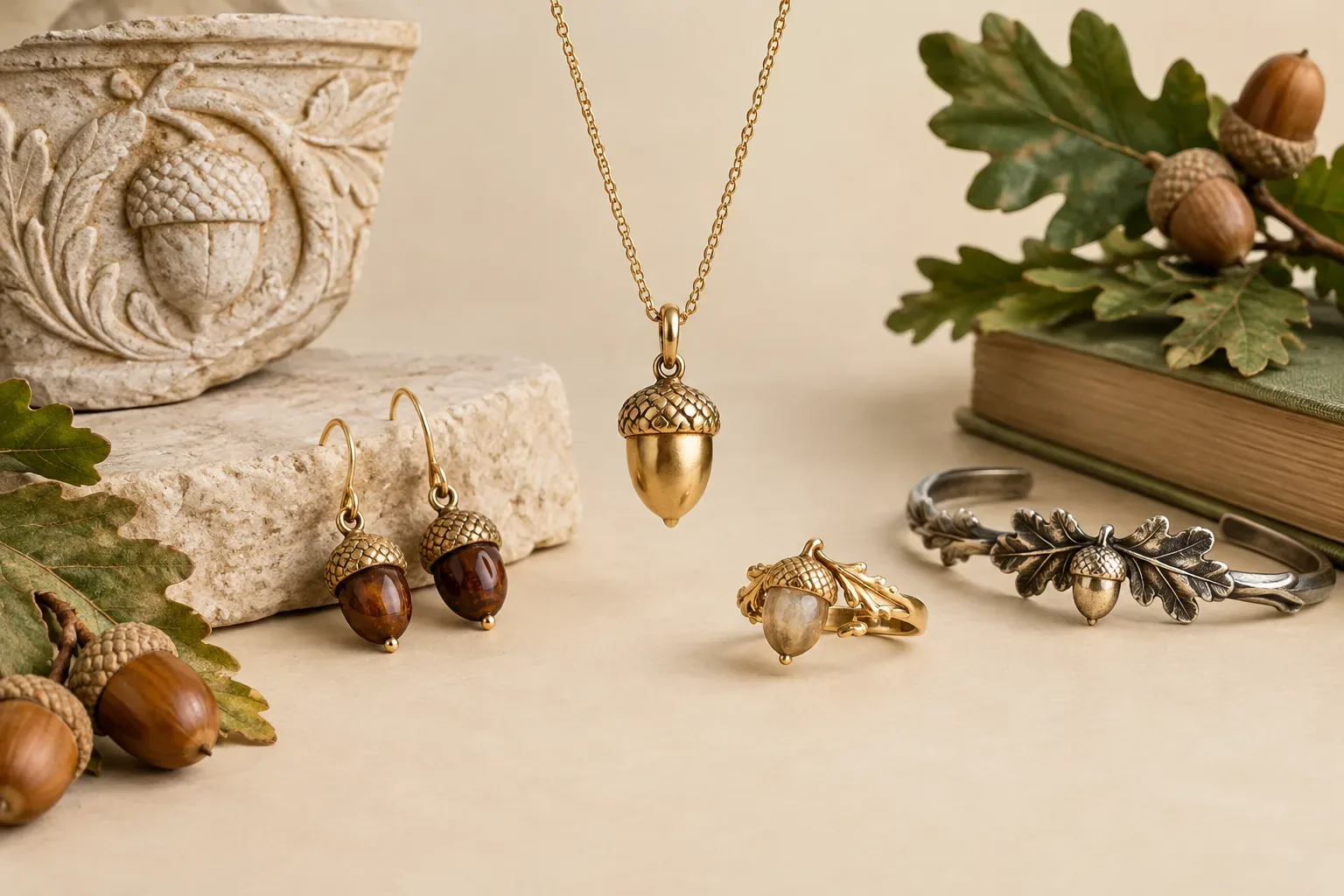
In museum collections and in the wider history of decorative jewellery, botanical forms such as acorns appear in a range of object types: pendants and charms that reference seeds, brooches that use leaves and fruits in overall composition, and decorative accents on rings and lockets. The V&A’s surveys of jewellery show botanical design adapted to many wearable forms as tastes and techniques evolved.
Gemstones and surface treatments have long been used to emphasize botanical motifs. Historical pieces use coloured gemstones, seed pearls, enamelling, and polished metalwork to suggest texture and scale. For guidance on gemstone identification, typical historical uses, and the range of materials you might encounter when examining acorn‑themed pieces, the V&A’s A–Z of Gemstones is a solid, object-based resource. When buying modern or antique acorn jewellery, expect to see a variety of stones and finishes—each choice affects the piece’s look, care needs, and value.
Practical advice for choosing or gifting acorn jewellery
Start with the recipient: match the piece to their everyday style, metal preferences, and lifestyle. A delicate acorn pendant in silver or gold vermeil suits someone who favors understated jewellery; a more substantial brooch or a piece with hard gemstones suits formal wearers or collectors. When the acorn is meant to convey a message—encouragement, a wish for growth, or a family connection—make sure that meaning aligns with the recipient’s expectations rather than imposing a symbolic narrative they may not share.
Respect cultural contexts. Because symbolic meanings can vary by community and individual, ask if you are unsure whether a botanical motif carries special significance for the recipient. Avoid asserting one universal meaning; instead frame any intended message as your own sentiment or as a contemporary interpretation.
For antique or higher‑value pieces, verify provenance and material disclosure. The U.S. Federal Trade Commission (FTC) advises buyers to seek clear information about gemstone treatments, laboratory enhancement disclosures, and any imitations or treatments applied to stones and metals. Ask the seller for written confirmation of metal purity, gemstone identity, and any treatments or repairs. When buying from a dealer or auction, request condition reports and, if appropriate, independent appraisals.
Consider durability and care. Choose robust settings and harder gemstones if the piece will be worn daily. For pieces with delicate enamelling or soft stones, plan for occasional professional maintenance. If the recipient has metal sensitivities, select appropriate metals (for example, high‑karat gold, platinum, or well‑finished stainless steel) or verified hypoallergenic options.
Buying and authenticity: what to check
Ask for documentation on materials and treatments. The FTC’s guidance on buying gemstones, diamonds, and pearls underlines the importance of disclosure about treatments and imitation materials. For both antique and contemporary acorn jewellery, ask whether stones are natural, treated, synthetic, or simulated, and whether metals are hallmarked or otherwise identified.
Evaluate condition and repair history for antique pieces and examine craftsmanship for contemporary work. Museum descriptions and object records are useful comparators: they show how motifs were executed historically and can help you spot later repairs or modern remakes. When provenance or age is central to your purchase decision, rely on reputable dealers, auction houses, or accredited appraisers.
Final considerations
Acorn jewellery meaning today sits at the intersection of documented decorative history and contemporary symbolism. The most responsible way to talk about the motif is to acknowledge the museum‑documented history of botanical design while making space for personal and modern interpretations. Whether you wear an acorn as a nod to nature, as a gift intended to convey encouragement, or simply because you like the design, clear information about materials, respectful consideration of cultural context, and care for the object will ensure the piece is both meaningful and well‑chosen.
Frequently asked questions
What did an acorn motif historically mean in jewellery?
Museum documentation emphasizes form and context rather than a single symbolic message. The Victoria and Albert Museum shows acorns as part of broader botanical ornamentation used in different periods; the sources do not establish one universal historical meaning for the acorn across cultures.
Is it OK to give acorn jewellery as a symbol of growth or luck?
Yes, as a contemporary personal sentiment. Many people today use acorns to symbolize potential, new beginnings, or resilience. When gifting, make clear that this is your modern interpretation rather than a claim of an ancient, universal symbolism, and consider the recipient’s cultural and personal preferences.
How can I tell if an antique acorn piece is authentic?
Check provenance, condition reports, and any hallmarks or maker’s marks, and request written information about materials and repairs. For gemstones and treatments, follow FTC guidance by asking sellers to disclose treatments, synthetic stones, or imitations.
Which metals or stones work best with acorn designs?
There is no single best choice. Historically, botanical motifs have been executed in a range of metals and with many types of stones. Choose metals and stones that suit the wearer’s style and lifestyle, and verify gemstone identity and treatment status with the seller.
Are botanical motifs like acorns ever culturally sensitive?
They can be, depending on context. If you suspect a motif has special significance within a particular community, research or ask respectfully before wearing or gifting. Treat symbolic claims as context‑dependent rather than universal.
Sources and further reading
- Bedazzled: A History of Jewellery — Victoria and Albert Museum
- An A-Z of Gemstones — Victoria and Albert Museum
- Buying Gemstones, Diamonds, and Pearls — Federal Trade Commission