Meaning at a glance
This article explains the documented history and changing contexts of the laurel wreath motif, separates cultural and religious evidence from later popular interpretations, and gives practical guidance for choosing and wearing the motif in modern jewelry.
Short answer
The laurel wreath jewelry meaning, as documented by museum collections and modern scholarship, is best treated as a motif with specific historical associations that changed across periods. Museums such as the Victoria and Albert Museum record the wreath’s use as a classical emblem invoked for victory, honor, or poetic achievement, later revived in neoclassical and sentimental jewellery for its associations with antiquity. Modern wearers often reassign personal meanings — achievement, remembrance, nature, or simply aesthetic preference. This article explains the documented history and changing contexts of the laurel wreath motif, separates cultural or religious evidence from later popular interpretations, and gives practical guidance for choosing and wearing the motif in modern jewelry.
Documented history, by culture and period
The laurel wreath motif appears in multiple historical contexts; the best general overview of such motif reuse and reinterpretation is supplied by museum scholarship. The Victoria and Albert Museum (V&A) treats classical motifs, including wreath forms, as elements that travel through time: appearing in classical antiquity, revived during the Renaissance, and again becoming fashionable in neoclassical and later periods. Using museum collections and exhibition narratives, we can map how jewelers and patrons repurposed the wreath form to speak in different symbolic languages across eras.
Classical antiquity: Museum collections frequently link laurel wreath imagery to the visual language of ancient Greece and Rome. In decorative arts and surviving metalwork, wreaths functioned as signifiers associated with victory, civic honor, or poetic accomplishment in classical iconography. The V&A’s holdings and interpretive materials place these classical forms as a foundational visual vocabulary that later craftspeople referenced and adapted.
Renaissance and early modern revivals: During the Renaissance, artists and patrons consciously revived classical imagery. The wreath motif appears in jewelry and portraiture from this period as a learned reference to antiquity, often signaling education, classical taste, or a connection to established ideals. Museum narratives at the V&A document how Renaissance and later European decorative arts used classical forms to confer cultural authority.
Neoclassical and 18th–19th centuries: The 18th-century neoclassical movement deliberately drew on classical motifs; jewelers created wreath rings, brooches, and hair ornaments that echo laurel forms. Collections and exhibitions catalogued by the V&A show wreath-inspired pieces made in gold, enamel, and inlay, often intended to reference classical virtues such as glory or poetic talent while fitting contemporary fashions.
Victorian and sentimental uses: In the 19th century, decorative motifs were often layered with personal or sentimental meanings. The laurel wreath appears in some Victorian pieces where classical reference blends with the era’s interest in symbolism and memory. The V&A’s historic jewelry surveys demonstrate how a single motif could carry both learned, public meanings and private, sentimental ones depending on context and wearer.
20th century to present: The 20th and 21st centuries have seen recurring revivals and reinterpretations of laurel motifs in costume jewelry, fine jewelry, and corporate or academic insignia. Museums record both faithful historical reproductions and stylized contemporary takes that prioritize aesthetic or brand identity over fixed symbolic content.
Documented meanings versus modern personal interpretations
When discussing laurel wreath jewelry meaning it is important to separate what is documented in historical records from how people use the motif today. Museum documentation (for example, interpretive labels and catalogue entries at the Victoria and Albert Museum) supports specific historical associations in certain contexts: in classical imagery a wreath could signify victory, honor, or poetic distinction; in neoclassical works it often functioned as a deliberate reference to those classical values.
Those documented associations are contextual and not universal. The same motif might mean one thing on a Roman medallion, another when worn by an 18th-century patron who wanted to evoke classical learning, and something else when used as a Victorian sentimental device. Museums emphasize context — object type, provenance, commission, and accompanying inscriptions or imagery — when assigning historical meaning.
Modern personal interpretations are broader and more variable. Contemporary wearers commonly choose laurel wreath jewelry to represent personal achievement, academic milestones, nature-inspired aesthetics, or continuity with classical ideals. Some choose it strictly for style. These are valid contemporary meanings, but they are modern reassignments rather than direct continuations of a single ancient symbolism. Treat the historical associations as documented possibilities, not fixed or universal definitions.
How the laurel motif and gemstones appear in jewelry
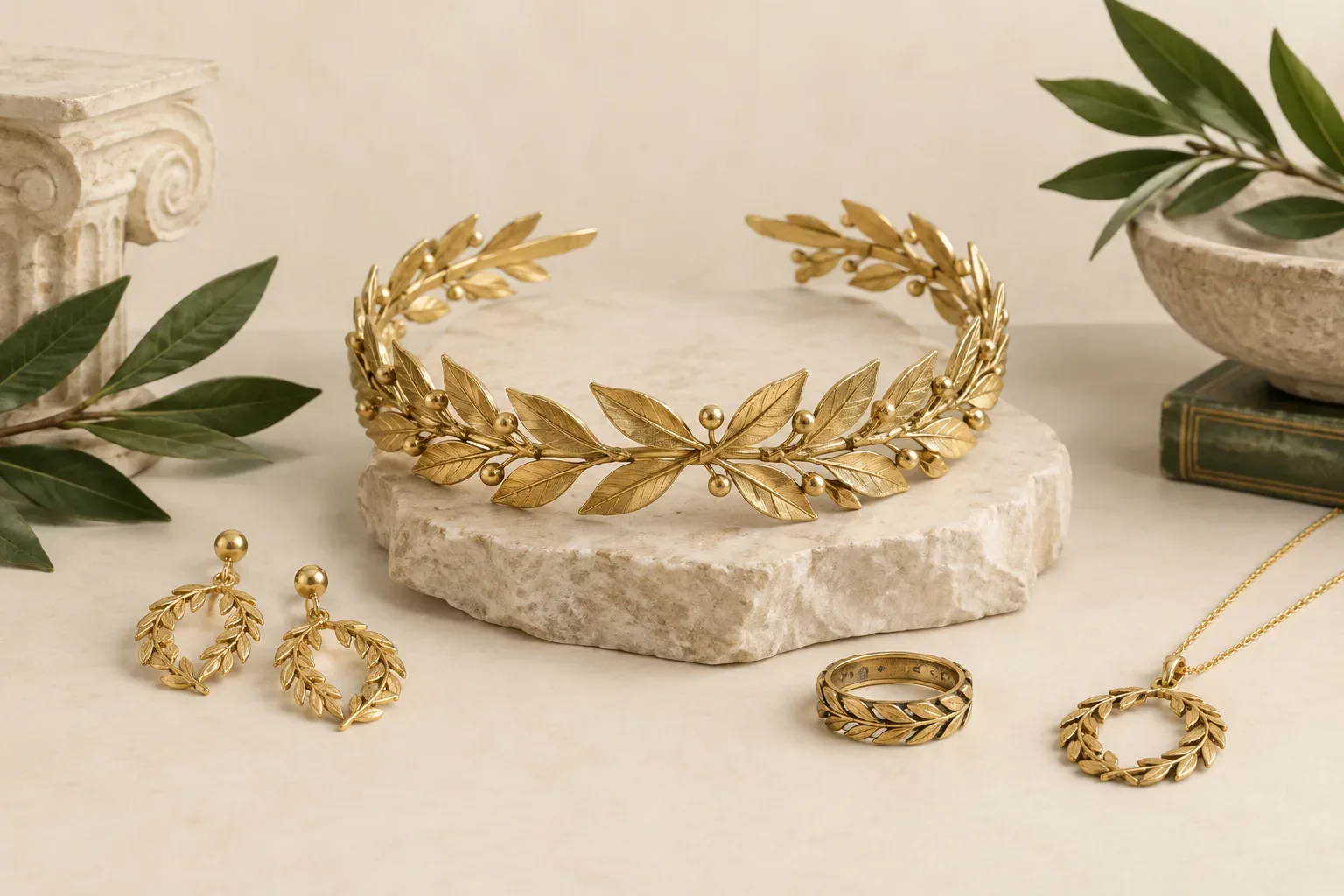
The laurel motif appears in jewelry in multiple forms: as full circular wreaths for brooches and pendants, as stylized leaf sprays on rings and bracelets, in garlanded tiaras and hair ornaments, or as engraved or repoussé decoration on lockets and boxes. Museums such as the V&A illustrate that the motif can be both sculptural and graphic, worked in metal or suggested by gem settings.
Materials and gemstones vary by period and purpose. Historic pieces in museum collections show laurel forms executed in gold, silver, and base metals, often combined with enamel, filigree, or gem inlay. The V&A’s gemstone references note that classical and later jewelers used common precious and semi-precious stones of their time in decorative combinations; in later centuries, diamonds, pearls, emeralds, and colored stones were chosen for their brilliance and social value. Contemporary makers may use any metal or gem, from traditional gold and pearls to contemporary alternatives.
Design language also matters. A laurel motif rendered realistically in metal leaves has a very different feel from a simplified, geometric wreath or a pavé diamond band that merely suggests a garland. When gemstones are used to form leaves or berries, the stone choice, cut, and setting technique all change how the motif reads — decorative, commemorative, or purely fashionable.
Practical and respectful guidance for choosing or gifting laurel wreath jewelry
Consider the recipient’s relationship to the motif. If you intend a symbolic gift — for an academic milestone, athletic achievement, or creative accomplishment — be explicit about your meaning so the recipient understands your intent. If you are buying for style rather than symbolism, choose a design that matches the wearer’s usual scale and metal preference.
Match style to context. A delicate laurel pendant or ring suits everyday wear and personal symbolism. A larger brooch or tiara-style piece reads as ceremonial or statement jewellery. Museums such as the Victoria and Albert Museum demonstrate that formality and scale have historically signaled different social uses for similar motifs, so think about when and how the recipient will wear the piece.
Ask about materials, treatments, and provenance. The U.S. Federal Trade Commission recommends that buyers request clear disclosure about gemstone treatments, synthetic stones, and imitations. When purchasing an heirloom or an object marketed as ‘antique’ or ‘period,’ ask for documentation and examine condition and repairs; museum cataloguing practices emphasize provenance and context when assigning historical meaning.
Respect cultural and institutional uses. Laurel wreath imagery is used in academic and organizational insignia in some contexts; avoid appropriating official emblems or insignia reserved for particular institutions. If the piece is intended to signify an official honor, verify whether an institutional or ceremonial variant is required.
Care and longevity. Choose metals and settings that suit the wearer’s lifestyle. For everyday pieces, sturdy prong settings and durable metals such as 14k or 18k gold or platinum are practical. For delicate historic-style pieces, consider professional maintenance and appropriate storage to preserve detail and patina. Museum conservation practice, as represented in public guidance from institutions like the V&A, treats material care as essential to preserving meaning and craft.
Where to research further
For historical context, museum collections and exhibition catalogues are primary starting points: the Victoria and Albert Museum provides accessible overviews of jewelry history and gemstones that help place motifs like the laurel wreath in changing social contexts. For buying guidance and regulation on gemstones, the Federal Trade Commission offers practical advice about disclosures, treatments, and consumer protections.
On this site you can learn more about symbols and gift selection in related articles such as the Symbols category, a practical gift guide on choosing meaningful jewelry, and a history of lockets where motif and memory intersect. If you want to evaluate a single piece, combine stylistic comparison with maker marks, hallmarks, and provenance research; consult specialist dealers or certified gemologists when in doubt.
Frequently asked questions
What does laurel wreath jewelry traditionally symbolize?
Traditionally, museum interpretation links the laurel wreath in classical contexts with ideas such as victory, honor, and poetic distinction; later revivals used it as a learned reference to those classical virtues rather than a single, unchanging meaning.
Is the laurel wreath a religious symbol?
The laurel wreath is primarily a secular classical motif historically associated with civic or cultural honors; any religious significance depends on a particular object’s context and should be established from that object’s provenance and associated imagery.
How can I tell if a laurel wreath piece is genuinely old or a modern reproduction?
Examine maker’s marks, hallmarks, construction techniques, patina, and provenance documentation; for reliable guidance consult museum references or a qualified appraiser, and ask the seller for paperwork when purchasing.
What gemstones or metals work well with laurel wreath designs?
Historic pieces use a range of metals and stones; the Victoria and Albert Museum notes that gold, enamel, pearls, and common precious stones appear in period work. Choose materials to match the wearer’s taste and lifestyle, and ask about treatments or synthetics before buying.
Do I need to worry about gemstone treatments and imitations?
Yes. The Federal Trade Commission advises buyers to request clear disclosure about gemstone treatments, synthetics, and imitations and to seek written confirmation of what you are buying.
Is a laurel wreath design appropriate as a graduation or achievement gift?
A laurel wreath can be an appropriate symbol for achievement if presented with clear intent; be mindful of institutional insignia that may have specific rules, and choose a design and scale that the recipient will want to wear.
Sources and further reading
- Bedazzled: A History of Jewellery — Victoria and Albert Museum
- An A-Z of Gemstones — Victoria and Albert Museum
- Buying Gemstones, Diamonds, and Pearls — Federal Trade Commission