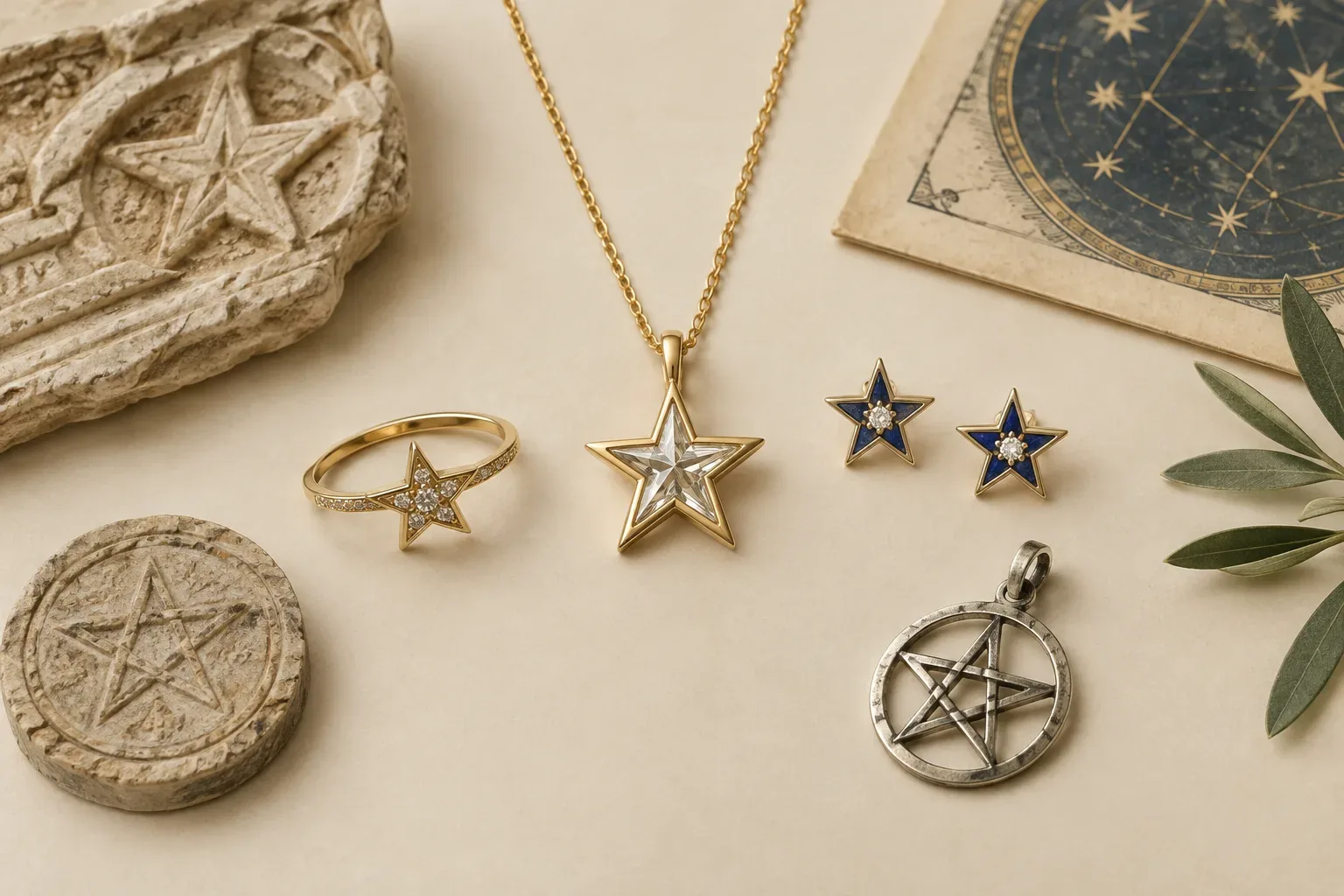
Meaning at a glance
The five-pointed star motif has appeared in many periods and contexts; museum research shows its use as a decorative and status motif in historical jewelry, while modern meanings are diverse and often personal. This article separates documented historical uses from contemporary interpretations and gives practical advice on gemstones, makers' disclosure, selection, and respectful gifting.
Direct answer: what five-pointed star jewelry means
The five-pointed star jewelry meaning is not a single, fixed symbol. Museum research indicates the motif has been used for decoration, status display, and personal ornament across many historical periods, and more recently it has been adopted with varied personal, cultural, and fashion-oriented meanings. In short: historical evidence supports the star as a recurring decorative motif in jewelry, while modern wearers often project personal or contemporary symbolic meanings onto it.
Documented history and where the evidence comes from
When tracing the five-pointed star in jewelry, rely on published museum research and catalogues rather than broad generalizations. The Victoria and Albert Museum (V&A) places the star motif within the wider history of jewellery as one of many recurring decorative elements that artisans have used for centuries to signal taste, craftsmanship, or fashion rather than a single universal meaning. The V&A's overview of jewellery history explains how motifs move in and out of fashion and are reused in new social contexts.
Historically, star motifs appear alongside other celestial imagery in pieces that range from personal brooches and pendants to decorative settings on rings and garments. The V&A's work on gemstones and jewellery also clarifies how gem cutting and decorative techniques affect the appearance of stars in jewellery, whether as engraved or enamelled star shapes or as optical effects produced by certain stones.
Identifying specific cultural or period uses (evidence-based)
Museum research documents that jewellers in different periods borrowed from existing motifs and adapted them to new materials and social meanings. For example, star motifs can be found in objects catalogued by museums that place them in late medieval, Renaissance, Georgian, and Victorian collections as decorative devices and as part of larger symbolic programs, but the specific interpretation often depends on context within the object. The V&A explains these shifts in social context and fashion across periods.
Beyond motif use as decoration, gemstones with star-like optical effects were historically prized. The V&A's A–Z of Gemstones discusses 'asterism'—the star effect seen in some cabochon-cut stones such as star sapphires—which has been collected and set into jewellery for its striking appearance in multiple historical periods. These documented material facts (gemstone asterism, use of star motifs in ornament) are distinct from later narrative layers or modern appropriations.
Separating documented historical meanings from modern interpretations
Recorded historical evidence tends to show the five-pointed star used as a motif within broader decorative schemes, fashion trends, or as part of personal insignia, rather than as a single, consistent symbolic message. Museum sources emphasize changing social contexts and the reuse of motifs, so it is more accurate to describe the star as a flexible design element whose meaning depended on time, place, and the owner's intent.
Modern wearers and retailers often attach new meanings—such as guidance, protection, patriotism, or identity—that are contemporary interpretations rather than direct continuations of a single historic meaning. These modern attributions are valid as personal or collective meanings, but they should be distinguished from documentary evidence. When assessing five-pointed star jewelry meaning, note whether a given interpretation is supported by historical documentation or is a later, culturally specific reading.
How the motif, gemstones, and traditions appear in jewelry
In jewellery design the five-pointed star appears in several ways: as a purely graphic metalwork motif cut, stamped, engraved, or pierced into metal; as an applied element such as a star-shaped plate or charm; as an inlaid pattern using enamel, pietra dura, or mixed materials; and as a setting accent created with gemstones. Historical and modern makers both use these approaches, adapting the technique to the materials and tastes of the time. Museum scholarship illustrates these technical variations across the history of jewellery.
Gemstones add another layer of literal 'star' effects. The V&A's A–Z of Gemstones describes asterism, the optical phenomenon where light reflects from needle-like inclusions to form a star across the surface of a cabochon-cut gem. Stones such as star sapphires and some garnets and spinels have been used historically and continue to be used in rings and pendants for this striking appearance. Makers may also cut or facet stones to suggest a starburst or use rose-cut diamonds and seed pearls to create a star-like pattern in older pieces.
Practical guidance for choosing or gifting five-pointed star jewelry
Decide first whether you value historical authenticity, material quality, aesthetic preference, or symbolic meaning. If historical context matters, consult museum catalogues or reputable dealers and ask for provenance information; museum research shows that motifs migrate between periods, so provenance helps clarify how a piece was intended to be read.
Check gemstone disclosures and treatment certifications. The Federal Trade Commission advises buyers to look for clear disclosure of treatments, synthetics, and imitations when purchasing gemstones, diamonds, and pearls. Ask the seller for documentation about any treatments (heat, diffusion, filling) and for grading or identification reports where available.
Match scale, setting, and metal to the recipient's lifestyle. Smaller, low-relief star motifs work well for everyday wear on rings and pendants, while larger or more ornate star brooches and statement necklaces are suited to occasional wear. Choose durable metals and secure settings for frequently worn pieces, and favour closed-back or bezel settings for cabochon star stones to protect asterism gems.
Be culturally and personally respectful when gifting. If the recipient associates the star with a specific cultural, religious, or political meaning, ensure your gift aligns with their values. If you are unsure, opt for a neutral approach—a simple star pendant in a classic setting or a charm that can be added to a bracelet lets the wearer ascribe their own meaning. For research tools and further reading on symbols before gifting, consult our guide on "How to Research the Meaning of a Jewelry Symbol."
Finally, consider the maker. Handcrafted or vintage pieces often carry a stronger sense of story, while contemporary brands may offer clearer information about materials and ethical sourcing. If certification matters to you, ask for documentation and read sellers' policies on returns and authenticity.
Concluding note
The five-pointed star jewelry meaning is best approached as layered: documented material history shows its use as a versatile decorative motif and, in the case of certain gems, an optical phenomenon; modern meanings are diverse and often personally chosen. Use museum research to understand historical context, rely on transparent seller disclosures for materials, and choose or gift with attention to the recipient's beliefs and lifestyle.
Frequently asked questions
Is the five-pointed star always a religious symbol?
No. Historical museum research shows the five-pointed star often functions as a decorative motif in jewellery and its meaning varied by context. While some groups may use star imagery with religious meaning, many historical and modern uses are secular or personal.
Do any gemstones naturally create a star in jewellery?
Yes. Certain gemstones show asterism, an optical star-like reflection when cut as a cabochon. The Victoria and Albert Museum's A–Z of Gemstones discusses stones such as star sapphires that display this effect and have been used in jewellery for their visual impact.
How can I tell if a star gemstone has been treated or is synthetic?
Ask the seller for full disclosure. The Federal Trade Commission advises buyers to seek information on treatments, synthetic origins, and imitations. Request documentation, treatment reports, or an independent identification if the provenance or treatment history matters to you.
Is it appropriate to gift star jewellery with political or cultural meanings?
Gifting symbols with potential political or cultural meanings requires sensitivity. If you know the recipient's associations and values, a meaningful gift can be appropriate. If you are unsure, choose a neutral design or discuss the symbolism with the recipient before gifting.
What styles of five-pointed star jewellery are best for everyday wear?
For everyday wear choose smaller, well-set pieces in durable metals with secure settings. Simple star pendants, small stud earrings, or minimalist signet-style rings are practical choices that minimize snagging and wear while allowing personal expression.
Where can I learn more about historical symbolism in jewellery before buying vintage pieces?
Consult museum publications and reputable catalogues. The Victoria and Albert Museum's resources on jewellery history are a useful starting point, and our guide on how to research jewelry symbols can help you assess provenance and meaning.
Sources and further reading
- Bedazzled: A History of Jewellery — Victoria and Albert Museum
- An A-Z of Gemstones — Victoria and Albert Museum
- Buying Gemstones, Diamonds, and Pearls — Federal Trade Commission