Meaning at a glance
The open hand motif in jewelry has been used in varied ways across cultures and periods; this article explains the documentary evidence, separates historical meanings from modern personal interpretations, describes common jewelry forms and gemstones, and offers practical guidance for selecting or gifting open-hand pieces today.
What the historical record shows
Museum scholarship records the open hand as a recurring decorative and symbolic motif in jewelry across many regions and time frames. The Victoria and Albert Museum (V&A) treats hand imagery as part of the broader history of jewellery and its changing social meanings, noting that designers and wearers repurposed motifs to fit new cultural contexts and fashions.
From museum collections and catalogues, hands appear in European jewellery of the medieval and early modern eras as emblematic devices on rings and pendants, and they feature in South Asian and Middle Eastern metalwork and amulets in forms that may have served devotional or protective functions. The V&A emphasises the importance of tracing each object’s provenance and context to understand its original use and meaning rather than assuming a single interpretation for every example.
Documented historical meanings versus modern personal interpretations
Historical meanings attributed to hand motifs vary by object and provenance and are best recovered from contemporary records or museum attributions. For example, museum labels and scholarship may identify a specific piece as a protective charm, a devotional emblem, or a signet-type device when there is contextual evidence such as associated texts, burial finds, or known ritual use. The V&A’s work on jewellery history stresses that motifs change function as social practices and fashions change.
Modern interpretations, by contrast, are often personal or community-based. Contemporary wearers may choose an open hand for reasons that include perceived protection, welcome, openness, solidarity, or simple aesthetic preference. These modern associations are legitimate for the wearer but should not be conflated with documented historical meanings unless a piece can be shown to come from the relevant cultural context and time period.
How the open hand motif appears in jewelry
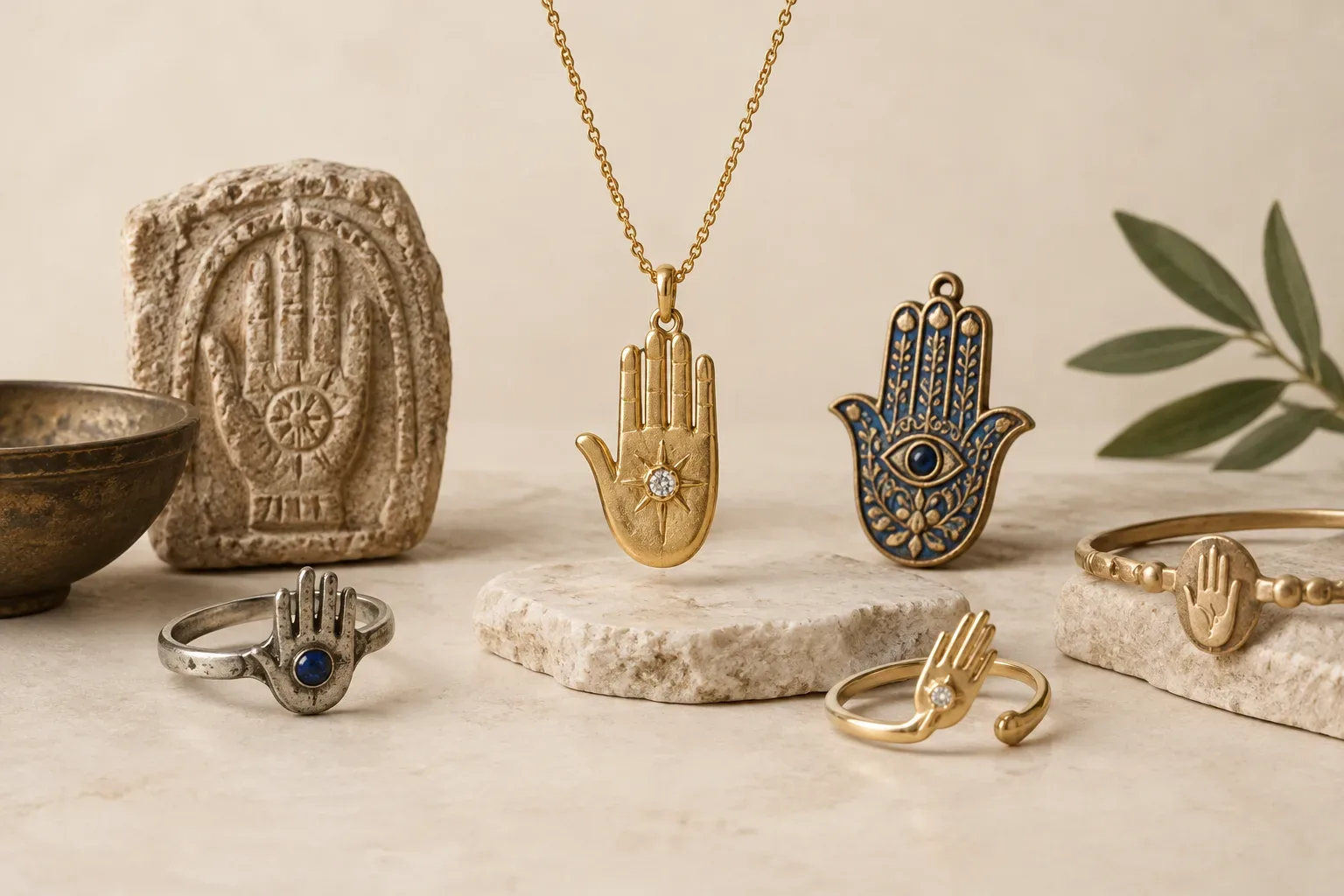
The motif appears in many jewelry types: rings, pendants, charms, brooches, amulets, and even elements of larger items such as lockets. Makers have used a range of techniques to render the open hand — cast or chased metal, engraved signet faces, enamel, carved gemstones, and repoussé work — depending on the period and place of manufacture.
In museum collections and decorative arts exhibitions, wearer function can be deduced from form and workmanship. A small carved gemstone set in a ring face may indicate a personal seal or token, while a pierced metal pendant with an eye motif nearby may be catalogued as a protective amulet. The V&A’s resources on jewellery and gemstones help identify common materials and techniques that determine how motifs were made and worn.
Gemstones, materials, and visual language
Gemstones and materials influence perception. Brightly coloured stones, enamel, or elaborate filigree can make a hand motif read as a fashionable decorative element, while plain metal, crude casting, or inscribed surfaces are more likely to indicate an object made for practical or ritual use. The V&A’s A–Z of Gemstones provides context about how different gems and materials were used historically and the social meanings they carried in different times.
In modern pieces, gem choices often reflect contemporary taste or symbolic layering: for instance, birthstones, protective stones, or gems chosen for colour harmony. If historical authenticity matters for a purchase, museum scholarship and provenance remain the most reliable ways to check whether a particular gem-cut or setting type fits the period a seller claims.
Practical guidance for choosing or gifting open-hand jewelry
Be clear about your purpose. If you want a historically informed piece, look for documented provenance or museum-style references and consult reputable dealers or auction catalogues. If your intent is symbolic or personal, choose a design and material that match the wearer’s tastes and cultural background, and explain your intention when gifting to avoid misunderstanding.
Respect cultural associations. Because motifs can have religious or culturally specific meanings for some communities, do a little research into the motif’s use in the relevant culture before giving it as a gift. When in doubt, ask the recipient or choose a neutral design and describe your gift as an aesthetic or personal token rather than a claim about religious or cultural identity.
Check materials and disclosures. The Federal Trade Commission (FTC) provides guidance about gemstone treatments, imitations, and disclosure responsibilities for sellers. Ask sellers about metal tests, gemstone treatments, and return policies, and request documentation for any claims of age or provenance. If a piece is described as ‘antique’ or ‘period’, request corroborating evidence such as hallmarks, paperwork, or specialist reports.
Prioritise craftsmanship and fit. For everyday wear, choose durable metals and secure settings and make sure the scale and weight suit the wearer’s lifestyle. Consider whether a pendant’s bail size will suit different chains, or whether a ring band can be resized. If gifting, include a note about care and the meaning you intend to convey.
Caring for open hand jewelry and verifying authenticity
Simple care keeps symbolic pieces wearable: clean according to the metal and stone involved, store items separately to avoid scratches, and have settings checked by a jeweller if a piece is worn frequently. For historically important or old pieces, consult a conservator rather than attempting home cleaning.
To verify age, origin, or material, ask for paperwork, hallmarks, or specialist reports. For gemstones, the FTC’s consumer guidance explains common treatments and the importance of disclosure; reputable sellers should answer questions about enhancements such as heating, dyeing, or surface coatings. When provenance or age is central to value, seek an independent appraisal.
Final considerations
The open hand motif is versatile: it can carry long-established cultural meanings when properly contextualised, and it can also be a meaningful contemporary choice for wearers who assign their own associations. Museum scholarship, notably the Victoria and Albert Museum’s resources on jewellery history and gemstones, is the best starting point for placing an object within a documented historical context.
Whether you choose a vintage amulet or a modern designer charm, respect for the motif’s cultural resonance and careful attention to materials, provenance, and the recipient’s background will make the piece both beautiful and considerate. For further practical advice on selecting meaningful jewelry see our guide How to Choose Meaningful Jewelry: A Practical Gift Guide and related historical treatments such as our article on the History of Lockets.
Frequently asked questions
Is the open hand the same as the Hamsa?
They can look similar, but they are not automatically the same. The Hamsa is a specific hand motif with cultural and religious associations in some Middle Eastern traditions; an open hand motif in jewelry may be inspired by that form or may be a different, unrelated motif. Investigate the object’s provenance and context before assuming equivalence.
How can I tell if a hand motif piece is genuinely antique?
Ask for provenance, hallmarks, or specialist reports and request clear photographs of construction details. Museum resources and professional appraisers can help interpret hallmarks and manufacturing techniques; if age or origin is important, demand documentation rather than relying on a seller’s label.
What gemstones work well with open hand designs?
Both historical and modern pieces pair hands with a wide range of materials. Choose stones that suit the design scale and the wearer’s preferences; consult the V&A’s A–Z of Gemstones for historical context, and ask sellers about treatments or imitations per FTC guidance.
Are there cultural sensitivities to consider when gifting open-hand jewelry?
Yes. Because motifs can have religious or cultural significance for some groups, research the motif’s usage in the relevant culture and, when appropriate, explain your intentions to the recipient to avoid misunderstandings.
What should I ask a seller before buying an open-hand piece?
Request information on materials, gemstone treatments, hallmarks, provenance, and return policies. For gemstones and treatments, refer to the Federal Trade Commission’s guidance on disclosure and truthful descriptions.
How should I care for an open-hand pendant or ring?
Care depends on the materials: clean gently for metals and stones according to their requirements, store separately to avoid scratches, and have settings checked by a jeweller for frequently worn pieces. For historically significant pieces, consult a conservator.
Sources and further reading
- Bedazzled: A History of Jewellery — Victoria and Albert Museum
- An A-Z of Gemstones — Victoria and Albert Museum
- Buying Gemstones, Diamonds, and Pearls — Federal Trade Commission