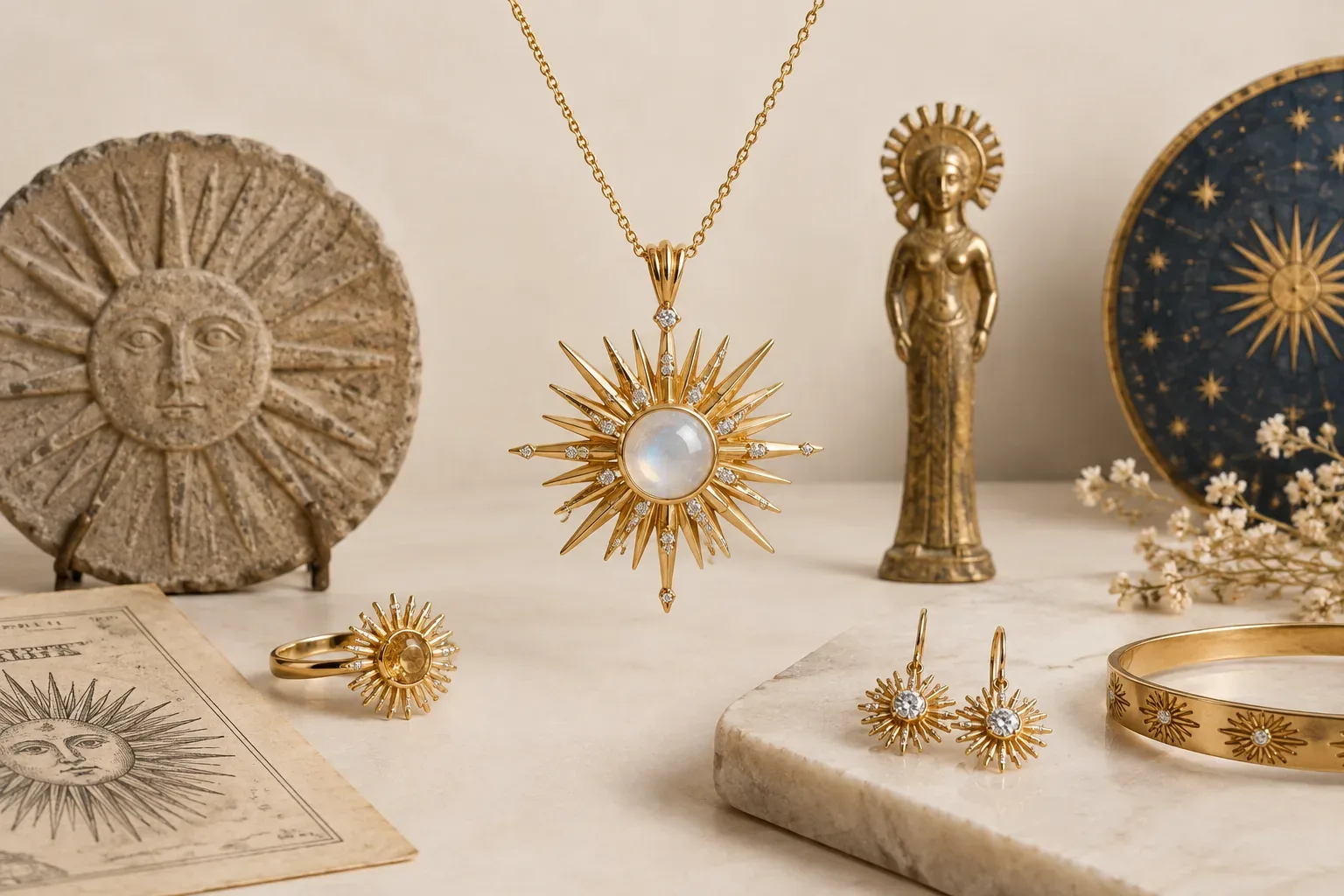
Meaning at a glance
The sunburst motif has clear documented uses in many historical jewellery traditions and later revivals; this article separates those recorded cultural meanings from contemporary personal interpretations and gives practical advice on choosing and wearing sunburst jewelry today.
Direct answer: What does 'sunburst jewelry meaning' mean?
In brief: sunburst jewelry meaning combines a long documented visual history with changing contexts. Museums and curators describe the sunburst as a recurrent decorative motif in many periods—used for its visual association with light, power, and prestige—while modern wearers often ascribe personal ideas such as optimism, guidance, or individuality. This article explains the documented historical evidence for the motif, keeps cultures and periods distinct, separates historically recorded meanings from modern interpretations, and offers practical selection and gifting guidance.
Documented historical evidence, by culture and period
The Victoria and Albert Museum's historical overview of jewellery notes that solar imagery appears repeatedly across widely separated places and periods, from ancient objects through later European revivals to 19th- and 20th-century fashions. The V&A presents these occurrences as part of shifting social contexts for jewelry rather than as a single, continuous meaning.
In ancient and classical contexts the sun or radiating motif was used as a decorative and symbolic element on objects and ornaments recorded in museum collections, with variations in form and emphasis depending on local visual language. The V&A's materials on jewellery history place these uses among a broader set of symbolic devices employed in personal ornaments.
In the Renaissance and later European decorative traditions the sunburst reappeared as part of court and religious imagery and as a fashionable decorative device. The V&A catalogs examples showing how motifs move in and out of vogue as tastes, technologies and patronage change, and how jewellers adapt a visual motif to contemporary technique and meaning.
The 19th century and early 20th century saw further revivals and reinterpretations of radiating forms in brooches, pendants and tiaras, again documented in museum collections described by the V&A. These examples show the motif functioning as ornament, status display, or allegorical reference in the specific cultural contexts of their makers and wearers.
Separating documented historical meanings from modern interpretations
Documented historical meanings are what contemporary records, object labeling, or museum interpretation attribute to a motif within a specific culture or period. The V&A emphasizes that the same visual device—rays, halos, or radiating designs—can carry different connotations depending on place, patronage and object type. For example, a radiating halo on a devotional object in one context may signify a sacred attribute, while a similar arrangement on a court jewel in another context may signal rank or fashion.
Modern personal interpretations are what wearers and designers attribute to sunburst jewelry today. These frequently include ideas such as optimism, inner light, guidance, resilience, or simply aesthetic pleasure. These contemporary meanings are valid as personal or contemporary cultural symbolism but should not be conflated with a single historical or cross-cultural meaning.
How the sunburst motif appears in jewelry: forms, techniques and gemstones
The sunburst motif appears in jewelry through a variety of forms: openwork pendants and brooches with radiating spokes, medallion settings with a central stone and outward rays, enameled surfaces that imitate the play of light, and tiaras or diadems arranged in sun-ray profiles. Museum descriptions at the V&A show these formal variations across time and technique, demonstrating how jewelers adapt a basic radiating idea to available skills and fashions.
Gemstones and materials contribute to the sunburst effect. Contemporary and historical pieces use faceted diamonds or clear stones to suggest brilliance, and yellow or golden-hued gems—such as citrine or topaz in modern pieces—are often chosen to echo solar colour. The V&A's guidance on gemstones places individual stones in historical and decorative context but does not prescribe a single stone for the motif; choices have varied by period, availability and taste.
Construction techniques that emphasise radiance include pavé and cluster settings that create a glittering field around a center, star or rose-cut central stones surrounded by baguettes or tapered stones to form rays, and metalwork such as chased or stamped rays that catch light. Enamelling and gilt metals also accentuate a sun-like appearance. The effect is both optical and symbolic: jewelry makers exploit light, reflection and colour to allude to the sun's qualities while satisfying decorative aims.
Choosing and gifting sunburst jewelry: practical and respectful guidance
Consider the recipient's personal and cultural context first. Because the sunburst carries recorded meanings that vary by culture and object type, ask discreetly or reflect on whether a solar image has particular significance—religious, cultural or familial—for the person. When in doubt, present the piece as a modern symbolic gift (for example, 'a reminder of brightness and resilience') rather than asserting a universal historical meaning.
Choose materials and craftsmanship that match the intended purpose and longevity of the gift. If the piece is meant as an heirloom, prefer solid precious metals and verified gemstones; museum guidance summarized by the V&A reminds buyers that jewellery history values technical quality and maker skill. For everyday wear, lighter or plated pieces can be suitable but expect shorter life and different maintenance needs.
Check disclosures about gem treatments, imitations and origin. The U.S. Federal Trade Commission provides clear consumer guidance that sellers should disclose treatments, enhancements and whether a stone is synthetic or an imitation. Ask the seller for written confirmation of metal purity and gemstone treatment when these factors are important to you or the recipient.
Respect formality and occasion. A large, ornate sunburst brooch or tiara-style piece reads as formal and historically referential, whereas a small pendant with a single central stone and subtle rays reads as casual and contemporary. Match the scale and finish of the piece to the recipient's usual dress and lifestyle.
If you're buying vintage or antique sunburst jewelry, verify provenance and condition. Museums like the V&A emphasise the importance of context in interpreting historical objects; for consumers that means seeking reputable dealers, condition reports and, where possible, documentation about the object's date and previous ownership.
Personalisation can make a sunburst piece more meaningful without imposing a specific historical reading. Consider engraving a short dedication, choosing a gemstone in the recipient's birthstone range, or pairing the pendant with a note about why you chose the motif. That frames the piece as a personal symbol rather than a claim about universal meaning.
Practical care and authenticity checks
Sunburst jewelry often relies on fine settings and many small stones or enamel details; these features can trap dirt and are more delicate than plain metal forms. Store pieces in a dry place, clean gently following the metal and stone type, and consult a jeweller for repairs to settings or enamel work.
Follow FTC-style precautions when assessing value and authenticity. Ask for documentation on metal hallmarks, gemstone certificates for valuable stones, and clear disclosure of any treatments or synthetic materials. For online purchases, request detailed photographs of hallmarks and settings and buy from sellers who clearly state refunds or return policies.
Wear it thoughtfully: context and contemporary styling
Modern styling of sunburst motifs ranges from minimalist necklaces worn daily to statement brooches and earrings for formal occasions. A simple sunburst pendant can be layered with other necklaces for a relaxed look; a brooch can be pinned to a jacket lapel or scarf as a deliberate statement. Match the piece's scale and finish to the rest of the outfit to keep the motif coherent with personal style.
Remember that modern symbolic attributions—such as hope, leadership or personal radiance—are contemporary and subjective. Presenting the motif as a personal talisman is a valid choice, but avoid asserting that such meanings are historically universal.
Final note: meaning as layered and personal
The sunburst motif carries layered meanings. Museum records like those at the V&A document its recurrence and changing roles across cultures and centuries. Contemporary wearers add further personal layers of meaning, and consumer guidance from bodies such as the FTC helps protect buyers when choosing materials or verifying authenticity. Treat the motif as a bridge between documented visual history and individual expression rather than as a single fixed symbol.
Frequently asked questions
Is the sunburst motif historically tied to a single religion or culture?
No. Museum documentation summarised by the Victoria and Albert Museum shows that radiating or sun-like motifs appear in multiple cultures and periods with different local meanings. The motif's use should be read in its specific historical and cultural context rather than assumed to have a single origin or meaning.
What gemstones are appropriate for sunburst jewelry?
There is no single compulsory gemstone. Historically and today, jewellers use a range of stones and techniques—clear faceted stones for brilliance, or warm yellow stones to echo solar colour. The V&A's resources on gemstones explain how different stones were used in decorative contexts; choose a stone that fits the design, budget and intended meaning.
How can I verify the authenticity of a vintage sunburst piece?
Ask the seller for documentation of provenance, hallmarks and a condition report. For valuable gemstones, request certification and disclosure of treatments. The Federal Trade Commission advises buyers to seek clear information on treatments, synthetics and imitations before purchase.
Is it appropriate to gift sunburst jewelry as a symbol of hope or resilience?
Yes, as a contemporary personal symbol this is appropriate, provided you present the meaning as your intention or the recipient's personal interpretation rather than as a universal historical fact. Consider the recipient's cultural or religious background and select materials and scale that suit their taste.
How should I care for delicate sunburst pieces with many small stones or enamel?
Store them separately to avoid abrasion, clean gently according to the metal and stone type, and consult a professional jeweller for any repairs. Fine pavé settings and enamel are delicate and benefit from periodic professional inspection.
Sources and further reading
- Bedazzled: A History of Jewellery — Victoria and Albert Museum
- An A-Z of Gemstones — Victoria and Albert Museum
- Buying Gemstones, Diamonds, and Pearls — Federal Trade Commission