Meaning at a glance
This article explains the documented history and shifting meanings of the all-seeing eye motif, separates historical evidence from modern personal use, describes how the motif appears in jewelry, and offers practical selection and gifting advice.
Quick answer
The all-seeing eye jewelry meaning is not singular: historically the eye motif has appeared in multiple cultures as a marker of protection, divine sight, or authority, and modern wearers rework it as a personal symbol of vigilance, insight, or fashion. This article explains what museums and consumer guidance document about the motif’s history and materials, separates those documented uses from later interpretations, and offers practical advice for choosing and gifting pieces today.
What the motif is and why it recurs
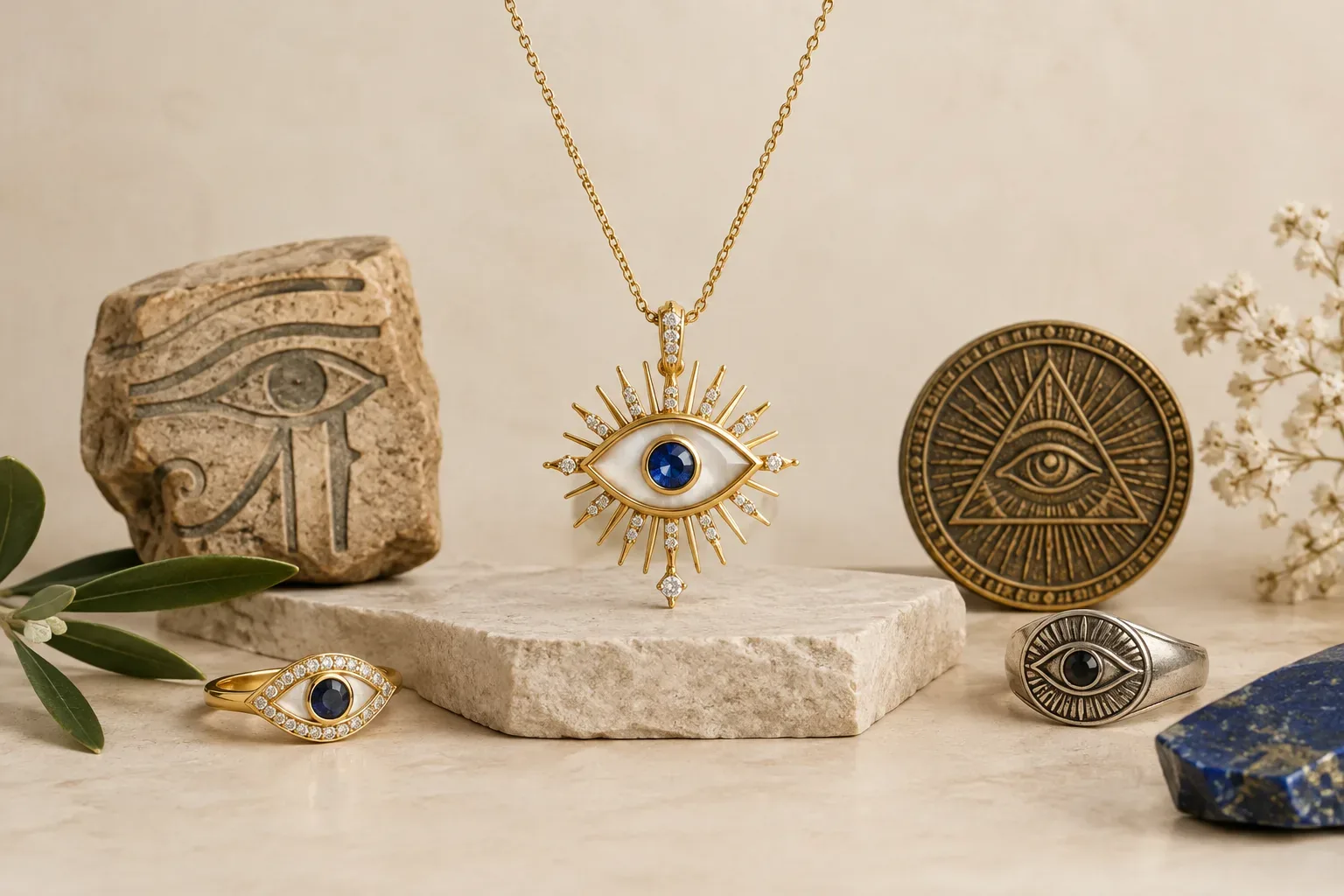
An eye—stylized or naturalistic—has long been used across cultures as a visual shorthand for seeing, watching, or being watched. Because vision and sight carry strong social and religious associations, the motif is adaptable: it can be protective, emblematic of divine or sovereign power, or a metaphor for knowledge and vigilance. According to the Victoria and Albert Museum, jewelry and ornaments have always reflected changing social meanings, and recurring symbols like the eye are reinterpreted each time they enter a new material, craft, or cultural context.
Documented historical uses (evidence-led and culture-by-culture)
Ancient Egypt: Eye motifs are present in ancient Egyptian art and jewelry. Museum collections and catalogues referenced by the Victoria and Albert Museum show eye forms used in amulets and funerary objects and treated in many studies as having protective and ritual associations in Egyptian contexts. The use of eyes in Egyptian material culture is part of a broader visual language rather than a single fixed meaning.
Classical Mediterranean and Near East: In Greek, Roman, and wider Mediterranean material, eye-like motifs appear on amulets, gems, and beads. According to the Victoria and Albert Museum’s treatment of jewellery history, such objects are often connected to personal protection or identity in the archaeological record, but meanings can vary by site, object type, and period.
Medieval and Renaissance Europe: Eye imagery shows up in devotional, heraldic, and artistic contexts across medieval and early modern Europe. Museum studies collected by institutions such as the Victoria and Albert Museum document shifts in how personal ornament and religious imagery interacted: an image that reads as protective in one setting might be political or devotional in another.
South and Southeast Asia: Visual traditions in Hindu and Buddhist art include eye symbolism—often connected to deities’ gaze or spiritual insight—and these visual motifs sometimes migrate into wearable objects. Again, museum-based cataloguing and scholarship cited by the Victoria and Albert Museum emphasize local meanings grounded in specific ritual and artistic systems.
Summary of evidence: Across these examples, the common thread in museum documentation is that eye motifs appear repeatedly but do not have a single universal meaning. The Victoria and Albert Museum’s work on jewellery history emphasises how context—material, place, and use—determines the likely interpretation of a motif.
Historical meanings vs modern interpretations
Documented historical meanings come from object contexts, inscriptions, and contemporary writings recorded and interpreted by museums and scholars. Where museums such as the Victoria and Albert Museum document an eye motif on an amulet from a burial or in a devotional setting, the most defensible historical readings link the motif to protection, divine sight, or identity within that specific cultural framework.
Modern interpretations are plural and often personal. Contemporary designers, wearers, and subcultures repurpose the eye motif for new statements: as a charm of personal protection, as a fashion motif, as an emblem of awareness or insight, or as a critique of surveillance. These uses are cultural creations of the recent past and present and should be distinguished from claims about ancient beliefs or single-origin meanings.
How the all-seeing eye appears in jewelry and what materials are typical
Forms and settings: In historical pieces museum collections record the eye motif in amulets, intaglios and cameos, pendants, finger rings, and inlaid work. Enamelling, carved hardstone, and painted surfaces were common historic techniques for rendering an eye. In modern jewelry the motif appears as pendants, signet-style rings, earrings, charm bracelets, and surface motifs set with stones or created in metalwork.
Gemstones and materials: Museums’ gemstone guides, including resources assembled by the Victoria and Albert Museum, show that lapis lazuli, turquoise, carnelian, onyx, glass paste and enamel have all been used historically to render vivid colours and contrasts that suggest an eye. Contemporary makers also use diamonds, sapphires, opal, and synthetic stones. The material choice influences both appearance and cultural resonance: a hardstone intaglio carries a different historical feel than a contemporary pavé-diamond pendant.
Modern manufacturing and disclosure: The Federal Trade Commission provides consumer guidance on gemstones, diamonds, and pearls. When shopping for all-seeing eye jewelry, sellers are legally obliged in many jurisdictions to disclose treatments, enhancements, and imitations. Shoppers should ask whether stones are natural, treated, or lab-created and request written information if needed.
Practical and respectful selection and gifting guidance
Consider context and the recipient’s background. Because eye imagery can have religious or cultural significance in some communities, ask whether the motif is appropriate for the person you plan to gift. When in doubt, a direct conversation about meaning is better than assuming universality.
Choose materials and makers thoughtfully. For a piece intended as a meaningful gift, select a reputable jeweller or established artisan. Verify gemstone descriptions and required disclosures as advised by the Federal Trade Commission to avoid surprises about treatments or imitations. If authenticity matters, request documentation or a simple letter from the maker describing materials and care.
Respectful design choices: If you want to evoke historical associations, look for techniques and finishes—hardstone carving, enamelwork, or traditional metalwork—that align with those histories. If you prefer a contemporary statement, minimalist metalwork or mixed-media designs can signal personal reinterpretation rather than cultural borrowing.
Sizing, wearability and longevity: Consider how frequently the recipient will wear the item and choose appropriate settings and stones. Delicate enamel or fragile inlay may be unsuitable for daily wear, while metal pendants are more robust. Include care instructions and a note explaining the piece’s intended meaning so the recipient understands your intention.
When gifting across cultures, prioritize humility and learning. If the symbol has sacred significance for the recipient’s community, respectful use may require consultation with members of that community or choosing a different motif.
Care, authentication, and next steps
Care and repair: Different materials require different care. Hardstones and metals are generally low maintenance, while enamel and inlay can chip and need gentle handling. Ask the maker for recommended cleaning and storage methods.
Authentication and consumer protections: If provenance or material authenticity matters, request written confirmation of stone type and treatments. The Federal Trade Commission’s guidance on buying gemstones, diamonds, and pearls explains the importance of disclosure around treatments, lab-grown stones, and imitations; insist on clarity when paying a premium for a named material.
Learn more responsibly: If you want to research a symbol or a maker, use museum catalogues and reputable guides. For a practical next step, the internal resources on this site can help you explore wider symbol meanings or practical gift selection.
Recommended related reading on this site
Explore the broader topic of symbols and meaning in jewelry in our Symbols category, use our practical gift guide to choose meaningful pieces, read the history of lockets to see how personal objects hold meaning across time, or follow our research guide to investigate the origins of a symbol in a specific piece.
Frequently asked questions
What does the all-seeing eye symbolize?
Historically the eye motif has been used in different cultures to suggest protection, divine or sovereign sight, or personal identity; modern meanings vary widely and can include protection, insight, vigilance, or aesthetic preference. Museum documentation stresses that interpretation depends on the object’s cultural and archaeological context.
Is it appropriate to wear or gift all-seeing eye jewelry?
It can be appropriate, but be mindful of cultural and religious contexts. Ask the recipient about their feelings, and avoid assuming a symbol’s meaning is universal. If the motif has known sacred significance for a community, consider choosing a different design or consulting members of that community.
Which materials are traditional for eye motifs?
Historically, hardstone carving, enamel, glass paste, and coloured gemstones such as turquoise, lapis, and carnelian have been used to render eye motifs. Contemporary pieces also use precious metals, diamonds, and lab-created stones; museum gemstone guides explain the historical uses of many materials.
How can I verify what I’m buying?
Ask the seller for written details about materials and any treatments. In many jurisdictions sellers must disclose gemstone treatments and whether a stone is lab-grown or an imitation; the Federal Trade Commission offers consumer guidance on these disclosures.
How should I care for an eye-motif piece?
Care depends on materials: metals are generally robust, enamel and inlay are more fragile, and some gemstones need special handling. Ask the maker for care instructions and store the piece away from abrasive contact and harsh chemicals.
Can I use the motif in my designs if I’m inspired by another culture?
Designers should proceed with cultural sensitivity. Research the symbol’s meanings, credit sources of inspiration where appropriate, and consider collaborating with or compensating artisans from the culture you reference to avoid cultural appropriation.
Sources and further reading
- Bedazzled: A History of Jewellery — Victoria and Albert Museum
- An A-Z of Gemstones — Victoria and Albert Museum
- Buying Gemstones, Diamonds, and Pearls — Federal Trade Commission