Meaning at a glance
Crescent moon jewelry meaning depends on historical context and contemporary use: museum collections document the motif across antiquity, medieval and Ottoman periods, Victorian revivals, and contemporary design; documented functions include decorative, calendrical, and emblematic roles, while modern meanings are often personal or aesthetic—use material and sourcing checks to choose or gift respectfully.
Short answer
The crescent moon jewelry meaning cannot be reduced to one universal symbol. Museum documentation shows the crescent motif appearing in many periods and places with different functions—decorative, calendrical, religious, or emblematic—while modern wearers most often assign personal, aesthetic, or spiritual meanings to the motif. This article explains the documented history across specific cultures and periods, separates recorded uses from later interpretations, describes how the motif and related gemstones appear in jewelry, and offers practical, respectful guidance for choosing and gifting crescent-moon pieces.
Historical evidence, organized by culture and period
Museum collections and scholarly exhibitions, including materials catalogued by the Victoria and Albert Museum, show that crescent and celestial motifs appear in a wide range of historical contexts rather than originating in a single culture. Objects identified in museum collections link the motif to antiquity, medieval and early modern empires, the 18th–19th century European revival of symbolic forms, and continued use into the present day. The Victoria and Albert Museum provides a broad overview of how jewellery styles and motifs shift with social context and fashion, which is the primary evidence for tracing the crescent motif across periods.
In antiquity, objects in museum collections indicate that lunar shapes and stars were used as decorative motifs and as part of religious and cosmological imagery in the ancient Near East and the Classical Mediterranean. These items are catalogued and interpreted within museum displays and publications as part of the material record of how people represented the sky, time, and divinity.
During medieval and Islamic periods, crescent forms appear in art and metalwork associated with courts and religious architecture; museum collections note that such celestial imagery could acquire emblematic or dynastic meanings in specific contexts. The crescent's later association with particular empires or polities—seen in coins, standards, or civic symbols—is documented in museum holdings and exhibitions that trace the emblematic use of celestial signs.
The Victorian and Edwardian eras saw a well-documented revival and reinterpretation of many historical motifs in jewellery. The Victoria and Albert Museum's surveys of jewellery history describe how nineteenth-century makers and consumers adopted motifs from antiquity and the medieval past for symbolic, sentimental, and fashionable reasons. In this period, crescent shapes were often incorporated into brooches, pendants, and tiaras as part of a broader interest in nature, astrology, and the exotic.
Contemporary makers draw on these layered histories while creating pieces that reflect current aesthetics and personal meanings. Modern design and popular culture have amplified associations such as femininity, cycles, and new beginnings, but those contemporary associations are modern interpretations layered onto a much older material record documented in museum collections.
Documented historical meanings versus modern interpretations
Documented historical meanings are those that can be tied to objects, inscriptions, or contemporaneous records preserved and interpreted in museum collections. In many of the items documented by museums, the crescent appears as a decorative motif or a component of religious or courtly visual programmes. Where a specific function is recorded—such as use on a coin, an architectural element, or as part of ritual paraphernalia—museum catalogues and exhibition texts present that evidence as context-specific rather than universal. The Victoria and Albert Museum's work on jewellery history emphasizes that motifs gain particular meanings within local cultural, political, or religious contexts.
By contrast, modern personal or popular interpretations—associating the crescent always with feminine energy, protection, or 'new beginnings'—are contemporary layers of meaning that often reflect current spiritual, aesthetic, or commercial trends rather than a single, historically documented symbolism. These modern readings are valid for wearers today but should be distinguished from claims that any one meaning is historically universal. Museum documentation supports the view that meanings change with time and place.
How the motif, gemstones, and traditions appear in jewelry
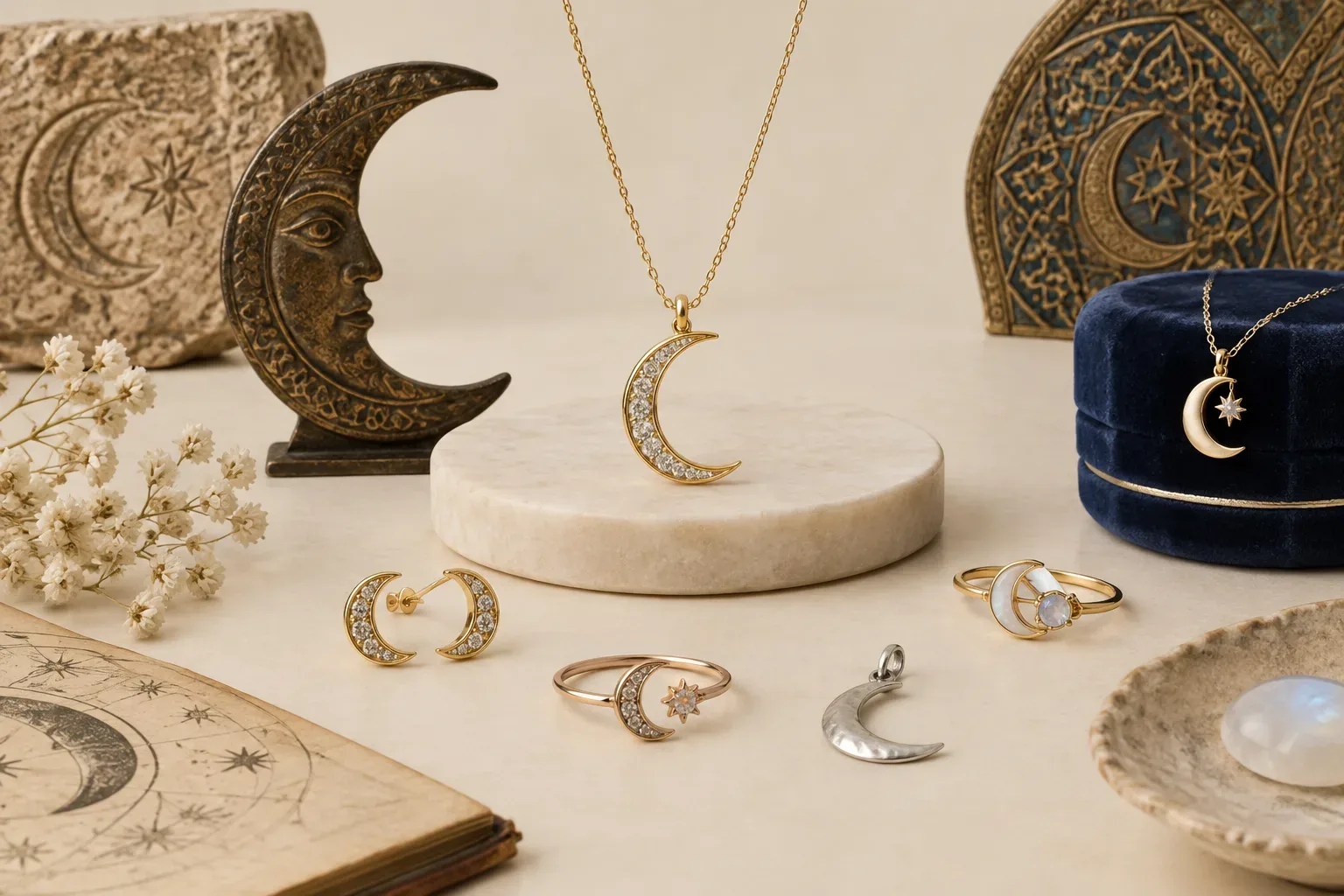
As a motif, the crescent appears in many jewellery types: pendants and necklaces, brooches and pins, rings, earrings, and headpieces. Design choices vary by period and maker—some crescents are highly naturalistic and slender, while others are bold and stylized. Museums document examples where the crescent is used as the central form of a piece and others where it is a secondary decorative element combined with stars, florals, or portraiture.
Gemstones historically associated with lunar imagery also appear in crescent-themed jewellery. Museum resources on gemstones, such as the Victoria and Albert Museum’s guides, explain how certain stones—pearls, moonstone, and opal—have long been linked to the moon in many cultures because of their lustre and play of light. In historical and modern pieces, makers set pearls or cabochon moonstone within crescent frames to underscore a lunar association, while diamonds and coloured gems may be used for sparkle or fashionable colour combinations.
Construction and materials reflect both era and intention. Historic pieces preserved in museum collections show a range of metals and techniques, from gold granulation and enamel to later silverwork and cast forms. Contemporary makers continue to use traditional techniques alongside modern fabrication. For buyers, material, finish, and gemstone treatment are meaningful markers of how a piece was made and what it conveys—whether a mass-produced silver pendant, a handcrafted gold brooch, or a period antique with era-specific mounting techniques.
Practical and respectful guidance for selecting or gifting crescent-moon jewelry
Decide whether you want a piece grounded in historical style or a contemporary design. If the buyer seeks historical authenticity, look for provenance and a clear description from the seller; museum catalogues and specialist dealers often provide contextual information about period pieces. If the goal is a modern, meaningful gift, choose a design that resonates with the recipient’s tastes and personal associations.
Consider cultural and religious sensitivity. Because the crescent can have emblematic uses in specific cultural or civic traditions, select pieces and language that respect those associations. If the receiver identifies with a tradition where the crescent has particular significance, choose wording and imagery that honour that context rather than appropriating or trivializing it.
Prioritise material and gemstone disclosure. The U.S. Federal Trade Commission provides authoritative consumer guidance on buying gemstones, diamonds, and pearls, including the importance of accurate disclosure about treatments, imitations, and metal content. Ask sellers for information about gemstone treatments, whether stones are natural or lab-grown, and for metal hallmarks. Clear disclosure helps set correct expectations about durability, care, and value.
Match scale and lifestyle. A small, delicate crescent pendant suits everyday wear and layering, while a larger brooch or statement ring will read as a fashion or ceremonial piece. Think about how the recipient dresses, their metal preference, and whether they have any skin sensitivities.
If gifting as a symbolic object, be explicit about your intent if the meaning matters—for example, note that you chose the piece as a token of encouragement for a new chapter rather than asserting that every culture has historically used the crescent to signify new beginnings. A short card that explains your personal reason for the gift helps avoid assumptions about universal symbolism.
When purchasing an antique or vintage crescent, seek documentation about condition and any restoration work. Museums’ conservation records show that older pieces may have been altered; reputable dealers will disclose repairs and condition issues. For gem and metal authenticity questions, request testing documentation or buy from established sellers who follow industry disclosure practices.
Care, buying tips, and further research
Care instructions depend on materials. Pearls and opal require gentler handling than faceted gemstones; silver benefits from storage to slow tarnishing, and gold is comparatively low maintenance. If a piece contains delicate settings or glued elements, avoid ultrasonic cleaners. For specific gemstone identification and historical context, the Victoria and Albert Museum’s resources on gemstones provide a useful starting point for understanding why certain stones have been paired with lunar imagery.
For ethical and transparency concerns, look for sellers who disclose gemstone origins and treatments and who provide clear information about metal fineness. The Federal Trade Commission’s guidance on buying gemstones, diamonds, and pearls provides practical checkpoints for consumers and explains what retailers are expected to disclose regarding treatments and imitations.
If you want to learn more about symbolic meanings or check the history of a particular object, consult museum catalogues and specialist publications. The Victoria and Albert Museum is a useful general reference for jewellery history; for detailed provenance of a specific item seek specialist curators or published catalogues raisonnés. When in doubt, research the motif’s history for the exact culture and period you are interested in rather than assuming a single lineage.
Conclusion
Crescent moon jewelry meaning is layered: museum documentation shows the motif appears in many periods and contexts with functions and meanings tied to their specific cultures, while modern interpretations are often personal or fashionable. To choose or gift crescent jewellery respectfully, distinguish historical documentation from contemporary symbolism, check material and treatment disclosures, and match the piece to the recipient’s aesthetic and cultural context.
Frequently asked questions
What does crescent moon jewelry mean?
There is no single, universal meaning. Museum documentation shows the crescent motif has served decorative, calendrical, religious, and emblematic functions in different cultures and periods; modern wearers often add personal or spiritual significance such as cycles or new beginnings.
Is the crescent moon a religious symbol I should avoid wearing?
The crescent has emblematic uses in some cultural and civic contexts, so consider the specific cultural or religious associations of a design before wearing it as a symbol. If you are unsure, choose neutral, contemporary designs or ask the recipient about their preferences when gifting.
Which gemstones are traditionally paired with lunar motifs?
Museum resources note that pearls, moonstone, and opal have historically been associated with the moon because of their sheen and optical effects; makers have paired these stones with crescent settings to reinforce lunar connections, while other gems are used for colour and sparkle.
How can I verify the materials and authenticity of a crescent-moon piece?
Ask the seller for clear disclosure about metal fineness, gemstone origin and treatments, and any restorations. The U.S. Federal Trade Commission recommends that buyers request written information about treatments and imitations and buy from sellers who provide transparent documentation.
Should I buy antique or new crescent jewelry as a meaningful gift?
Both can be meaningful. Choose antiques for historical resonance and provenance, but be mindful of condition and restoration. Choose contemporary pieces for personal style and up-to-date ethical or material standards, and accompany a gift with a note explaining your intended meaning when symbolism matters.
Sources and further reading
- Bedazzled: A History of Jewellery — Victoria and Albert Museum
- An A-Z of Gemstones — Victoria and Albert Museum
- Buying Gemstones, Diamonds, and Pearls — Federal Trade Commission