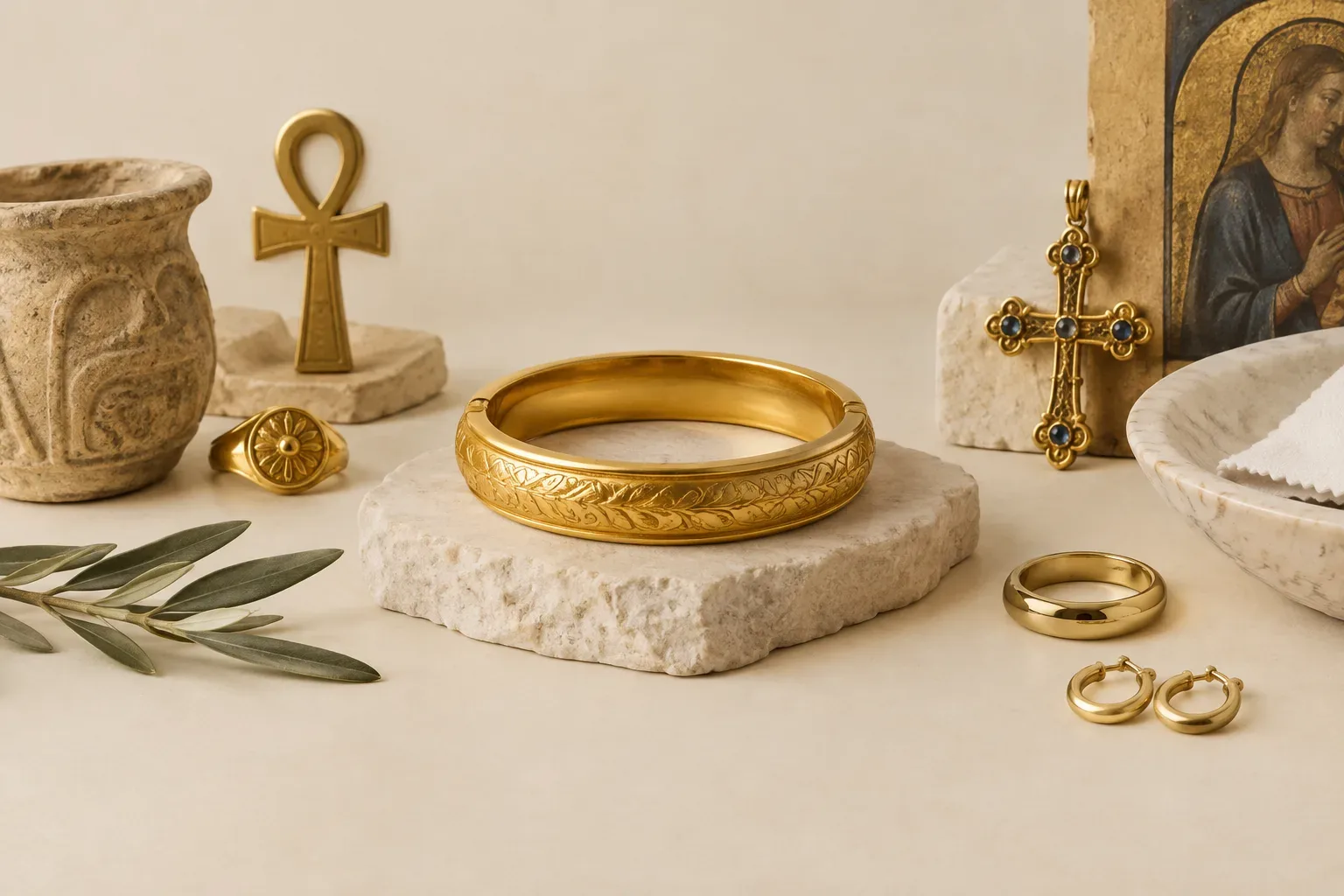
Meaning at a glance
Yellow gold has a long recorded history as a durable and culturally meaningful material, but its modern durability depends on alloy, finish, gemstone setting, and wear patterns; this article separates documented historical uses from later or personal meanings, explains how the material and motifs appear in jewelry, and gives practical selection and care advice for contemporary owners and gifters.
Quick answer
Yellow gold has been used for high-status and devotional objects for millennia and is widely valued for its color and longevity within many cultures. Its practical durability in modern jewelry depends on how the gold is alloyed, finished, and set; the metal itself resists some forms of corrosion but can show wear, scratches, and surface changes when combined with other metals or subjected to daily use. Choose pieces and care routines that match the recipient’s lifestyle, and ask sellers about alloy composition, finishes, and any treatments.
What the historical record shows
Museums and scholarship record a long, cross-cultural history of gold use in personal ornament and ceremonial objects. The Victoria and Albert Museum presents gold as a material with repeated cultural importance in many periods and places, from ancient societies through medieval and early modern Europe to later global exchanges. The V&A’s exhibitions and articles place gold within changing social contexts, showing how forms, techniques, and decorative motifs evolved as tastes, technologies, and trade networks changed.
Those historical records show continuity in why people prized gold: its color, workability, and association with social status and sacred uses. The precise meanings attached to gold—whether signifying royal authority in one period or a sentimental gift in another—are documented as situated, time-bound associations rather than universal symbolic facts. Relying on the V&A’s perspective helps keep cultural attributions specific to periods and regions rather than generalized claims.
Documented historical meanings versus modern interpretations
Documented meanings in museum records and scholarly catalogs tend to be contextual. The V&A reports, for example, that particular shapes and techniques gained prominence in specified eras because of court fashion, religious practice, or available technology. Those documentation-focused accounts make clear which meanings and functions are historically attested and tied to particular cultures or moments.
Modern or popular interpretations of yellow gold—such as claims that its color always symbolizes prosperity or spiritual light—often reflect contemporary preferences or marketing as much as history. These contemporary meanings are valid as personal or cultural choices today, but they should not be presented as the same thing historians record. Distinguishing the two helps you respect the history of objects while acknowledging how new meanings accumulate around materials and motifs.
How yellow gold, motifs, and gemstones appear in jewelry
Yellow gold appears across jewelry types: simple bands, signet rings, lockets, chains, religious pendants, and elaborate set pieces. Museums including the V&A document how certain forms—lockets with portraits, inscribed rings, or devotional pendants—were commonly executed in gold because of its perceived value and permanence. The same records trace how gem choices and settings shifted as new trade routes and lapidary techniques introduced different stones into local repertoires.
When gemstones are involved, catalogues such as the V&A’s ‘An A–Z of Gemstones’ show that gem choice, cut, and setting method influence long-term durability. Gemstones vary in hardness and sensitivity to heat, acids, or knocks, and their settings—bezel, prong, paved—affect how well the stone is protected. Historically, goldsmiths adapted mounts and construction techniques to balance the visual effect with physical protection for precious materials.
Durability: tarnish, wear, and the role of alloys and finishes
Durability in everyday use depends less on an abstract color label and more on composition and construction. Historic and modern makers use different alloy mixes and surface finishes to achieve a particular hue and working quality. Those choices change how the metal ages under friction, exposure to cosmetics or sweat, and contact with other materials. Museum studies described by the V&A highlight that technique and material choice are part of the object’s intended lifespan and function.
Surface treatments—including plating, polishing, and protective coatings—also change how a piece looks over time. Plated pieces can show base metal beneath the surface if the plating layer wears away. Solid gold pieces that incorporate other metals in the alloy may develop surface changes where those other metals interact with the environment. Because these practical outcomes depend on construction, you should ask for clear product information from sellers, and be alert to any disclosures about treatments or plating.
Cleaning, care, and everyday handling
Care routines should match the piece. Gentle cleaning with mild soap and water, soft cloths, and careful rinsing is appropriate for many gold items and avoids aggressive scrubbing that can round sharp details or remove thin surface finishes. For pieces with delicate gemstones, consult specific guidance for that stone type because heat, chemicals, or ultrasonic cleaning can damage some gems. Museum handling tips and conservation practice emphasize minimal intervention and the use of non-abrasive materials for routine cleaning.
For more significant maintenance—deep polishing, re-plating, or repair—use reputable jewellers who disclose the methods they will use. The Federal Trade Commission’s guidance for buyers reminds consumers to seek clear information about treatments and enhancements when purchasing gemstones or precious metals, and the same care applies to maintenance services. Keep receipts and records of any professional work so future caretakers know what has been done to the piece.
Choosing and gifting yellow gold with respect
Select jewelry to match how it will be worn. For everyday rings and bracelets, choose constructions and settings that prioritize strength and protection for gems and joints. For an object intended as a special-occasion piece, you may prioritize surface finish or historic style over ultra-durable construction. If the recipient has metal allergies, ask about the alloy components; sellers should disclose this information and any plating or coatings used.
When gifting with cultural or historical motifs, be precise and sensitive. If a design references a specific religious or cultural tradition, make that context clear and avoid treating the motif as a generic symbol divorced from its origin. If you are unsure about the cultural appropriateness of a motif, look for reputable sources or museum entries—such as V&A catalogues—that document the motif’s original meaning and use, or choose a purely personal or contemporary design inspired by those traditions while acknowledging the inspiration.
Buying: what to ask the seller
Ask for clear information on alloy composition, whether the piece is solid gold or gold-plated, and what surface treatments or coatings are present. The Federal Trade Commission’s consumer advice emphasizes that sellers should disclose treatments to consumers buying gemstones, diamonds, and pearls, and the same expectation reasonably applies to disclosures about metal finishes and plating in fine jewelry.
Also ask about the maker’s recommended care and any warranties or return policies. Request details about setting security for stones and whether prongs, bezels, or other features are suitable for everyday wear. If the piece has a historic motif or is an antique, ask for provenance information and condition reports, and consider having a conservator or trusted jeweller advise on necessary conservation work before regular wear.
Conclusion
Yellow gold’s cultural resonance is well documented in museum records and remains a popular choice for personal and ceremonial jewelry. Practical durability, however, is determined by composition, construction, and use. Keep historical meanings and modern personal interpretations distinct: museums such as the Victoria and Albert Museum provide the documentation of past uses and meanings, while contemporary wearers and gifters add new layers of significance.
Make buying and care decisions based on the piece’s construction, the recipient’s lifestyle, and transparent seller disclosures. When in doubt, seek professional advice for cleaning, repair, or conservation rather than relying on aggressive home treatments, and keep documentation of any work done so future caretakers can make informed choices.
Frequently asked questions
Does yellow gold tarnish?
Yellow gold as a metal is historically prized for its stable color, but modern jewelry is usually an alloy or treated finish. Pieces that contain other metals or that have thin gold plating can change appearance over time. Ask the seller about alloy composition and whether a piece is plated, and follow the maker’s care recommendations.
How should I clean yellow gold jewelry at home?
For many pieces, gentle cleaning with mild soap, lukewarm water, and a soft cloth is appropriate. Avoid aggressive scrubbing and be cautious with gemstones—some stones need specialized care. When in doubt, consult a reputable jeweller for professional cleaning.
Is gold plating less durable than solid gold?
Plating is a surface layer and will wear differently from solid metal. Plated items can reveal the base metal beneath the plating if worn heavily or exposed to abrasion. Verify plating thickness and intended use with the seller before purchasing.
Should I worry about metal allergies with yellow gold?
Allergic reactions typically relate to alloying metals rather than gold itself. If you or the recipient have known sensitivities, ask the seller which metals are included in the alloy and consider pieces with compositions known to be compatible with sensitive skin.
Can I wear yellow gold jewelry daily?
Yes, many yellow gold items are designed for daily wear, but durability depends on construction and setting. Choose sturdier settings for stones and designs intended for continuous wear, and accept that high-polish finishes and delicate details will show more surface wear over time.
What should I ask a seller before buying?
Request information on whether the item is solid gold or plated, the alloy composition, any surface treatments, recommended care, and warranties. The Federal Trade Commission advises buyers to seek disclosure about treatments and enhancements when purchasing gemstones and precious metals.
Sources and further reading
- Bedazzled: A History of Jewellery — Victoria and Albert Museum
- An A-Z of Gemstones — Victoria and Albert Museum
- Buying Gemstones, Diamonds, and Pearls — Federal Trade Commission