Meaning at a glance
This article explains the documented history and changing contexts of the window motif in jewelry, distinguishes historical cultural uses from later popular interpretations, and offers practical guidance for selecting and wearing window-inspired pieces today.
Documented history and where the evidence comes from
Jewelry has long echoed larger visual cultures, and museum scholarship shows that motifs drawn from architecture appear regularly in European decorative arts. The Victoria and Albert Museum frames the history of jewellery as one of evolving social context and visual borrowing; exhibitions and catalogues demonstrate that motifs move from buildings and textiles into small personal objects as fashion and taste change. The V&A's overview of jewellery history places emphasis on how design vocabulary—arches, repetitive panes, and tracery—became available to goldsmiths and silversmiths during particular historical moments when architecture itself was in vogue.
Two especially visible moments for architectural borrowing were the Gothic and Gothic Revival periods. In original medieval contexts church architecture and stained-glass windows were integral to religious experience; later, nineteenth-century Gothic Revival designers revived cathedral forms in domestic and personal objects, including jewelry, to evoke history, faith, or romanticism. The V&A's history materials describe how nineteenth-century taste made architectural ornament a fashionable decorative source, and how craftsmen translated large-scale stone tracery and colored glass effects into metalwork, enamel, and gem settings for brooches and pendants.
Beyond specific revival movements, the V&A also documents general techniques used to suggest windowed effects: openwork metal tracery, cloisonné and translucent enamel that imitate stained glass, and the strategic use of colored gemstones to stand in for panes of glass. These techniques appear intermittently across periods whenever historical or architectural styles were in fashion, rather than representing a continuous, single meaning across cultures.
Keep cultures and evidence distinct: historical uses versus later interpretations
When examining window motifs in jewelry it matters which period and culture you are studying. In medieval Europe stained-glass windows and architectural ornament had liturgical and didactic functions; jewelry that directly borrowed imagery from sacred windows would most often have been connected to devotion or to the patronage of a religious institution. The direct, contemporaneous link between architecture and liturgy is a historical fact about medieval church art, not a modern projection.
In contrast, nineteenth-century Gothic Revival jewelry frequently appropriated cathedral aesthetics as part of a broader romantic and historicizing fashion. The pieces from the Victorian era that echo tracery or stained-glass color do so within a context of nostalgia and stylistic preference. The V&A characterizes Victorian interest in historical styles as socially and stylistically motivated, shaped by changing ideas about taste and identity rather than by a single religious intent.
Modern, personal interpretations—such as reading a cathedral window pendant as a talisman for protection or as an explicit religious confession—are valid for individual wearers but are not necessarily supported as historical meanings by museum documentation. In short, documented historical meanings come from the particular practice and context identified by scholars; contemporary wearers’ meanings are personal and plural.
How the window motif appears in jewelry (motifs, materials, and techniques)
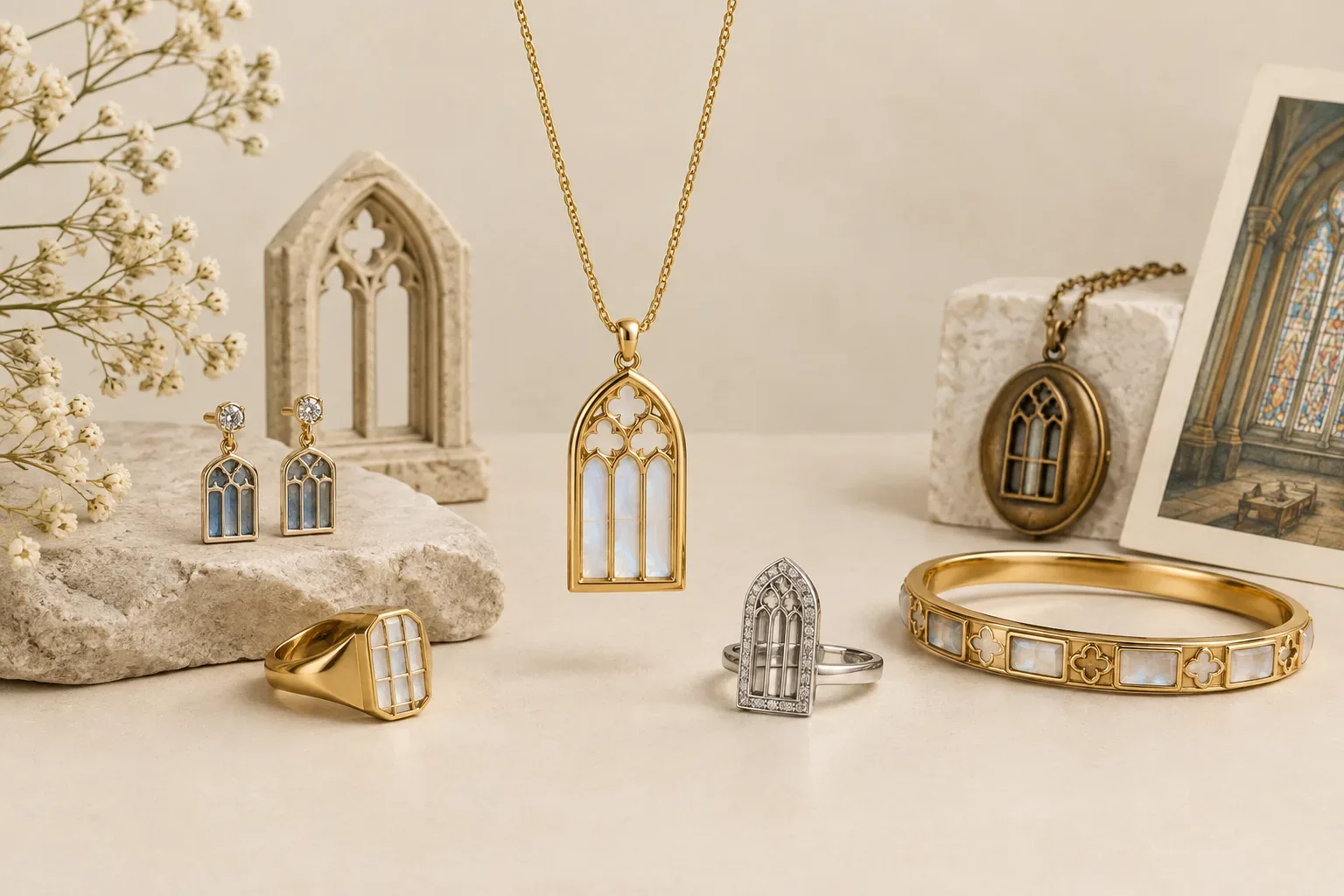
The motif appears in jewelry through a few repeatable design strategies that the V&A's writing on jewellery history documents. Openwork or pierced metal creates tracery-like patterns that visually mimic the stone frameworks of windows. Enamel—especially translucent and back-painted techniques—has been used to imitate the luminous effect of stained glass, often combined with gilding or foiling to enhance light play. Colored gemstones can act as ‘panes,’ with small sapphires, garnets, and topazes set into compartments to create a miniature, jewel-like window.
Closely related are lockets and miniature panels that incorporate small scenes or images behind glass, a family of objects the V&A frequently highlights when discussing how personal jewellery captured and refracted larger visual ideas. In revivalist pieces, the motifs tend to be stylised: simplified arches, quatrefoils, and repeating lobed patterns rather than literal reproductions of a particular stained-glass design. Contemporary makers extend these ideas with laser-cut metalwork, gem mosaics, and architectural silhouettes in pendant form.
Gemstones, treatments, and shopper protections
If color or stone is central to a window design, historical context and practical buying considerations both matter. The Victoria and Albert Museum’s materials on gemstones explain how different stones and colors have historically been associated with particular styles and aesthetic effects. When you encounter richly colored “pane-like” stones in a piece, a basic understanding of gemstone variety helps you judge whether those colors were chosen for aesthetic fidelity to stained glass or for other symbolic reasons.
Modern buyers should also be aware of treatments, enhancements, and imitations. The U.S. Federal Trade Commission advises that sellers disclose common treatments and imitations when selling gemstones so consumers can make informed choices. If you value natural, untreated stones or specific optical effects, ask sellers about treatments and request documentation or certification where appropriate. For historically informed reproductions, quality enamel work and hand-cut stones will make a greater visual and material match to period techniques.
Choosing and gifting window-motif jewelry: respectful, practical guidance
First, identify whether you or the intended recipient are attracted to the motif for aesthetic, historical, or spiritual reasons. If the piece references a sacred building’s imagery and the wearer is religious, consider whether wearing such imagery would be welcome and appropriate in their practice. If the interest is historical or architectural, seek makers who can explain the inspiration and techniques used.
Assess materials and craftsmanship. For an object meant to echo stained glass, look for translucency in enamel or small, well-matched colored stones rather than glued, mass-produced veneers. Check for hallmarks or maker’s marks and, when gemstones are central to the design, ask about any treatments or imitations as recommended by the FTC. For high-value purchases request a written description of treatments or certification.
For gifts, provide context. A short note explaining why you chose the motif—whether for its architectural beauty, its link to a specific place, or its personal symbolism—makes the gift less likely to be misinterpreted. Avoid presuming a single symbolic meaning; acknowledge that the recipient may interpret the piece differently. If the piece references a specific cathedral or religious emblem and you are unsure of the recipient’s views, a more neutral, decorative interpretation might be safer.
Finally, consider scale and wearability. Openwork pendants and brooches that reproduce tracery can be delicate; choose closures and settings suited to everyday wear if the recipient intends regular use. For collectors interested in historical accuracy, prioritize makers who use traditional enamelling and hand-setting techniques.
Care, conservation, and final considerations
Care for window-motif pieces as you would any jewelry that includes fragile surfaces: protect enamel from hard knocks, avoid chemical exposure for both metal and stones, and store openwork pendants flat or suspended to prevent distortion. The V&A’s broader guidance on historical jewellery conservation highlights the value of professional cleaning and the risks of amateur restoration; when in doubt, consult a conservator or trusted jeweller.
Remember that the meaning of a window motif on jewelry is often layered. Museum documentation explains historical contexts and techniques; modern wearers bring personal meanings. When choosing or gifting such a piece, balance respect for documented origins with sensitivity to contemporary beliefs and practical concerns about materials and care.
Frequently asked questions
Does a window motif always mean religious devotion?
No. Historically, window imagery could be religious in medieval contexts, but later uses—especially during the Gothic Revival—often signalled fashion, nostalgia, or aesthetic preference. Modern wearers may also adopt religious meanings personally, but that is not a universal or historically constant meaning.
How can I tell whether colored panes are genuine gemstones or imitations?
Ask the seller for disclosure about materials and treatments. The FTC advises that sellers should disclose common treatments and imitations. For valuable purchases, request certification or a written statement describing treatments and the gem’s origin.
Are stained-glass effects made only with gemstones?
No. Jewelers historically used translucent enamel, foiling, and glass as well as colored gemstones to achieve stained-glass effects. The V&A notes that enamel techniques have been used to imitate the luminous quality of stained glass in small-scale objects.
Is it appropriate to gift a cathedral-themed piece to someone of a different faith?
Consider intent and sensitivity. If the recipient values architecture or design, a cathedral-theme may be meaningful as an aesthetic gift. If the motif has explicit religious connotations and you are unsure of the recipient’s views, choose a more neutral architectural or decorative piece or explain your choice when giving the gift.
How should I care for an openwork or enameled window pendant?
Avoid harsh chemicals and strong impacts. Store enameled pieces separately to prevent abrasion, and have fragile or historically styled pieces cleaned and repaired by a professional jeweller or conservator when needed.
Sources and further reading
- Bedazzled: A History of Jewellery — Victoria and Albert Museum
- An A-Z of Gemstones — Victoria and Albert Museum
- Buying Gemstones, Diamonds, and Pearls — Federal Trade Commission