Meaning at a glance
Path jewelry meaning combines long-standing ideas of journey, movement, and life stages recorded in jewellery history with a wide range of modern, personal interpretations; this article separates museum-documented uses and periods from contemporary symbolic readings and gives practical buying and gifting advice.
Quick answer
Historically, jewellery has used motifs evoking journeys, movement, and transition—ideas that museums document across many periods—but the specific meaning of a 'path' motif is often modern and personal rather than a single, universal symbol. This article explains the documented historical contexts for movement-related motifs in jewelry as recorded by the Victoria and Albert Museum, distinguishes those documented uses from later popular interpretations, describes how the motif and gemstones appear in pieces, and offers practical guidance for choosing or gifting path-themed jewelry.
What the historical record shows
The Victoria and Albert Museum catalogues and exhibitions on jewellery history emphasize that decorative motifs change with social context, fashion, and meaning. Objects in museum collections demonstrate that visual themes evoking travel, pilgrimage, stages of life and movement recur across many periods, including ancient, medieval, Renaissance, Georgian, Victorian and modern eras. The V&A's materials highlight how makers and wearers repurposed motifs to signal status, memory, religious devotion or social role rather than to encode a single, immutable message.
Because the term 'path motif' is a modern shorthand, surviving historical pieces rarely label themselves 'path jewelry'. Instead, museums point to a range of motifs that historically referenced journeys and movement: examples include pilgrimage badges and charms that marked religious travel, tokens and keepsakes referencing life passages, and decorative elements such as winding vines, serpentine lines, or ship imagery that suggested movement or progress. The V&A frames these motifs in terms of changing social uses rather than as evidence of a single symbolic vocabulary across cultures and centuries.
Where jewellery was explicitly tied to religious pilgrimage or travel—such as badges or amulets worn by pilgrims—the object frequently served a documentable social function, confirming the wearer’s journey or devotion. Museum records distinguish those documented ritual or commemorative uses from later fashion-driven or sentimental uses of similar motifs.
Separate documented historical meanings from modern interpretations
Documented historical meanings come from object records, provenance and contemporary accounts preserved in museum collections. The V&A’s work on jewellery stresses that an artifact’s original purpose and meaning usually rests in those primary records: whether the piece was commissioned as a memento of pilgrimage, given as a token of marital fidelity, or worn as a status item. Where such evidence exists, it is the best basis for historical interpretation.
Modern interpretations of a 'path' or 'journey' motif are often personal, poetic, or marketed by designers as symbolic of inner growth, life changes, recovery, or career progression. These contemporary meanings are valid as personal symbolism but should not be conflated with documented historical uses unless there is evidence that a particular culture or period used the motif in the same way. In other words, a modern pendant shaped like a winding road can carry a meaningful narrative chosen by the wearer or maker, but that does not prove the motif had the same connotation in earlier periods.
How the path motif and related motifs appear in jewellery
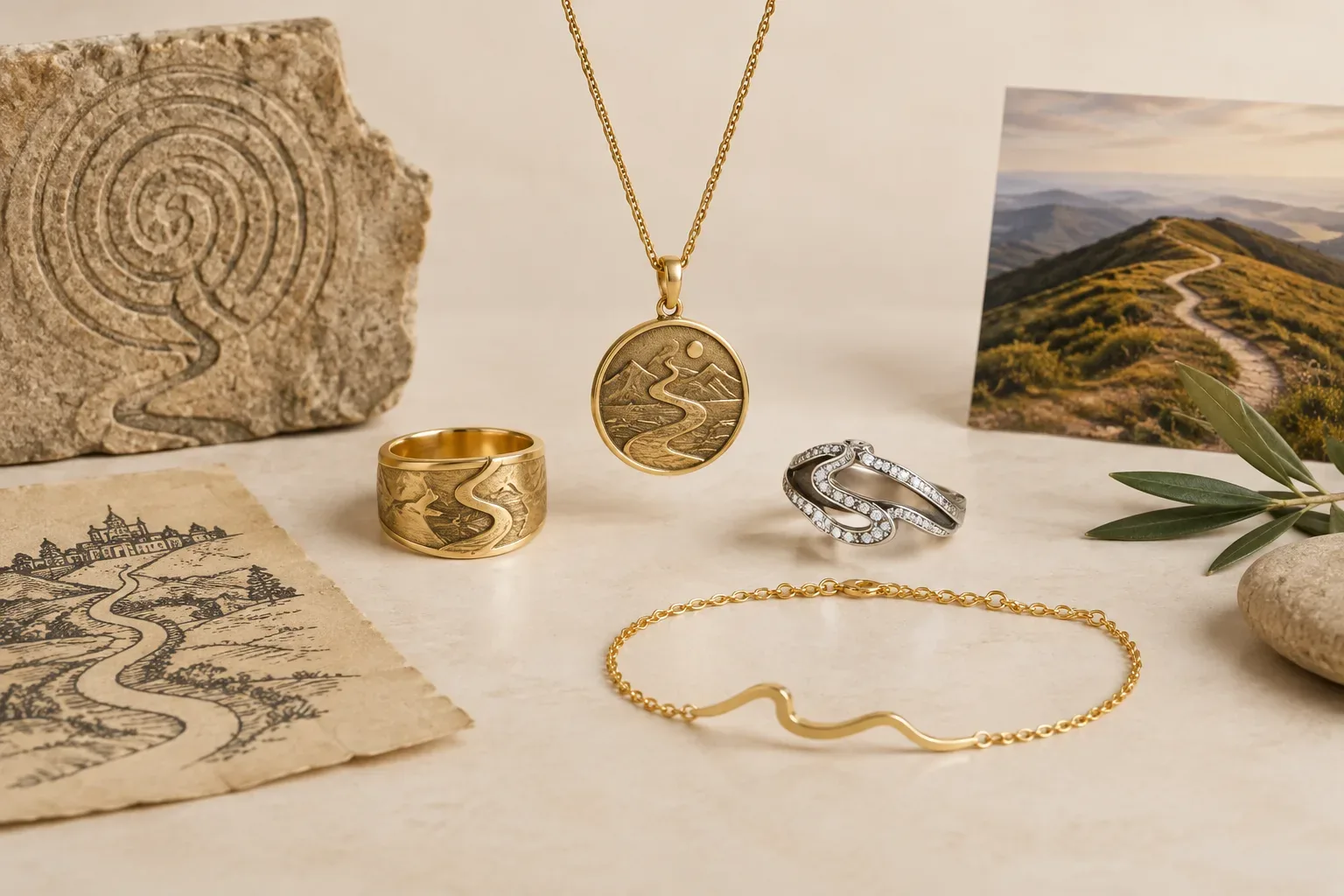
The motif of a path appears in jewellery in a variety of visual forms. Designers may use literal representations such as engraved or enamelled winding roads, footprints or stepping stones, or they may suggest a journey through more abstract devices: serpentine lines, meandering filigree, linked segments, or a progression of gems that move in size or color along a chain. Museum collections discussed by the V&A include pieces where motion is implied by composition rather than a literal depiction, such as graduated gemstones or cascading forms that lead the eye along a visual 'path'.
Gemstones are another way makers signal stages or transitions. Historical manuals and museum writing collected by the V&A show that gem choice often combined aesthetics and social meaning. In contemporary pieces, designers might place stones in sequence to symbolize stages of life, use a single stone as a milestone marker, or choose colors that align with personal narratives. For readers buying gemstones, the Federal Trade Commission provides guidance about disclosure of treatments, enhancements, and imitations, which is important when selecting stones for symbolic jewelry.
Designs and techniques to look for
If you are seeking a piece that conveys 'path' or 'journey', look for designs that guide the eye or the hand: linear compositions, graduated or sequenced stones, repeated motifs that suggest footsteps, or enamelled bands with directional patterns. Filigree, cloisonné, and engraved channels can create flowing lines that read as movement. Museum labels reported by the V&A show that makers have long used these technical approaches to imply motion or progression in a discrete and wearable form.
Consider also the object's construction and provenance. Historical pieces with documented links to pilgrimage or commemoration are best understood through their collection records. For contemporary makers, examine the design statement or artist notes to know whether a motif was intended as a narrative device or simply as decoration.
Practical and respectful selection or gifting guidance
Begin by clarifying why you want a path motif. Are you marking a literal journey, celebrating personal growth, offering support during transition, or choosing an aesthetic you find pleasing? A clear intention will guide metal, stone, and style choices and help you communicate the meaning when gifting. If the recipient values documented provenance, select a piece with clear maker notes or an established design narrative. If they prefer personal meaning, a bespoke or customizable piece may be best.
When buying gemstones or vintage pieces, follow the Federal Trade Commission’s consumer guidance: ask for written information about any treatments, enhancements, or imitations, and request reliable identification if the piece is being represented as a particular gem. This protects both buyer and recipient and respects the object's material history.
Be mindful of cultural or religious symbols that might look like a 'path' but have distinct communal meanings. If a motif is tied to a specific religious practice or cultural rite in its original context, treat that origin with respect. If you are unsure of a symbol’s cultural significance, consult the seller, the maker, or reference material, or choose a clearly contemporary design that intentionally repurposes the motif with the wearer’s consent.
For commemorative gifts, consider how the piece will wear over time. Simple, sturdy constructions hold up better to daily wear, while intricate, historically inspired pieces may be best kept as occasional or ceremonial jewelry. If you commission a custom piece, discuss repairability and the use of responsibly sourced materials with the maker.
Care, authentication and resale considerations
If your path-themed piece includes treated or fragile gemstones, follow care advice for that material. The V&A’s resources on gemstones help identify common stones and their properties, which can inform care and cleaning. For any significant purchase, obtain documentation about treatments and ask for a written appraisal if you expect future resale or insurance needs.
Museum and consumer guidance emphasize transparency: sellers should disclose treatments, composites, and imitations. If a piece is advertised as historic or culturally specific, request provenance or a condition report. Clear documentation preserves both value and the story you intend to honor when wearing or gifting the item.
Putting meaning into practice
Wearing a path motif need not be a literal statement. Many wearers choose the motif as a private reminder of resilience, a career milestone, recovery, or a long-term relationship. When gifting, a short note that explains your intended meaning gives the recipient context and preserves the emotional value of the gift. If the recipient prefers open symbolism, allow them to define the motif’s meaning for themselves.
If you want to learn more about symbol research before buying or gifting, consult resources that help you investigate design origins and meanings. Our related guides on Symbols, how to choose meaningful jewelry, and the history of lockets provide practical next steps for research and selection.
Frequently asked questions
Does the path motif have a single historical meaning?
No. Museums such as the Victoria and Albert Museum show that motifs suggesting journeys or movement have been used for different purposes—pilgrimage badges, commemorative tokens, fashion statements—so there is no single historical meaning that applies across cultures and periods.
Can modern path jewelry be given as a meaningful gift?
Yes. Modern path jewelry is commonly used to mark transitions or personal journeys, and these contemporary meanings are meaningful when chosen and explained with intention. If the recipient values provenance, choose a piece with clear maker notes or a custom design that reflects the intended meaning.
How should I verify a gemstone used in path-themed jewelry?
Follow the Federal Trade Commission’s guidance: ask the seller for written disclosure of any treatments, enhancements or imitations, and request gem identification documentation if the gemstone’s identity affects value or meaning.
Are there cultural sensitivities to consider when choosing path motifs?
Yes. Some motifs that suggest movement may be part of religious or cultural practices. If a design appears linked to a specific culture or religion, research its origin or consult the seller before gifting to avoid appropriation or disrespect.
What design elements best express the idea of a journey in a piece of jewelry?
Compositional devices that imply movement—such as graduated stones, linear chains, repeating elements that suggest steps, or meandering filigree—tend to read as a journey. The V&A’s jewellery studies show makers historically used both literal and abstract devices to suggest motion.
Should I prioritize durability or symbolism when buying everyday path jewelry?
Balance both. If the piece is intended for daily wear, prioritize sturdy construction and secure settings while retaining the symbolic elements you value. Discuss repairability and material properties with the maker or seller so the piece remains wearable and meaningful over time.
Sources and further reading
- Bedazzled: A History of Jewellery — Victoria and Albert Museum
- An A-Z of Gemstones — Victoria and Albert Museum
- Buying Gemstones, Diamonds, and Pearls — Federal Trade Commission