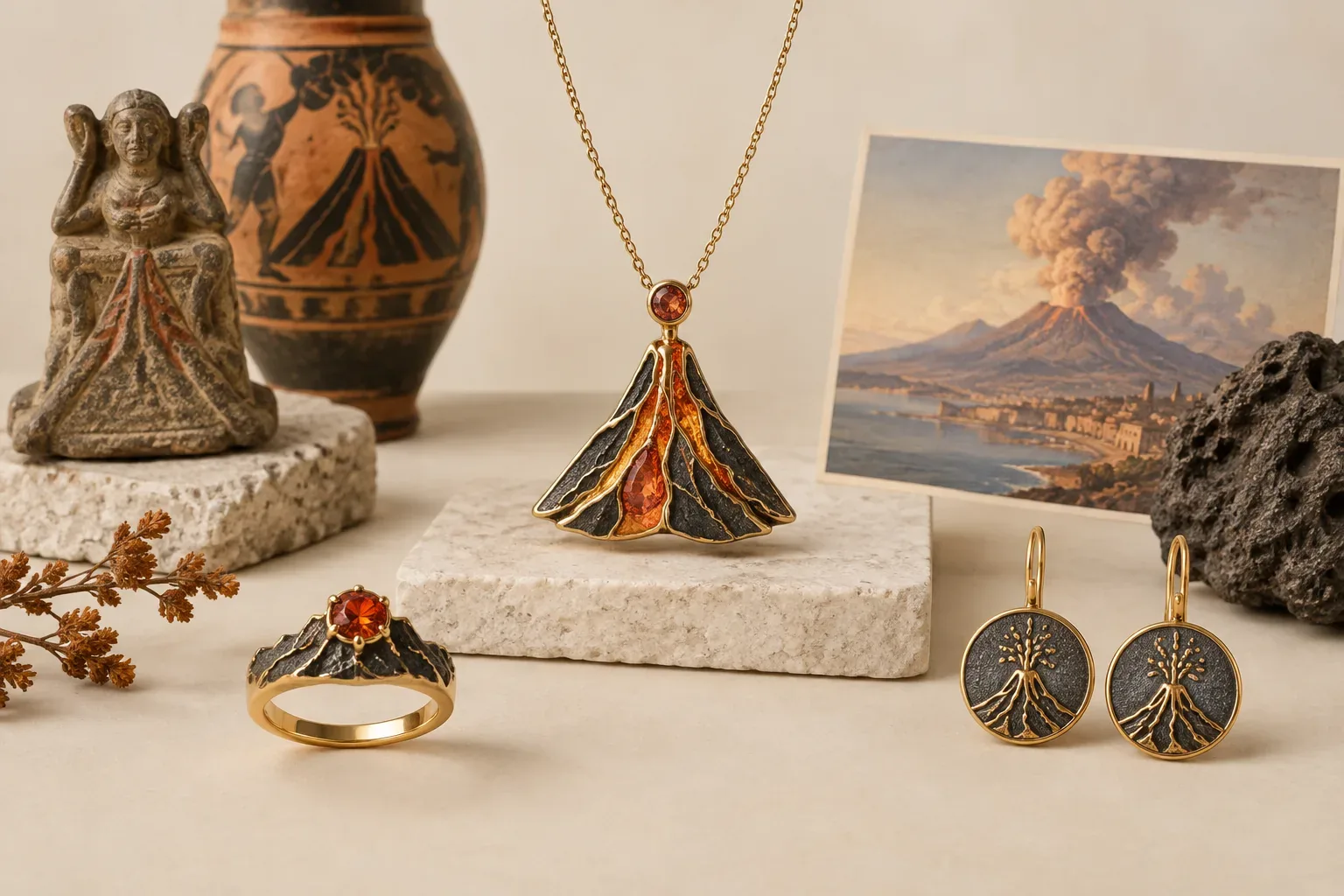
Meaning at a glance
Documented connections between volcanic materials and jewelry are primarily material and regional (for example, historic use of obsidian); later cultural meanings—renewal, destruction, creation—are largely modern or localized. Choose pieces with clear material disclosure, respect cultural contexts, and match symbolism to the wearer’s intention.
Direct answer — concise thesis
Volcano jewelry meaning is best explained as a combination of documented material history and later, chiefly personal and popular symbolism: museums and gem guides show that volcanic materials such as obsidian have been used for tools and ornament, while modern jewelers and wearers commonly attach symbolic ideas of fire, transformation, and origin to volcano motifs. This article separates what is documented in the historical record from contemporary interpretations and gives practical guidance for choosing and gifting volcano-themed jewelry.
What the historical record actually documents
When we look for historical evidence, the strongest, most verifiable material link between volcanism and jewelry is the use of volcanic substances themselves. The Victoria and Albert Museum’s overview of gemstones and their histories explains how certain materials that are volcanic in origin—most notably obsidian—appear in archaeological and museum collections as worked material for ornament and tools. Obsidian, a natural volcanic glass, was prized for its sharpness and reflective surface and was sometimes polished or shaped for personal adornment rather than purely utilitarian use.
Beyond the material evidence, authoritative museum treatments of jewelry history emphasize how meanings attached to materials and motifs change with time and place. The Victoria and Albert Museum’s broader history of jewelry highlights that social context—status, trade networks, technological change, and fashion—helps determine why a material or motif becomes popular. That documentation shows that while volcanic materials appear in many cultures' material repertoires, specific symbolic meanings for volcano imagery are not consistently recorded across distinct historical societies in the museum literature.
Which cultures and periods are precisely documented, and which are not
Museum and gemstone reference sources make clear distinctions between material use and symbolic attribution. For example, the V&A records and curatorial summaries identify obsidian and other volcanic-derived materials in archaeological collections from different regions, often noting function and craftsmanship rather than a single shared religious meaning. Where a culture’s texts or ethnographic records explicitly tie volcanic features to religious or cosmological beliefs, those links belong to that culture’s documented corpus; however, the V&A’s general surveys do not present a single, widely attested ancient “volcano symbolism” that carried the same meaning across multiple, unrelated societies.
Put simply: the presence of volcanic material in jewelry is well documented in museum and gemstone literature, but precise cultural meanings need to be verified case by case from specialists in that culture’s archaeology or ethnography. The V&A’s publications emphasize the need to treat material evidence (what a necklace is made from) separately from inferred symbolic meanings unless primary textual or ethnographic sources support a specific interpretation.
Historical meanings versus modern interpretations
Documented historical meanings: Where museum records or archaeological reports provide explicit evidence, meanings are tied to context. A polished piece of obsidian used as a pendant might be documented as a trade item or status object in one context and as part of ritual kit in another. The V&A’s work on jewelry history shows that scholars prefer to anchor symbolic claims in texts, inscriptions, or reliable ethnography rather than infer universal symbolism from material use alone.
Modern interpretations: In contrast, many of the symbolic associations now attached to volcano imagery—ideas of inner fire, creation from destruction, rebirth after eruption, or raw elemental power—largely reflect contemporary aesthetic and emotional readings. These are often shaped by modern storytelling, popular culture, and individual meaning-making rather than by a continuous historical tradition. It is entirely appropriate for modern wearers to adopt these meanings, but they should not be presented as universal historical facts. Museums like the V&A demonstrate how meanings evolve and how modern fashion can repurpose older materials and motifs for new symbolic uses.
How the volcano motif and volcanic materials appear in jewelry
Design motifs referencing volcanoes appear in two distinct ways: as literal visual motifs of mountains, craters, or flowing lava in metalwork and enamel, and as the use of volcanic-origin materials such as obsidian and pumice. Contemporary designers may render a volcano’s outline in a pendant, sculpt a flowing-lava texture in precious metal, or incorporate volcanic rock beads for their tactile, matte black surfaces.
Materials of volcanic origin commonly used in jewelry include obsidian (volcanic glass) and various forms of cooled volcanic rock such as basalt or pumice. The V&A’s A–Z of gemstones discusses identification and historical contexts for many materials and helps distinguish naturally occurring volcanic gems from treated or simulated stones. In modern commercial jewelry, makers may also use heat-treated or dyed stones to evoke lava colors; the U.S. Federal Trade Commission advises that sellers disclose treatments, enhancements, and imitations so buyers understand what they are purchasing.
Practical guidance for choosing or gifting volcano-themed jewelry
Start by deciding whether you value material authenticity, symbolic design, or both. If the material matters to you or the recipient, ask the seller whether a black bead is natural obsidian, a basalt bead, dyed howlite, or an imitation. The Federal Trade Commission’s consumer guidance on buying gemstones and pearls stresses that sellers should disclose treatments, enhancements, and whether a stone is natural or synthetic. Request that information before purchase so you know what you are buying and can judge its durability and care needs.
Be culturally respectful. If a piece explicitly reproduces a motif that a living community regards as sacred or proprietary, pause to research or ask directly about its cultural significance. Treat gifts that reference natural or spiritual themes thoughtfully: ask whether the recipient prefers symbolic meanings (for example, rebirth or resilience) or purely aesthetic pieces. For an heirloom feeling, choose well-made metalwork and secure settings; for a casual, earthy piece, porous lava beads and matte volcanic stones suit everyday wear but will require different cleaning than polished gemstones.
Consider longevity and care. Volcanic glass like obsidian is hard but brittle and can chip if dropped; porous lava rock can absorb oils and may darken with wear. If you want a piece that withstands daily wear, choose sturdy settings and confirm stone hardness and treatments with the seller. If you prioritize symbolic impact, a stylized volcano pendant in gold or silver can communicate a chosen meaning without relying on fragile materials.
Finally, for gifting, pair the object with an explanation of the intended meaning if that interpretation is important. That both clarifies your intention and avoids presenting a modern, personal symbolism as an ancient or cross-cultural fact. If you want to learn more about selecting meaningful pieces generally, see our related guide on How to Choose Meaningful Jewelry: A Practical Gift Guide.
Summary and responsible interpretation
The most defensible historical claims about volcano jewelry meaning come from the material record: volcanic substances such as obsidian have long been used in ornament, and museum scholarship treats those facts separately from claims about symbolism. Contemporary readings that link volcano imagery to themes of destruction and renewal are valid as modern personal or cultural interpretations but are not the same as a single documented historical meaning shared by multiple ancient cultures. Use museum resources and seller disclosures to verify materials and context, and be considerate when adopting or gifting motifs that might have special meaning to living communities.
Frequently asked questions
Is obsidian the same as 'volcano jewelry'?
Obsidian is a volcanic glass that has been used historically for both tools and ornament, so jewelry made from obsidian is one clear material example of volcanic-origin jewellery; however, "volcano jewelry" more broadly can refer either to pieces that use volcanic materials or to designs that evoke volcano imagery.
Were volcano motifs used with the same meaning in ancient cultures?
No single, universal meaning for volcano motifs is documented across ancient cultures in the museum literature; the Victoria and Albert Museum cautions that meanings depend on local context and should be verified with culture-specific sources.
How can I tell if a volcanic-looking bead is genuine?
Ask the seller for material information and any certificates; the Federal Trade Commission recommends that sellers disclose treatments, enhancements, and whether a stone is natural or synthetic so buyers can verify authenticity and care needs.
Is it disrespectful to wear a volcano symbol from another culture?
It can be, depending on how that motif is regarded by the living community. Research the motif’s cultural significance first, and if the design is explicitly sacred or ceremonial, consider choosing an alternative or seeking permission from community representatives.
What jewelry styles best express volcano symbolism without using volcanic materials?
Stylized pendants that depict a crater, flowing lines that suggest lava, and metalwork textures that mimic cooled lava are durable ways to carry volcano symbolism while avoiding fragile or culturally sensitive materials.
Sources and further reading
- Bedazzled: A History of Jewellery — Victoria and Albert Museum
- An A-Z of Gemstones — Victoria and Albert Museum
- Buying Gemstones, Diamonds, and Pearls — Federal Trade Commission