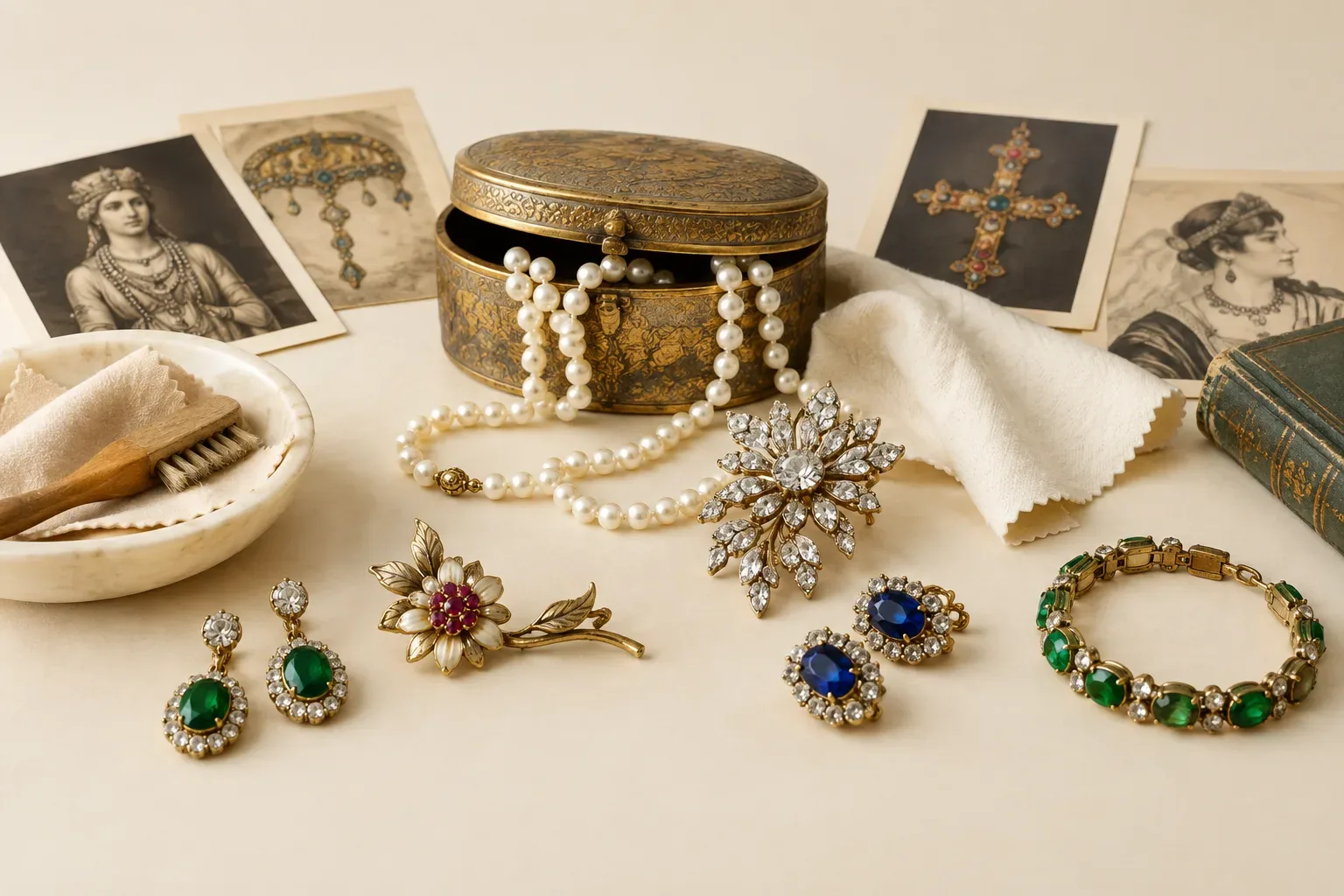
Meaning at a glance
Treat vintage costume jewelry gently: document its materials and condition, clean with mild, non-abrasive methods, avoid soaking or harsh chemicals, store pieces separately in low-humidity, padded environments, and research historical meanings through museum sources before gifting or repurposing.
Direct answer — what to do and why
For vintage costume jewelry cleaning and storage, the concise approach is to identify the materials and condition first, use only gentle, non-abrasive cleaning (soft cloths, very mild soap and water applied carefully), avoid prolonged soaking or ultrasonic cleaners, keep pieces dry and separated in padded, low-humidity storage, and document provenance and any repairs before you gift or wear the item. Museums and consumer guidance emphasize that many vintage pieces were made with plated metals, glue-set glass, and imitations that are more vulnerable than fine jewelry, so gentleness and documentation should guide every intervention.
What we mean by vintage costume jewelry and why its materials matter
“Costume” or fashion jewelry generally refers to pieces made to look like fine jewelry but using non-precious metals, plated finishes, glass paste, early plastics, and imitation gemstones. Because these materials and the adhesives used to assemble them age differently than solid precious metals and gemstones, they respond poorly to aggressive cleaning and common restoration techniques used for fine jewelry.
Understanding what a piece is made from — base metal, plating, paste stones, faux pearls, rhinestone glue settings, or Bakelite and early plastics — determines safe cleaning and storage choices. The Victoria and Albert Museum's general history and gemstone resources make clear that different materials and manufacturing methods have distinct vulnerabilities, so identification is the first and most important step.
Documented historical evidence and precise periods
Museum histories place costume jewelry within a long change of social and technological contexts. The Victoria and Albert Museum’s overview notes that jewellery forms and materials evolve with fashion, available technology, and social meaning, tracing continuity from ancient through medieval and modern periods and highlighting changes in the 18th, 19th and 20th centuries that made imitation gems and mass-produced ornament more common.
In practice that means costume techniques became widespread in the late 19th and especially 20th centuries, when glass paste, electroplating and new plastics allowed makers to mimic precious materials affordably. The V&A’s resources on gemstones and jewellery history help identify when certain materials and motifs are likely to have been introduced or popularized, so consult museum catalogues or exhibition notes when you need precise cultural or period attribution.
Clear separation: documented historical meanings versus later or personal interpretations
When discussing symbolism, keep museum-documented meanings and later personal or popular interpretations distinct. Museums like the V&A document certain historical uses — for example, that sentimental lockets or memorial motifs carried explicit meanings in particular times and places — and they place motifs in social and technological contexts rather than treating them as timeless facts.
Modern wearers often project new meanings onto vintage pieces. A brooch once worn as a mourning symbol in a specific 19th-century context may be adopted today as a purely decorative or personal-symbolic item. Both approaches are valid for personal wear, but they are different kinds of knowledge: the museum record establishes historical context, while contemporary significance is a matter of individual or cultural reinterpretation.
How motifs, gemstones and traditions appear in costume pieces
Costume jewelry often borrows the same motifs as fine jewellery — bows, flowers, animals, lockets, and geometric forms — but executes them with imitation stones and cheaper metalwork. The V&A’s materials on gemstones explain how glass paste, early rhinestones and simulated pearls were used to imitate more expensive gems, so similar visual vocabulary can span both fine and costume objects.
Traditions such as mourning jewellery, sentimental lockets, or fashion-driven motifs appear across price levels but with different materials and techniques. Identifying whether a motif is part of a historical tradition or a fashion revival requires looking at construction, hallmarks, and materials; museum descriptions and gemstone guides can help confirm whether a stone is natural, treated, or synthetic, and whether a piece’s construction matches the period it’s attributed to.
Safe cleaning methods — what to do (and what to avoid)
Begin with identification and documentation: photograph the piece, note any maker’s marks, and test a hidden area visually for plating wear or loose settings. For routine surface cleaning, use a soft, lint-free cloth and, if needed, a tiny amount of mild soap diluted in water. Dampen the cloth rather than immersing the item, and avoid scrubbing on glued settings or delicate enamels.
Avoid ultrasonic cleaners, steam, commercial jewelry dips, and strong solvents on vintage costume items because these can dislodge glued stones, strip plating, damage early plastics or remove enamel. Do not soak pieces for any length of time, and do not use abrasive polishes or brushes that will wear away plating or scratch glass paste. If a piece needs deeper repair, consult a conservator or a jeweller experienced with vintage costume materials rather than attempting aggressive home restoration.
Storage: respectful, practical approaches and common mistakes
Store vintage costume jewelry in a dry, stable environment away from direct sunlight and dramatic temperature changes. Wrap or pad pieces individually in soft, breathable fabric to prevent scratching and metal-to-metal contact; avoid plastic bags for long-term storage because some plastics can emit chemicals that degrade plating and coatings over time.
Keep humidity moderate and avoid storing items in bathrooms or other damp places where plating can corrode and glue can weaken. Check items periodically for signs of verdigris, active corrosion, or loose stones. A common mistake is stacking jewelry together in a single compartment, which leads to abrasion, entanglement, and accelerated wear of delicate finishes.
Selection, gifting and respectful handling
When choosing vintage costume jewelry to wear or to gift, consider condition, authenticity, and the recipient’s preferences. Condition matters: well-preserved pieces with original finishes are often more desirable and more fragile, so communicate care needs if you give such an item. If provenance or age is important to you, consult museum resources or reputable sellers and keep documentation of any restoration work.
Be mindful of motifs and cultural meanings. Museums help identify historical meanings and origins, so research any symbol or tradition before assuming it is merely decorative. If a motif is associated with religious or cultural practices in a documented way, exercise sensitivity when wearing or gifting it and prefer pieces whose provenance and context you understand. For practical advice on choosing meaningful jewelry, see our related gift guide.
When to seek professional help
If a piece has structural damage, loose stones, crumbling adhesives, or needs re-plating, consult a conservator or a jeweller who specializes in vintage costume pieces. Professional conservators can stabilize fragile materials without removing historical finishes, and experienced restorers will advise whether intervention is reversible or appropriate.
For identification and disclosure questions about gemstones or reproductions, the Federal Trade Commission provides guidance about imitations and labeling, which is useful when evaluating whether a stone is natural, treated, or simulated and when documenting the item for sale or insurance purposes.
Final notes and quick stewardship principles
Treat vintage costume jewelry as objects with historical and material fragility: document, identify, clean gently, store separately, and consult professionals for repairs. Use museum resources for historical context and the FTC’s guidance when questions about imitation materials or disclosure arise. With respectful care, vintage costume pieces can be enjoyed and passed on while retaining as much original material and meaning as possible.
Frequently asked questions
What household cleaner is safe for vintage costume jewelry?
Use a soft, lint-free cloth and, if needed, a tiny amount of very mild soap diluted in water applied with a dampened cloth; avoid soaking the piece, ultrasonic cleaners, steam, commercial dips, and solvents because they can damage plating, adhesives, early plastics, and glued stones.
Can vintage costume jewelry get wet?
Limit exposure to water. Brief contact from a damp cloth to clean is acceptable, but do not soak costume pieces and avoid wearing them in the shower, pool, or while swimming because moisture can corrode metal, weaken glue, and damage finishes.
How should I store multiple pieces together?
Store items separately in padded, breathable fabric or compartmentalized boxes to prevent abrasion and tangling; avoid stacking pieces together in a single compartment and do not rely on sealed plastic bags for long-term storage because some plastics can off-gas and harm finishes.
How can I tell if a stone is a simulated gem or natural?
Preliminary visual identification is possible by looking at facets, mounting quality, and wear, but for firm conclusions consult reference materials such as museum gemstone guides or a qualified appraiser; the Federal Trade Commission provides guidance on disclosure and identification of imitations that is useful when buying or selling.
Is it okay to re-plate or restore a vintage costume piece?
Minor conservation to stabilize a piece can be appropriate, but full re-plating or aggressive restoration may remove original material and reduce historical value; seek a conservator or specialist who understands reversible methods and document any interventions before gifting or reselling.
What are the most common cleaning mistakes to avoid?
The biggest mistakes are soaking pieces, using harsh chemicals or abrasive tools, ultrasonic cleaning, and failing to separate delicate pieces during storage — each can strip plating, loosen glued settings, scratch glass paste, or damage early plastics.
Sources and further reading
- Bedazzled: A History of Jewellery — Victoria and Albert Museum
- An A-Z of Gemstones — Victoria and Albert Museum
- Buying Gemstones, Diamonds, and Pearls — Federal Trade Commission