Meaning at a glance
Document the documented history and changing contexts of antique jewelry repair and maintenance, separate cultural or religious evidence from later popular interpretations, and give practical guidance for choosing, preserving, and wearing antique pieces.
What the historical record shows
Museum records trace the technical and social history of personal adornment across many cultures and periods. The Victoria and Albert Museum presents jewelry as a material culture that evolves with technology, taste, and social use, highlighting examples from ancient Egypt, classical Greece and Rome, Byzantine and medieval Europe, and later movements such as the Georgian, Victorian, Art Nouveau, and Art Deco periods. These institutional narratives focus on construction techniques, materials, and changing social contexts rather than offering a single, uniform meaning for all pieces (Victoria and Albert Museum).
Archaeological and curatorial evidence demonstrates that repair and maintenance were practical necessities long before modern conservatorship. Historical repair marks and re-mounted stones in museum collections show that owners and craftsmen reworked items to suit changing fashions or to prolong use. The V&A materials and displays underscore these shifts in technique and style and how they affect how we interpret and care for surviving pieces today (Victoria and Albert Museum).
Equally important is the long record of gemstone use and trade. The Victoria and Albert Museum's A–Z of Gemstones gives historical context for materials such as pearls, garnets, emeralds, diamonds, and glass imitations, noting that selections and treatments varied by period and region. Understanding a stone's historical use informs both conservation choices and expectations about durability and past treatments (Victoria and Albert Museum).
Documented historical meanings versus modern personal interpretations
When museums describe a historical object's use or symbolism, they rely on contemporary records, iconography, and surviving examples. For instance, curators use inventories, portraits, and writings to link certain forms—such as lockets or mourning rings—to particular social practices in specific periods. The V&A materials emphasize context: how and why an object was worn in a given society, not a single universal symbolism (Victoria and Albert Museum).
Modern owners and wearers frequently layer personal meanings onto antique pieces. A Victorian brooch once made for mourning may now be worn as a family heirloom or a fashion statement. These contemporary interpretations are valid on an individual level but should be clearly distinguished from documented historical use. Respectful stewardship means preserving whatever physical evidence exists of the object's original use while acknowledging that meaning can change over time.
How motifs, gemstones, and traditions appear in antique jewelry
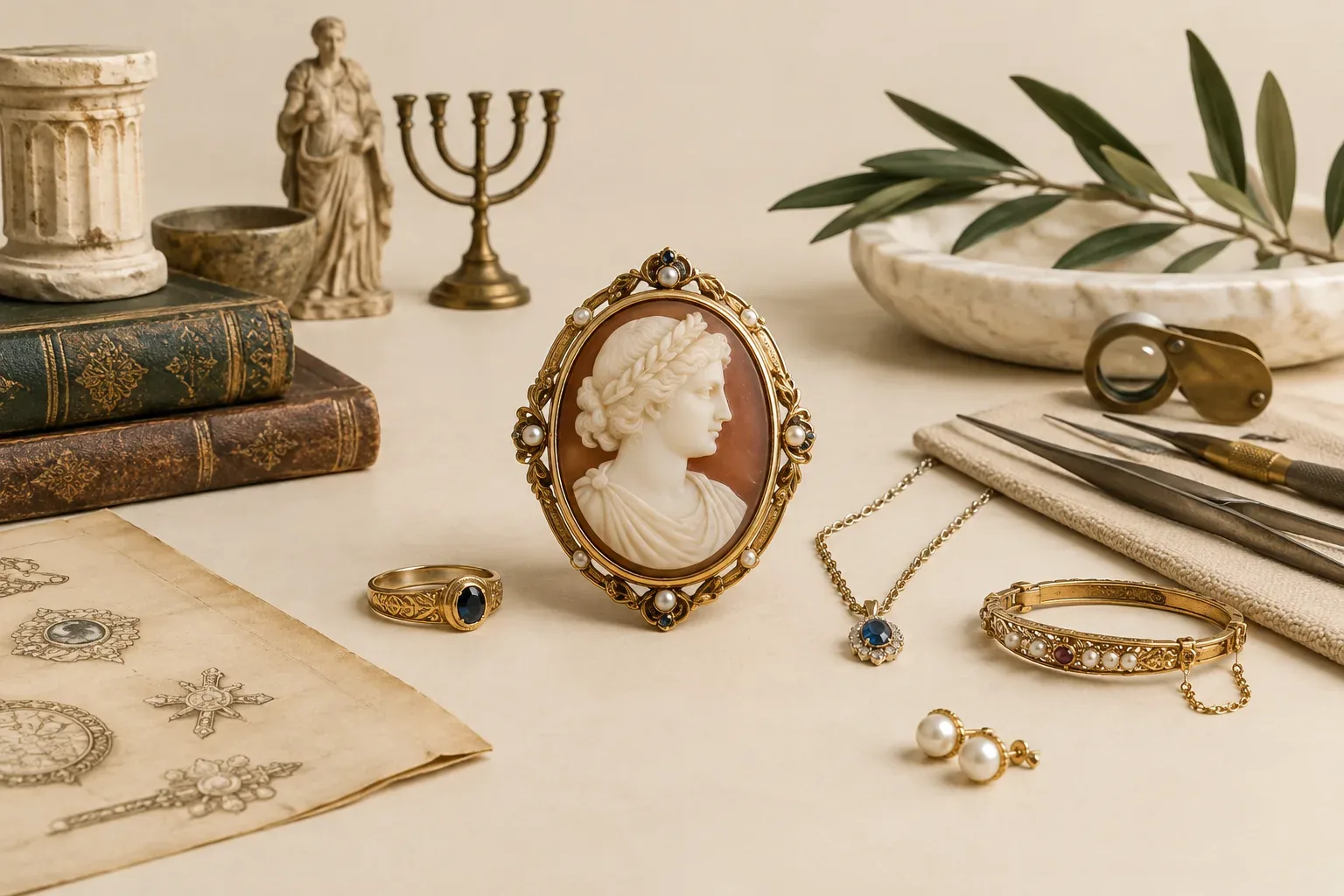
Motifs and modes of wear vary by period and region. In many European collections catalogued by museums, floral and naturalistic designs dominate the Art Nouveau period, geometric patterns characterize Art Deco, and sentimental motifs like hairwork, lockets, and portrait miniatures are common in Victorian items. The V&A treats these design patterns as markers of time and taste rather than as universal symbols (Victoria and Albert Museum).
Gemstones appear in antique jewelry both as structural elements and as indicators of trade and technology. Pearls and coral were prized in earlier periods for their organic luster, while diamonds and calibrated-cut stones became more prominent as cutting and setting techniques advanced. The V&A's gemstone overviews point out that historical pieces may contain materials that are now rare, treated, or imitated, and that those choices were often practical as well as aesthetic (Victoria and Albert Museum).
Traditional practices, such as the remounting of heirloom stones into contemporary settings or the reuse of gems across generations, show up in the physical evidence of many antique pieces. These interventions can be part of a piece's history and may complicate straightforward dating or attribution, a fact emphasized in museum documentation.
Warning signs that a piece needs repair or professional attention
Some problems are immediately obvious and merit prompt professional assessment. These include loose or missing stones, split or cracked settings, bent prongs, unstable clasps, visible hairline fractures in gemstones, and gaps in soldered joints. Even when a piece still wears, subtle instability in a mounting can lead to sudden loss of a stone.
Other indicators are less dramatic but still important. Discolored metal at joints can indicate corrosion or previous poor repairs. A change in how a ring sits on the finger or how a clasp engages may signal wear to the internal structure. Surface scratches, worn engraving, or a dull appearance from accumulated grime reduce both aesthetic and collectible value and sometimes hide more serious structural problems.
If an item has sentimental or historical value—such as a family heirloom, a piece with documented provenance, or a work by a known maker—err on the side of professional care. Museum practice treats such objects conservatively to preserve evidence, and a similar approach is prudent for private owners (Victoria and Albert Museum).
Choosing qualified professionals for antique jewelry repair
Not every jeweler has the training to work safely on antique pieces. Look for a conservator or a jeweler experienced with period techniques and materials. Ask about specific experience with the era or type of piece you own. Reputable professionals will describe their approach to preserving original elements and explain when they will intervene and when they will conserve.
Request a written estimate and a clear scope of work. For example, will the jeweler replicate old solder marks and patina or remove them? Will they use modern alloys or try to match historical materials? A professional who understands historical construction can advise on reversible techniques and on how repairs will affect both wearability and value.
Disclosure about treatments and imitations matters when buying or repairing gemstones. The Federal Trade Commission provides guidance on buying gemstones, diamonds, and pearls and on disclosing treatments and imitations, so ask your jeweler how they identify and document any enhancements before work begins (Federal Trade Commission).
Practical maintenance you can do at home, and what to avoid
Routine care reduces the need for major repairs. Clean pieces gently with a soft brush and mild soapy water, rinse well, and dry on a soft cloth. Store items separately to prevent abrasion and protect fragile settings from knocks. Periodic inspections under magnification help spot loose stones, thinning prongs, or corrosion early.
Avoid ultrasonic cleaners, steam cleaners, and abrasive polishes unless a professional has confirmed the piece is safe for those treatments. Some historical materials—soft stones, glued-in elements, or porous gems—are easily damaged by harsh cleaning. Similarly, avoid amateur soldering or reshaping; heat and force can fracture stones or value-bearing construction details.
Document the piece with clear photographs before any repair or major cleaning. This record preserves a visual history of condition and can be useful for later conservators, appraisals, or family records. Treat any inscriptions, hairwork, or fragile components as evidence of provenance; preserving them intact retains historical information.
Selection and gifting guidance: respectful and practical advice
When choosing an antique piece as a gift, consider both the aesthetic and the practical. Match the size and durability of the item to the recipient's lifestyle. A finely detailed brooch or a delicate ring may be ideal for occasional wear but not for daily use by someone who works with their hands. If the recipient intends to wear the piece regularly, prefer items with secure mountings and durable stones.
Communicate the piece's history and care needs. If you know the period or provenance, share that context and explain any limitations on cleaning or repair. A well-informed gift respects the object's past and signals thoughtfulness. For pieces with documented maker marks or provenance, keep and pass on accompanying paperwork or documentation.
If you plan to commission a repair before gifting, discuss conservation principles with the conservator or jeweler and obtain photographic documentation of the work. Make any interventions reversible where possible and avoid unnecessary modernization that erases historical character. For guidance on choosing meaningful jewelry more broadly, consult related resources that emphasize matching symbolism to the recipient and context (see internal links).
When to avoid DIY repairs
Avoid attempting prong tightening, re-tipping, stone setting, soldering, or metal reshaping without professional training. Even experienced hobbyists risk irreversible damage to fragile settings or stones. Home repairs can obscure evidence of age and provenance and may reduce market or sentimental value.
If you are unsure whether a cleaning method is safe, stop and seek advice. Conservators and qualified antique jewelers generally prefer minimal, documented intervention that stabilizes rather than replaces original work. This conservative approach is consistent with how museums care for objects of material culture (Victoria and Albert Museum).
Final considerations
Antique jewelry is both wearable art and a repository of personal and social history. Conservation-minded repair and regular maintenance extend an object's life and preserve the information it carries about technique, taste, and use. Use caution, favor professionals with documented experience, and keep clear records of condition and any work performed so future custodians can make informed decisions.
For more practical guides and related reading on meaningful jewelry, consider resources that cover selecting symbolic pieces, research methods for jewelry symbols, and histories of specific forms such as lockets. These will help you pair historic understanding with thoughtful modern use (see internal links).
Frequently asked questions
What are the first signs that antique jewelry needs repair?
Early signs include loose or shifting stones, bent prongs, a clasp that no longer engages securely, hairline cracks in stones, visible corrosion at joints, and changes in how the piece sits or balances. Any instability in a setting or sudden change in condition warrants professional inspection.
How often should I have antique jewelry inspected?
Inspect wearable antique pieces visually and by touch every few months and do a more careful check under magnification at least once a year. If you wear a piece regularly or during activities that stress settings, have a qualified jeweler or conservator examine it more frequently.
Can I clean antique jewelry at home?
You can perform gentle cleaning with a soft brush, mild soapy water, and a soft cloth for many hard-stone pieces and sturdy mountings. Avoid ultrasonic or steam cleaning and strong chemicals unless a professional has confirmed the piece is safe for those treatments, because some historical materials and adhesives are easily damaged.
How do I find a qualified professional for antique jewelry repair?
Seek a conservator or a jeweler with documented experience working with antiques and the relevant period techniques. Ask for references, examples of past work, a written estimate, and clarification about materials and methods. Professionals should explain whether proposed interventions are reversible and how they will affect the piece's appearance and value.
Do repairs affect the value of antique jewelry?
Thoughtful, well-documented repairs that preserve original materials and evidence of age generally maintain value better than invasive or poorly executed fixes. Unnecessarily modernizing or erasing historical features can reduce collectible and historical value, so opt for conservative, reversible approaches when possible.
Sources and further reading
- Bedazzled: A History of Jewellery — Victoria and Albert Museum
- An A-Z of Gemstones — Victoria and Albert Museum
- Buying Gemstones, Diamonds, and Pearls — Federal Trade Commission