Meaning at a glance
Explain the documented history and changing contexts of the victorian jewelry symbols motif, separate cultural or religious evidence from later popular interpretations, and give practical guidance for choosing and wearing the motif in modern jewelry.
What the historical evidence shows
The strongest sources for understanding Victorian jewelry symbols come from museum collections and scholarship that contextualize objects within fashions, technology, and social practices of the period. The Victoria and Albert Museum provides an interpretive framework connecting specific motifs and materials to nineteenth-century tastes, mourning practices, and advances in gem cutting and setting. Surviving pieces, period catalogs and trade literature, and a museum’s curatorial research together form the documented base for the meanings discussed below.
Because much of what we now call Victorian symbolism circulated through popular prints, catalogs, and shop displays, meanings were not fixed across all social groups. Evidence assembled by museums shows patterns—such as the use of lockets for memory or the popularity of certain gemstones for bridal or mourning jewelry—but it does not support a claim that a single interpretation applied universally to everyone in the period.
Common Victorian symbols and documented meanings
The serpent is one of the best-documented motifs of the era. Curators at the Victoria and Albert Museum identify serpents as a popular design motif in nineteenth-century jewelry, often associated with eternal love when used in engagement rings or brooches because of its circular form and ability to be adapted to rings and bracelets. This meaning is a documented nineteenth-century reading rather than a timeless fact about serpents.
Bows, ribbons, and floral motifs appear frequently in Victorian pieces. Museum interpretation links these designs to contemporary fashions and an emphasis on femininity and ornament, and they often signaled affection or beautification rather than a single codified message. Cameos and classical subjects draw on a revived interest in antiquity and were worn to display education, taste, or connection to classical ideals as documented by institutional collections.
Mourning symbols such as black enamel, jet, and hairwork are well attested in museum holdings and period sources. The Victoria and Albert Museum documents the use of jet and black enamel as part of mourning dress conventions, and the presence of woven hair or hair-filled lockets is recorded as an explicit memorial practice used to keep a physical trace of a deceased loved one. These materials and forms have a stronger documentary link to grief and remembrance than many other motifs.
Gemstones and materials in historical context
Victorian tastes in gemstones changed across the century and varied by occasion. The Victoria and Albert Museum’s resources on gemstones explain how availability, cutting techniques, and trade influenced which stones were fashionable. For example, garnet and turquoise feature in many nineteenth-century pieces because of aesthetic trends and supply networks rather than inherent symbolic power assigned in every context.
Understanding the historic use of materials helps separate documented practice from later symbolic attributions. A stone used frequently in bridal jewelry in the period might be read today as a traditional 'wedding stone' but the museum evidence emphasizes market and stylistic reasons for its use as much as any symbolic assignment.
Mourning, memory, and the difference between evidence and modern readings
Mourning jewelry practices in the nineteenth century are among the clearest examples where material evidence supports specific meanings. Items made of jet, lockets containing hair, and black-enamel pieces are documented as tied to mourning by museum collections. The Victoria and Albert Museum’s historical interpretation situates these items within social expectations about dress and remembrance.
Modern readings sometimes expand or shift those meanings. Contemporary wearers may adopt hairwork-inspired motifs for aesthetic reasons or interpret black enamel as a fashion statement rather than explicit mourning. Those modern uses are valid personal choices, but they should be distinguished from the practice documented by institutions that connect particular materials and forms with nineteenth-century grief and commemoration.
How these motifs and traditions appear in jewelry
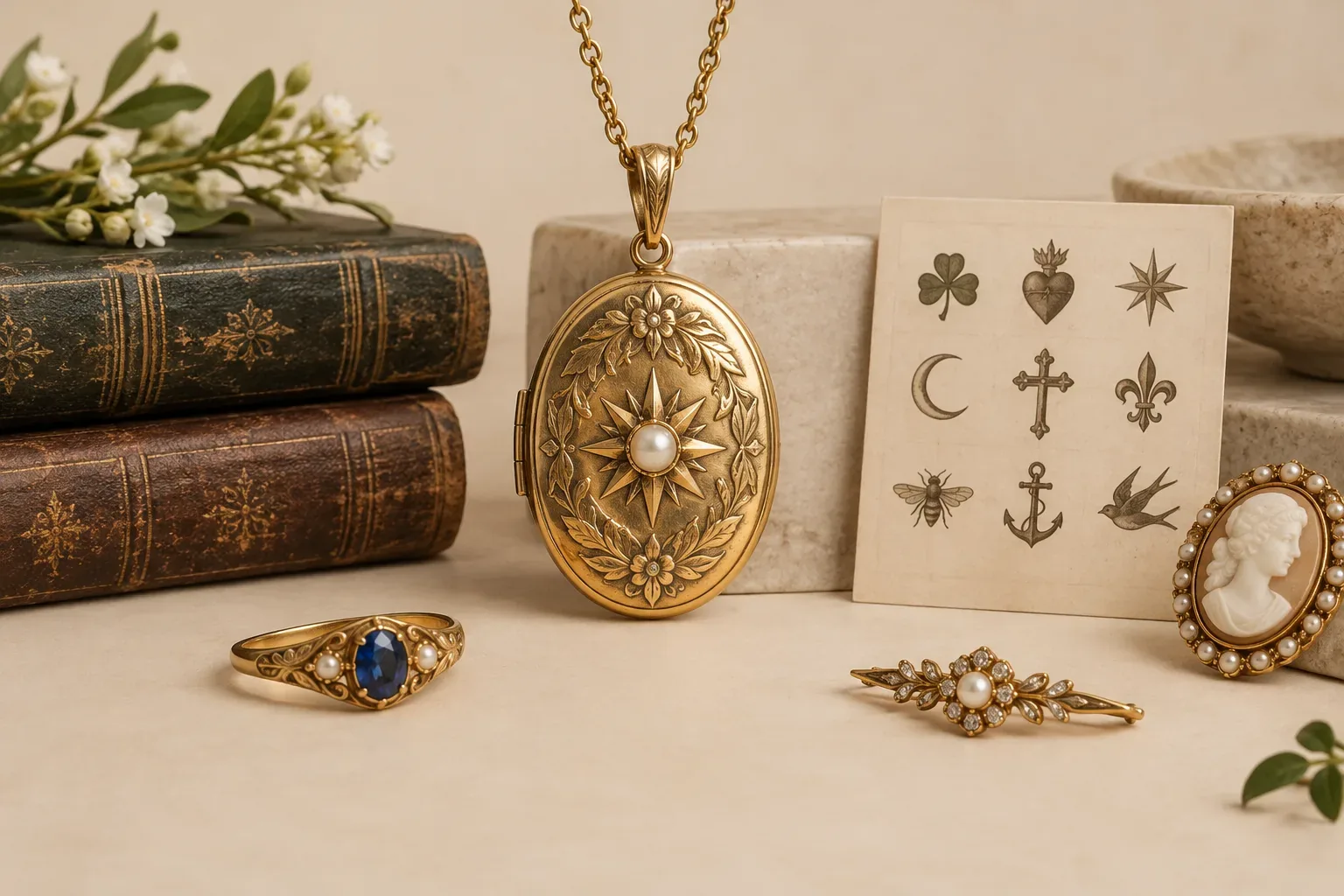
Victorian-symbol motifs appear in specific object types: engagement and posy rings, brooches, lockets, cameos, bracelets, and hairwork pieces are all common carriers of symbolic imagery in surviving collections. Lockets and portrait miniatures often functioned as intimate containers for images or hair, while brooches displayed motifs like serpents or bows more publicly on outer garments. Museums catalogue these forms and show how technique and scale influence meaning.
Techniques such as micro-engraving, enamel work, use of hair as a contained element, and sentimental inscriptions are characteristic ways symbolism was embedded in the object. The visual language of these techniques—color, texture, and the presence of a hidden compartment—contributed to how contemporaries read the object in a social context.
Separating documented historical meanings from modern personal interpretations
When evaluating a Victorian motif, first ask whether museums or period sources associate it with specific practice, such as mourning, marriage, or commemorative exchange. If a motif is documented in museum interpretation as connected to a social practice, that is a historically supported meaning. If the connection rests primarily on later folklore, commercial narratives, or modern fashion writing, treat it as a modern interpretation rather than a verified nineteenth-century fact.
Many motifs have both documented nineteenth-century associations and living contemporary meanings. For example, a serpent ring can be both an historically rooted engagement motif and a modern symbol of personal renewal or power depending on the wearer and context. Both readings can coexist, provided you acknowledge which is historical and which is modern personal significance.
Practical guidance for selecting or gifting Victorian-symbol jewelry today
Decide whether you want an authentic period piece, a reproduction, or a contemporary design inspired by Victorian motifs. If choosing an antique, consult reputable dealers or a museum’s documentation to confirm provenance and condition. The Victoria and Albert Museum’s discussions of jewelry history can help you understand why a particular motif or material was used, which informs authenticity and significance.
When purchasing gemstones, treatments, or imitations, follow consumer-protection advice about disclosure. The U.S. Federal Trade Commission provides guidance on how gemstones, diamonds, and pearls should be described by sellers and warns about treatments and imitations, so ask for clear information about whether a stone is treated, synthetic, or natural. Request written documentation when possible and be wary of sellers who refuse to discuss treatments or provenance.
If gifting with symbolic intent, explain the meaning you intend for the recipient. Victorian motifs will not carry the same automatic meaning today as they did in the nineteenth century, so a short note about why you chose a serpent, a locket, or a mourning-style piece helps preserve the intended sentiment while respecting historical context. For wearable practicality, choose sizes and mechanisms (clasps, pin mounts, locket hinges) suitable for modern daily use if that is the wearer’s preference.
Care, authenticity, and respectful use
Treat historical materials with appropriate conservation care: delicate hairwork, weak enamel, and fragile jet require careful handling and professional conservation if damaged. For reproductions, assess the maker’s materials and techniques to ensure long-term wearability.
Respect the original contexts when wearing or displaying pieces with explicit funerary or memorial functions. If a piece is documented as mourning jewelry and you plan to wear it in a casual or celebratory setting, consider whether that may unintentionally obscure its original social meaning. Conversely, wearing historically inspired motifs for new intentions is a legitimate personal choice provided the original practice is acknowledged and not misrepresented as universal.
Frequently asked questions
Are Victorian jewelry symbols universally meaningful today?
No. Museum evidence shows some motifs had commonly understood roles in the nineteenth century, such as mourning uses for black enamel and hairwork. Contemporary wearers often attach new personal meanings, so the symbolic value today depends on context and individual intention.
How can I tell if a piece is genuinely Victorian?
Authentication combines material, technique, provenance, and condition. Consult reputable dealers or museum documentation and ask for written provenance. Museum catalogs and curatorial notes are useful for comparison to documented nineteenth-century examples.
If I buy a Victorian-style piece, how should I find out what gemstones have been treated?
Ask the seller for full disclosure and any laboratory reports. The Federal Trade Commission advises buyers to request clear information about treatments, synthetics, and imitations and to seek written documentation where possible.
Is it appropriate to wear mourning jewelry if I am not in mourning?
Wearing a mourning-style piece for fashion or personal reasons is common today, but it is respectful to recognize the original context. If the piece is a specific memorial item containing personal mementos, consider whether wearing it publicly is appropriate.
What motifs commonly indicate sentiment or love in Victorian jewelry?
Museum research identifies motifs such as serpents (often used in rings), bows, and lockets as frequently associated with love and affection in nineteenth-century contexts, but meanings varied by region, class, and occasion.
Sources and further reading
- Bedazzled: A History of Jewellery — Victoria and Albert Museum
- An A-Z of Gemstones — Victoria and Albert Museum
- Buying Gemstones, Diamonds, and Pearls — Federal Trade Commission