Meaning at a glance
This article explains the documented history and evolving contexts of the Uranus planet motif in jewelry, distinguishes museum-supported historical meanings from later personal and astrological interpretations, describes how the motif and related gemstones appear in pieces, and gives practical selection and gifting guidance.
What the historical record shows (by culture and period)
Museums and curators document that celestial imagery — stars, suns, moons and other sky motifs — recurs across many cultures and historical periods, and that the meanings attached to those motifs change with social context. The Victoria and Albert Museum presents the long sweep of jewellery history from ancient Egypt through classical antiquity, medieval Europe, the Renaissance, the Georgian and Victorian periods, and into modern design, noting how motifs migrate, are reinterpreted, or are revived as tastes change. In each of these periods, celestial designs appeared for different reasons: as religious symbols and cosmological references in ancient and medieval work; as personal or dynastic emblems in the Renaissance and early modern era; and as fashionable, sentimental, or scientific motifs in the 18th and 19th centuries and beyond.
How documented historical meanings differ from modern interpretations
The documented historical record — as discussed by the Victoria and Albert Museum — ties celestial jewelry to social practices of the time: power, piety, commemoration, court fashion, mourning, and the display of wealth or scientific interest. These are contextual and specific to place and period. By contrast, many of the meanings you now hear attached to the Uranus motif — such as radical change, rebellion, sudden insight, or technological progress — are modern interpretive layers largely drawn from astrology, contemporary culture, and individual symbolism rather than from a continuous historical tradition tied to the planet Uranus itself. It is important not to present those modern interpretations as universal or historically continuous; they are contemporary attributions layered onto a much older visual language.
Astronomy, astrology and the appearance of Uranus as a motif
Planetary imagery as a recognisable, named motif in jewelry depends on the rise of modern astronomy and the public circulation of astronomical symbols. Museums like the Victoria and Albert Museum document that as scientific knowledge and popular interest in the heavens grew, makers and patrons sometimes adopted specific astronomical emblems or stylised planetary symbols in personal adornment. Where historical sources tie celestial motifs directly to astronomy, they tend to emphasize the cultural moment — for example, a surge of interest in the skies among collectors, amateur scientists, and fashionable circles — rather than a fixed, shared meaning.
How the Uranus motif, gemstones, and traditions appear in jewelry
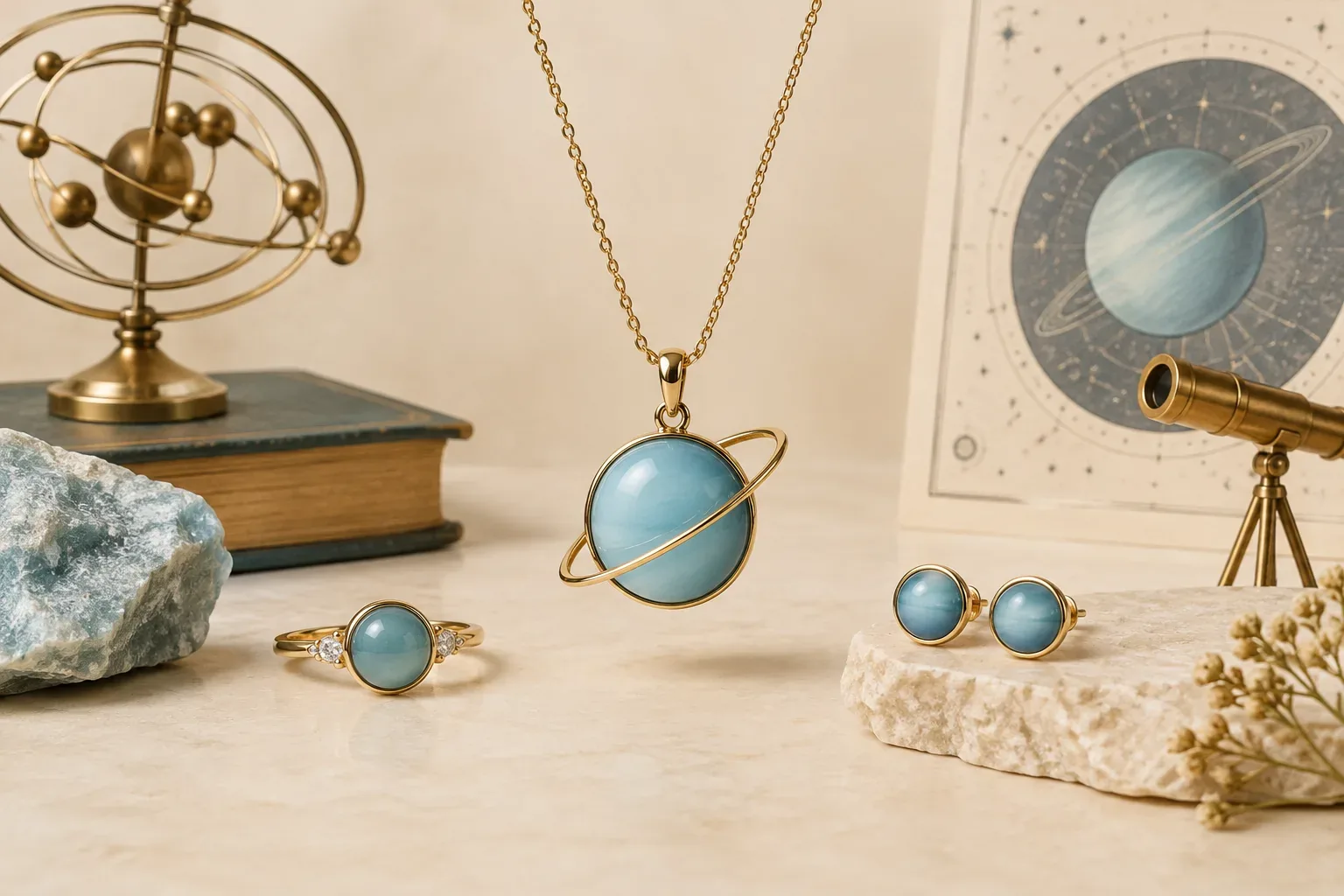
In contemporary jewelry the Uranus motif commonly appears as engraved or cut symbols, small pendants shaped after astrological glyphs, minimalist line-work representing the planet’s symbol, or as motif-focused enamel and metalwork. Makers also place planetary symbols on signet-style pieces, lockets, and pendants that reference personal identity or interest in the heavens. From a materials point of view, blue and green gemstones such as aquamarine, turquoise, or labradorite are often used to evoke a planetary or icy-blue association in commercial and artisanal pieces, though the choice of stone is an aesthetic convention rather than a historical necessity. The Victoria and Albert Museum’s guidance on gemstones records how particular stones have circulated through jewellery traditions and how their visual associations can inform design choices, while also reminding buyers and makers of the long histories of gem use and taste.
Design and craft techniques that carry meaning
Techniques that historically conveyed significance — cameo carving, enamelling, inlay, gemstone setting and engraving — continue to shape how planetary motifs are read. A small engraved Uranus glyph on a signet ring can read as a modern personal emblem, while a more elaborate enamel pendant with star fields evokes the older tradition of celestial decoration described in museum collections. The V&A emphasises how material, technique and context combine to produce meaning: identical motifs can signal different things depending on whether they appear in a court jewel, a mourning piece, a sentimental locket, or a contemporary minimalist pendant.
Buying and care: practical, respectful selection guidance
Choose Uranus-themed jewelry first by considering the recipient’s interests and the cultural or personal message you intend to convey. If the piece is meant as an interest-based gift — to mark a love of astronomy or astrology — look for accurate, tasteful symbols rather than novelty designs that may reduce the motif to a cliché. If you want historical resonance, prefer techniques and materials that reference older traditions (for example, enamel or cameo work) and consider a locket or small signet for a sense of continuity with past uses of celestial imagery. The Victoria and Albert Museum’s overview of jewellery history can help you think about how design choices signal different kinds of meaning.
When selecting gemstones or treated materials, follow the practical consumer guidance of the Federal Trade Commission: ask sellers for full disclosure about treatments, enhancements, and whether stones are synthetic or imitation. The FTC advises consumers to request clear information on material treatment and to keep receipts that describe what was represented at the point of sale. For everyday wear, check metal quality, secure settings, and ask about care recommendations. For heirloom intentions, choose durable settings and ask a trusted jeweller about conservation-friendly options.
Be culturally respectful. Do not claim ancient or sacred provenance for a contemporary Uranus motif unless the maker provides documented provenance. If a piece references a specific culture’s sky symbolism, make sure its attribution is accurate and that the seller or maker acknowledges its origins rather than packaging it as generic “mystical” merchandise.
Gifting and wearing: considerations and etiquette
Match the formality of the piece to the occasion: a small Uranus pendant or discreet signet is suitable for birthdays or personal milestones, while a more elaborate, historically informed pendant might be chosen for ceremonial gifts or as a collector’s object. Consider personalization — engraving a date or short phrase inside a locket or on a ring can root a modern symbol in private meaning. If the recipient is religiously or culturally sensitive about celestial symbolism, ask discreetly or choose a neutral design. For those who value sustainability, ask makers about material sourcing and consider pre-owned pieces that carry history and patina.
Where to research further
For historical context on celestial motifs and changing jewellery practices, the Victoria and Albert Museum is a useful starting point. For practical consumer protection and accurate information on gemstones and treatments, consult the Federal Trade Commission’s consumer guidance. For help choosing meaningful designs or researching a piece’s symbolism, our related articles on Symbols, How to Choose Meaningful Jewelry: A Practical Gift Guide, History of Lockets, and How to Research the Meaning of a Jewelry Symbol offer step-by-step approaches and further reading.
Frequently asked questions
Is the Uranus symbol in jewelry historically ancient?
No single continuous ancient tradition ties a uniquely recognisable Uranus glyph to ancient jewellery. Celestial imagery is ancient and widespread, but the specific planetary symbol and its modern astrological meanings are later developments; museums such as the Victoria and Albert Museum emphasise that motifs and meanings shift across periods and cultures.
Does wearing Uranus jewelry mean the wearer believes in astrology?
Not necessarily. People wear planetary motifs for many reasons: aesthetics, personal identity, appreciation of astronomy, or as symbolic statements. Modern astrological meanings attached to Uranus are a contemporary interpretive layer and are not universal.
Which gemstones are best for a Uranus-themed piece?
There is no single ‘correct’ stone. Blue and green stones such as aquamarine, turquoise, or labradorite are frequently chosen for their color associations with the skies or icy tones, but choice should be guided by aesthetics, durability, and budget. Consult resources like the Victoria and Albert Museum’s A–Z of Gemstones for historical context and the FTC for consumer protection on treatments.
How can I verify whether a gemstone in Uranus jewelry is genuine or treated?
Ask the seller for written disclosure about treatments and the stone’s origin, and request certification from a reputable gemological laboratory when appropriate. The Federal Trade Commission advises consumers to get clear information on material treatment, enhancements, and whether a stone is synthetic or an imitation.
Is it appropriate to give Uranus jewelry as a meaningful gift?
Yes, when chosen with thought. Match the design to the recipient’s interests and the occasion, consider personalization like engraving, and be transparent about materials and provenance. For historically resonant gifts, prefer techniques or pieces that reference earlier jewellery traditions.
Sources and further reading
- Bedazzled: A History of Jewellery — Victoria and Albert Museum
- An A-Z of Gemstones — Victoria and Albert Museum
- Buying Gemstones, Diamonds, and Pearls — Federal Trade Commission