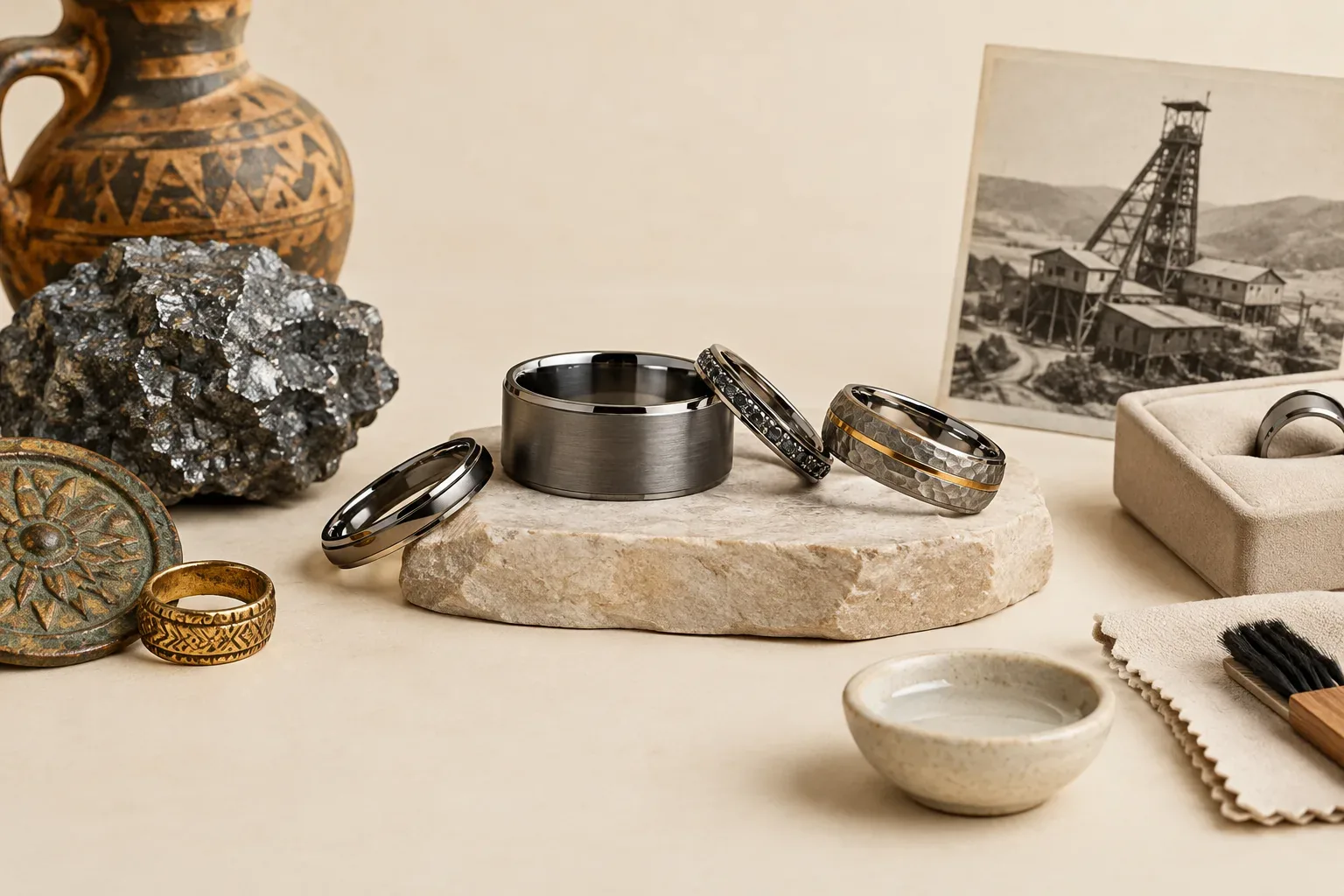
Meaning at a glance
Explain the documented history and changing contexts of the tungsten carbide jewelry durability motif, separate cultural or religious evidence from later popular interpretations, and give practical guidance for choosing and wearing the motif in modern jewelry.
What tungsten carbide jewelry refers to and why 'durability' is emphasized
In everyday use the phrase 'tungsten carbide jewelry durability' groups three related ideas: the physical behavior of a modern, engineered material used for rings and other pieces; the marketing and cultural messaging that associates that behavior with values such as permanence or strength; and the consumer practices that grow up around buying, wearing, and caring for such items. Museum writing on jewellery makes clear that new materials and technologies repeatedly reshape jewellery forms and meanings, especially in the modern era when industrial processes and wide retail distribution change what is available and how people understand it (Victoria and Albert Museum).
Because tungsten carbide is a relatively recent entrant compared with traditional metals and gemstones, the concept of its 'durability' is primarily a contemporary signifier. In practice, that signifier can be used in different ways: as a straightforward description of how the material performs in daily wear, as a symbolic shorthand in wedding or commitment rings, or as a marketing-driven trait used to differentiate products in a crowded market.
Documented historical evidence and distinct cultural or period contexts
Museum scholarship emphasizes that jewellery materials and their associated meanings are historically contingent. The Victoria and Albert Museum’s work on the history of jewellery traces how metals, gemstones, and new technologies have repeatedly altered form and social meaning across periods and cultures. That research provides the proper context for assessing tungsten carbide: unlike gold, silver, or specific gemstones that have recorded roles in historical rituals, political display, or personal identity across named cultures and centuries, tungsten carbide belongs to the modern industrial period when new engineered materials became commercially available (Victoria and Albert Museum).
When historians discuss jewellery from particular cultures or periods—whether ancient Egypt, medieval Europe, or 19th-century fashionable society—they do so with documentary and archaeological evidence about the materials, manufacture, and social roles of those pieces (Victoria and Albert Museum). Comparable documentary evidence does not exist for tungsten carbide before the industrial and consumer age; therefore there are no long-standing cultural or religious traditions from those earlier periods directly tied to tungsten carbide itself. This absence is a factual point about the material’s relatively recent emergence into jewellery practice, not a denial that contemporary wearers can create meaningful personal associations.
Separating documented history from modern interpretations
It is important to keep two lines of evidence separate. First, museum and historical sources document longstanding associations between certain materials and roles—examples include the use of particular gemstones in mourning jewellery or of precious metals in courtly regalia. Those documented links are grounded in dated objects, written records, and provenance studies (Victoria and Albert Museum; An A-Z of Gemstones, Victoria and Albert Museum).
Second, modern interpretations attach new symbolic weight to recently introduced materials. The contemporary association of tungsten carbide with 'durability' is a modern interpretive layer created by manufacturers, retailers, reviewers, and wearers themselves. That interpretation can be meaningful and legitimate on a personal level, but it is not the same thing as a continuity with ancient or traditional symbolism. Noting that difference keeps historical evidence distinct from contemporary cultural practice.
How the durability motif appears in jewellery practice today
In current jewellery markets the idea of durability tends to appear as product language, design choices, and use-cases. Retail descriptions and branding often emphasize a material’s resistance to everyday effects—such as dulling or surface damage—as a reason to choose it for high-contact pieces like rings. Designers may pair engineered materials with traditional decorative elements, or use them for styles tailored to active lifestyles. Museum commentary about changing materials in jewellery helps explain this pattern: new materials enter fashion as techniques and social needs evolve (Victoria and Albert Museum).
The durability motif can also be combined with other symbolic elements: people choose durable-looking pieces to express commitment, endurance, or a practical aesthetic. Those are modern symbolic associations built on consumer perceptions rather than on pre-existing ritual use. When gemstones or motifs are present alongside tungsten carbide, historical meanings attached to those stones or motifs remain distinct and should be evaluated on their own documented histories (An A-Z of Gemstones, Victoria and Albert Museum).
Tarnish, wear, and everyday care: practical guidance
Claims about whether a specific piece will tarnish or how it will wear over years depend on the exact manufacturing and finishing processes used by a maker. Consumer protection guidance from the Federal Trade Commission reminds buyers that treatment, coating, or imitation disclosures matter; retailers are expected to provide accurate information about how a material has been treated or finished and about any care requirements (Federal Trade Commission). Before purchase, ask for written information about surface finishes, plating, or coatings and any recommended cleaning methods.
For everyday care, general safe practices apply whether a piece is made of a traditional metal or a modern engineered material. Avoid exposure to aggressive household chemicals such as bleach or strong acids. Remove rings and bracelets for heavy manual work or tasks where the piece may be subjected to strong impact or force. Clean gently with mild soap and water and a soft cloth; avoid abrasive cleaners or brushes unless the maker specifically approves them. When in doubt about a visible mark or a change in finish, consult the retailer or a professional jeweller rather than attempting invasive repair at home.
Store pieces separately to prevent contact with other jewellery that might cause abrasion. If a warranty or repair policy is offered, read its terms carefully so you understand what kinds of wear are covered and what actions may void coverage.
Selecting and gifting tungsten carbide jewellery: practical and respectful advice
When choosing tungsten carbide as a material for yourself or as a gift, start by clarifying the practical priorities of the wearer. Consider their daily activities, whether they prefer low-maintenance jewellery, and whether they value a modern or traditional aesthetic. Ask the seller about the piece’s finish, any coatings, and what the return, repair, or exchange policies are—information the Federal Trade Commission highlights as important for confident purchases (Federal Trade Commission).
Because the symbolic meaning of tungsten carbide’s durability is a modern construction, be explicit about the sentiment you want a piece to carry when gifting. If the goal is to express endurance, permanence, or resilience, say so in the gift message so the recipient understands that this is the intended meaning rather than assuming an older cultural symbolism. Conversely, avoid asserting that the material has ancient or religious significance unless you have documented evidence linking it to a specific tradition.
Be culturally sensitive: if you are borrowing motifs, stones, or inscriptions that have documented significance in particular cultures or religions, research those meanings independently and acknowledge them honestly. Use the presence of gemstones or traditional motifs to convey documented historical meanings only when those meanings are supported by reliable sources (An A-Z of Gemstones, Victoria and Albert Museum). For further help choosing gift-appropriate symbolic jewellery, see our practical guidance in the related article on how to choose meaningful jewelry.
Summary and next steps
Tungsten carbide jewelry durability is best understood as a modern, market-shaped motif layered over the historic, varied meanings of jewellery materials. Museum scholarship shows that materials and their meanings change across time and cultures, and the lack of pre-industrial documentary evidence means tungsten carbide’s symbolic life begins in the modern consumer era (Victoria and Albert Museum).
Practical care and selection follow well-established consumer practices: request clear information about treatment and finishes, follow gentle cleaning and storage habits, and check repair and warranty policies before purchase. If you are gifting with symbolic intent, be explicit about what the material is meant to signify for the recipient, and respect documented cultural meanings when they apply. For general research methods on jewelry symbols and to read more about jewellery history, see our recommended internal resources on jewellery guides and symbolic research.
Frequently asked questions
Will tungsten carbide jewelry tarnish?
Whether a specific tungsten carbide piece tarnishes depends on its surface finish and any coatings applied by the maker. Many engineered materials are presented as resistant to tarnish or dulling, but you should ask the retailer for written details about finishes and care. The Federal Trade Commission advises buyers to request accurate information on how a piece has been treated or finished before purchase.
How should I clean tungsten carbide jewelry safely?
Use mild soap and warm water and dry with a soft cloth. Avoid strong household chemicals and abrasive cleaners unless the maker explicitly approves them. If you see unusual marks or damage, consult the seller or a professional jeweller rather than attempting aggressive home repairs.
Is the symbolic meaning of 'durability' for tungsten carbide historically documented?
No long-standing cultural or religious tradition ties tungsten carbide specifically to historical symbolism. Museum scholarship shows that meanings attached to jewellery materials evolve, and tungsten carbide’s association with durability is a modern, consumer-era interpretation rather than an inherited historical meaning.
Can I rely on manufacturer claims about durability?
Manufacturer claims vary and may refer to different things (e.g., resistance to surface marks, the permanence of a finish). Ask for written details about treatments, coatings, and warranty terms. The Federal Trade Commission highlights the importance of truthful disclosure about treatments and imitations.
Is tungsten carbide appropriate for engagement or wedding rings?
Many people choose modern materials for engagement or wedding rings because of personal meaning, style, or practical considerations. If you select tungsten carbide for a symbolic ring, be explicit in your gift message about the sentiment you intend to convey, and confirm repair, resizing, and warranty policies with the seller.
Are there special storage or wearing precautions?
Store tungsten carbide pieces separately to avoid contact with other jewellery that could cause abrasion. Remove them for heavy manual labor or activities with significant risk of impact. Follow any additional care instructions provided by the maker.
How do gemstones affect the historical meaning of a piece with tungsten carbide?
Gemstones and traditional motifs carry their own documented histories and meanings independent of the mounting material. If a piece combines tungsten carbide with identifiable gems or cultural motifs, evaluate those elements on the basis of their own documented histories and sources (see museum references on gemstones).
Sources and further reading
- Bedazzled: A History of Jewellery — Victoria and Albert Museum
- An A-Z of Gemstones — Victoria and Albert Museum
- Buying Gemstones, Diamonds, and Pearls — Federal Trade Commission