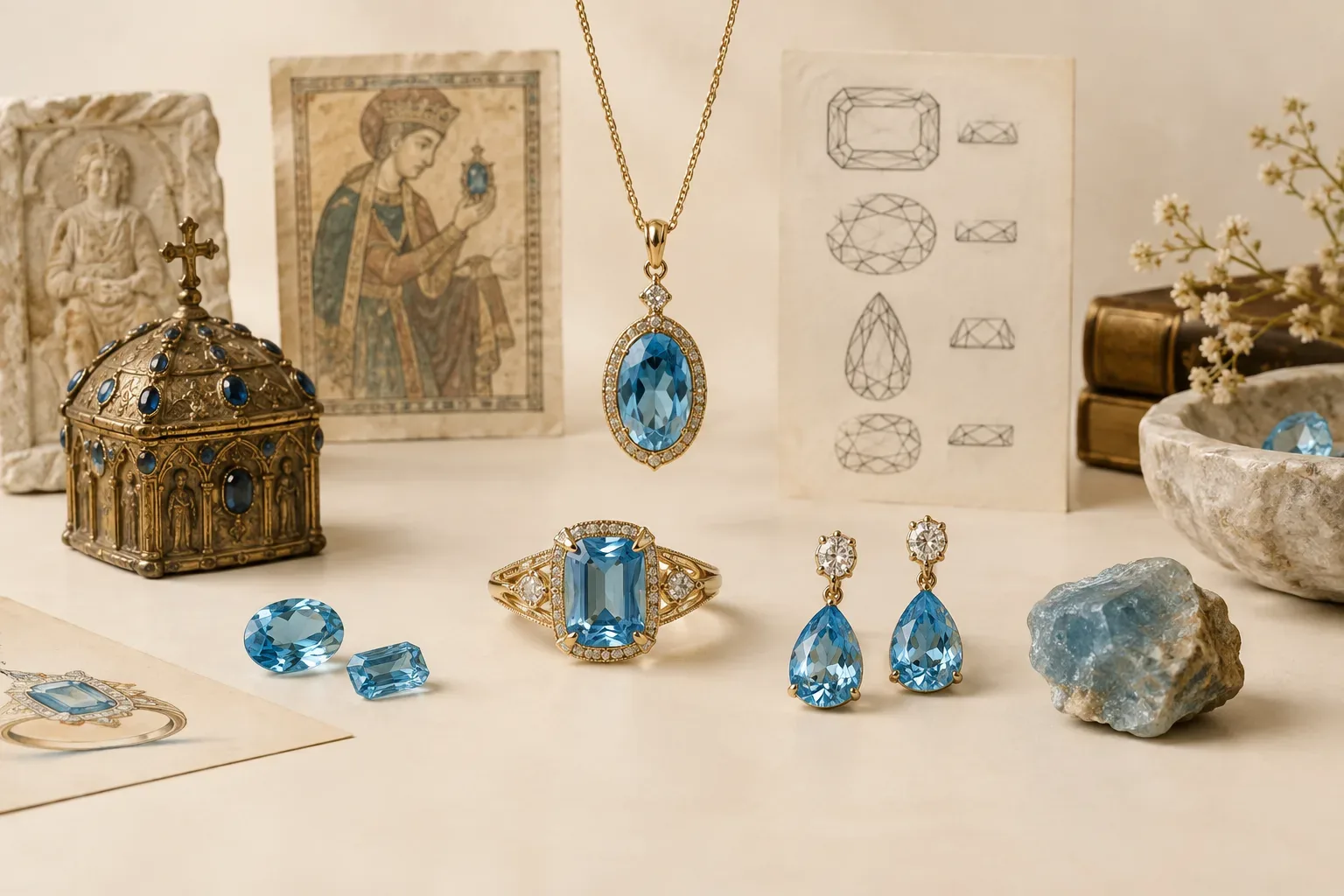
Meaning at a glance
This article explains the documented history and changing contexts of topaz cuts and settings, distinguishes museum-documented meanings from later popular interpretations, and offers practical, respectful guidance for choosing and caring for topaz jewelry today.
What the historical record actually shows
Museum scholarship makes two clear points about topaz and similar gemstones: cutting and setting are technologies shaped by available tools and social taste, and the way people displayed gemstones has varied by period and culture. The Victoria and Albert Museum’s exhibition materials and reference articles frame jewellery history as a changing social practice in which techniques and fashions evolve alongside cultural meanings.
Historical catalogues and museum overviews document that gem cutting became more sophisticated as lapidary technology advanced, which changed which cuts were common and which optical qualities—color, brilliance, or clarity—were emphasized. The V&A’s A–Z of Gemstones places individual stones inside that technical and social history, explaining how gem identification and treatment can affect appearance and use.
Settings also shifted over time. Period jewellery in museum collections shows a range of approaches intended to display or protect stones, from close-set bezels and closed backs in earlier periods to open-backed and prong settings that allow more light in once cutting and mounting techniques permitted. The V&A frames these changes as responses to evolving tastes, practical needs, and technical possibilities rather than as fixed symbolic laws.
Separating documented cultural meanings from modern interpretations
Documented meanings in museum records tend to be specific and contextual. For example, collections and catalogues held or interpreted by the Victoria and Albert Museum discuss jewellery as social signifiers—status, fashion, mourning, and identity—in particular historical contexts. Those records show how design choices communicated something about the owner’s rank, wealth, or taste in a given time and place.
By contrast, many modern claims about a stone’s universal spiritual or emotional properties are contemporary personal or commercial interpretations rather than facts recorded in primary historical documentation. While individuals or communities today may attach personal significance to topaz cuts and settings, those meanings are not the same as documented historical uses unless a specific record links them. Avoid assuming that a cut or setting carried the same meaning across cultures or centuries; museum scholarship emphasizes variability and context.
How cuts and settings affect a topaz’s look and durability
Cut influences how topaz displays its color and how much its surface and internal flaws are concealed. Cuts that emphasize brilliance—often described in modern trade as brilliant or mixed cuts—can increase sparkle and make a stone appear lively in varied light. Step cuts and emerald-type facets emphasize color and clarity and may be chosen for stones with attractive color and good transparency. Museum overviews note that lapidary choices have long been guided by the stone’s natural qualities and the available cutting technology.
Settings determine how much of the stone is exposed and how well it is protected. A bezel setting surrounds the stone’s girdle with metal and offers good protection for the edges; a prong or claw setting exposes more of the stone and maximizes light entry but leaves corners and edges more vulnerable. Historical collections show both conservative closed-back mounts—used to control color or back gemstones with foil—and later open-back settings that take advantage of modern cutting to boost brilliance. The practical trade-off is usually between protection and optical performance.
Documented motifs and the appearance of topaz in jewellery
Museum records describe topaz appearing in a variety of motifs: set as central stones in rings and brooches, grouped in parures and necklaces, and used in combination with other gems and pearls to achieve fashionable colour contrasts. Exhibitions and articles at the Victoria and Albert Museum catalogue these uses and discuss how motifs—bouquets, geometric panels, or portrait miniatures, for example—reflected contemporary tastes and techniques.
Cuts and settings interact with motif. A cluster motif may use smaller stones in tight pavé or bead settings, while a solitaire ring often features a single, well-cut stone in a prong or bezel to make it a visual focus. Historical pieces in museum collections illustrate that jewellers adapted cutting and mounting to the motif’s demands and to the constraints of the time’s technology.
Modern practical guidance for selecting topaz cuts and settings
Start by assessing the stone’s qualities. If the topaz has strong color, choose a cut that maximizes color saturation, such as a step or mixed cut; if it has excellent clarity and you want sparkle, a brilliant-style cut will emphasize fire and scintillation. Ask the seller about the stone’s provenance and any treatments. The Federal Trade Commission requires accurate disclosure of treatments and imitations, so request written confirmation of any heat treatment, irradiation, or coatings and of whether the stone is natural, synthetic, or an imitation.
Match the setting to the wearer’s lifestyle. For someone who uses their hands a lot or has an active job, choose protective settings such as bezels, low-profile prongs, or designs that shield the girdle and corners. If the wearer values maximum light performance and the piece will be worn with care, prong or open-back settings will boost brilliance. For heirloom purposes, consider settings that are repairable and use seatings that allow future resizing without compromising the stone.
Consider metal choice as part of durability and appearance. Platinum and gold alloys differ in hardness and wear patterns; a harder metal will protect the mounting better over time, whereas softer gold alloys are easier to rework for repairs. Discuss repairability and future maintenance with the jeweller.
Respectful selection and gifting guidance
When gifting topaz jewelry, be explicit about what you know and what you don’t. If a stone has been treated or is lab-grown, mention it openly and provide any documentation the seller supplied. That transparency aligns with FTC expectations and shows respect for the recipient’s right to know what they are receiving.
Pay attention to cultural context. If the recipient has a clear cultural or religious background that would interpret a motif in a specific way, ask or research discreetly rather than assuming. Use museum resources and respected cultural histories to check whether a design has particular significance in a culture you are not part of. When in doubt, choose classic, durable styles and offer the piece as a personal gesture rather than one that claims universal symbolism.
For heirloom or sentimental purchases, prioritize serviceability. Choose settings that a trusted jeweller can resize or repair and keep paperwork, appraisals, and a simple care plan with the gift.
Care, treatment disclosure, and long-term considerations
Ask sellers for written information about any treatments. The Federal Trade Commission’s consumer guidance on buying gemstones, diamonds, and pearls highlights the importance of disclosure for treatments that alter appearance. Knowing whether a topaz was treated will inform how you care for it and how to value it over time.
Routine care depends on setting and wear. Protective settings need less worry about sharp knocks, but all topaz should be kept from hard knocks and abrasive cleaners. Keep jewellery paperwork with notes about the cut and setting so future caretakers know how it was constructed and what to watch for when servicing the piece.
Final thoughts
Topaz cuts and settings are a practical conversation between what the stone naturally offers and what the owner wants it to do—sparkle, show off color, or stay protected for daily wear. Museum scholarship, such as the Victoria and Albert Museum’s essays on jewellery history and its A–Z of gemstones, underscores that cutting and setting practices have always been shaped by technology and taste rather than by fixed meanings.
Ask clear questions, request written treatment disclosures as advised by the Federal Trade Commission, and choose a setting that suits the wearer’s lifestyle. Doing so respects both the stone’s physical needs and the recipient’s personal values.
Frequently asked questions
Are certain cuts better for topaz durability?
Cut choice affects how force is distributed across a stone. Cuts with protected corners, such as rounded cushions or bezel-set step cuts, reduce the risk of chipping compared with sharply pointed corners left exposed. The setting is equally important: secure bezels or low-profile prongs improve durability for everyday wear.
How do I know if a topaz has been treated?
Ask the seller for written disclosure. The Federal Trade Commission advises that dealers disclose treatments, enhancements, and whether a gemstone is synthetic or an imitation. Documentation should describe any heat treatments, irradiation, coatings, or other interventions that alter appearance.
Is an open-back setting better for a topaz’s appearance?
Open-back settings can allow more light to enter the stone and enhance brilliance, but they also expose the pavilion to potential damage. Consider how and where the piece will be worn. For pieces intended for frequent wear, a compromise—a low-profile prong setting or partial bezel—may balance appearance and protection.
What should I consider when gifting topaz jewelry?
Be transparent about treatments or lab-grown origin, match the setting to the recipient’s daily activities, and check cultural sensitivities for any motifs. Provide care instructions and any written documentation from the seller so the recipient can maintain and insure the piece properly.
Can historical meanings of a cut or setting be applied today?
Some historical meanings are explicitly documented in museum records for particular times and places, but meanings shift. Do not assume a historical symbolic meaning applies universally today; instead, use historical sources to inform context while respecting the recipient’s modern beliefs and preferences.
Sources and further reading
- Bedazzled: A History of Jewellery — Victoria and Albert Museum
- An A-Z of Gemstones — Victoria and Albert Museum
- Buying Gemstones, Diamonds, and Pearls — Federal Trade Commission