Meaning at a glance
This article explains the documented history and changing contexts of the sunflower motif in jewelry, separates museum-documented meanings from modern personal interpretations, describes how the motif and related gemstones appear in pieces, and gives practical guidance for selection and gifting.
What the historical evidence shows (and how museums report it)
Institutions that collect decorative arts treat floral ornament and sun imagery as recurring themes rather than single-culture symbols. The Victoria and Albert Museum's overview of jewellery history stresses how changing social contexts, technologies, and tastes shaped the use of botanical and solar motifs in rings, brooches, pendants, and other forms. Those broad patterns are the primary museum evidence for how and why jewelers depicted flowers and sunlike forms over time rather than documentation of a continuous global meaning for the sunflower specifically.
In other words, the evidence kept and presented by museums such as the Victoria and Albert Museum documents that jewelers across periods have used naturalistic flowers, stylized floral forms, and bright yellow or gold color palettes to convey ideas associated with nature, seasonality, status, or ornament. The presence of these motifs in collections is best understood as part of the larger history of decorative taste, technological change, and individual patronage rather than as proof of a single, fixed symbolic meaning tied to the sunflower alone.
How documented historical meanings differ from modern interpretations
Museum records and object histories (for example, as summarized by the Victoria and Albert Museum) can identify when a piece was made, the materials and techniques used, and often what floral or solar imagery meant within the maker’s aesthetic or patron’s fashion. Those documented meanings are typically contextual and descriptive: a 19th-century brooch might be catalogued as a naturalistic flower brooch reflecting Victorian taste for botanical subjects, for example.
Modern personal interpretations—such as reading a sunflower piece as an emblem of optimism, loyalty, or resilience—are valid emotional responses and contemporary cultural readings but are not always traceable to the original maker’s intent or to continuous historical usage. When you claim a sunflower pendant symbolizes devotion or inner strength today, you are participating in a newer layer of meaning built from individual, cultural, and commercial practices rather than citing a single, longstanding historical tradition documented in museum catalogues.
The motif, gemstones, and techniques used to suggest sunflowers in jewelry
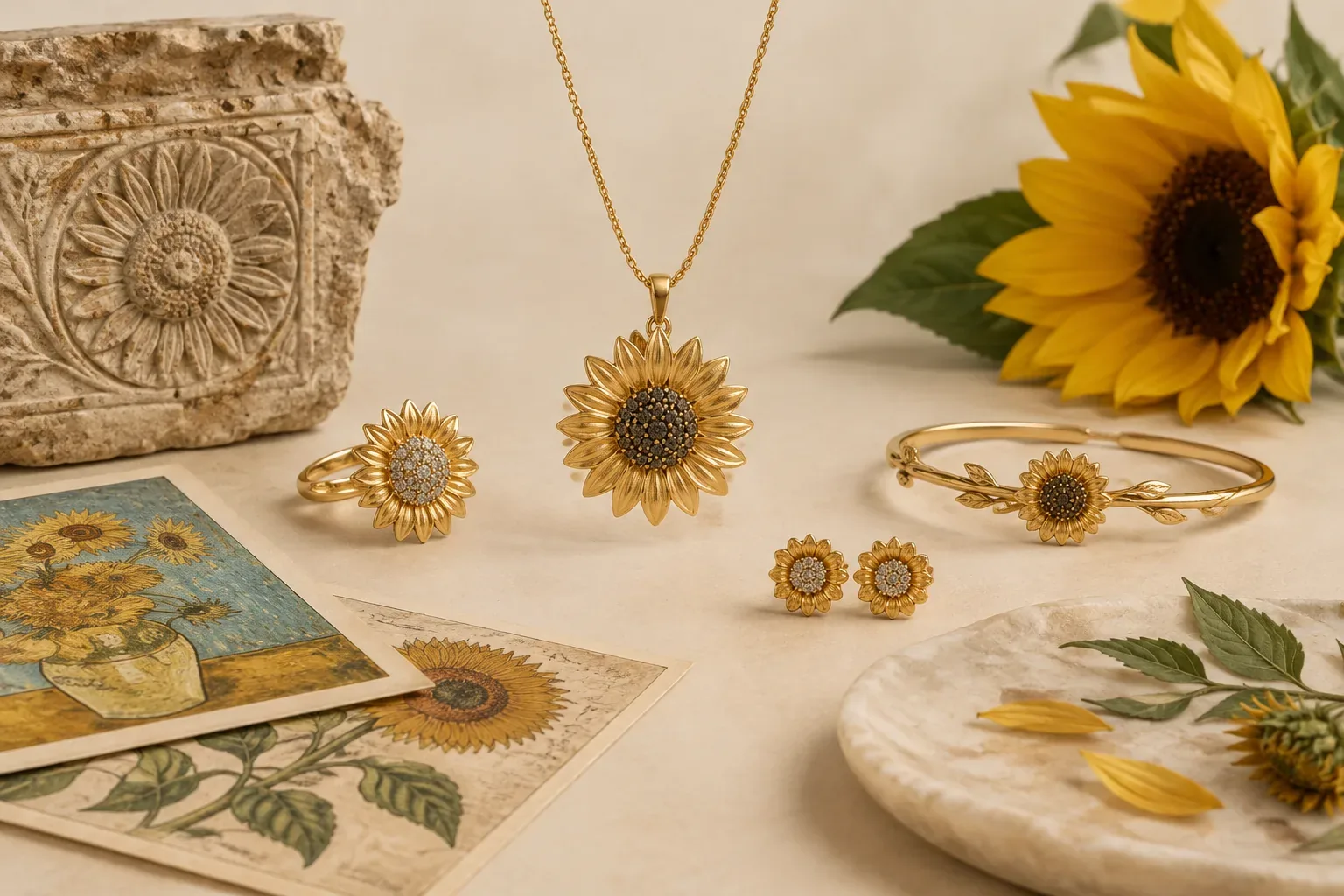
Jewelry designers suggest the sunflower through shape, color, and texture. Petals can be modeled in metal or enamel; the central disk may be crafted with textured gold, pavé gemstones, seed pearls, or granulation to mimic the seed head. Enamel work and gilt surfaces reproduce the bright contrast of petals and center, while openwork and filigree can create the flower’s radial pattern.
Gemstones are chosen for their color or sparkle to reference sunlit petals and warm centers. The Victoria and Albert Museum’s resource on gemstones explains how historical jewelers selected and prized particular minerals for their color, durability, and decorative effect. Yellow and warm-hued stones such as citrine, yellow topaz, and certain heat-treated gems are commonly used to evoke sunflower tones, while brown or honey-colored stones and textured gold often represent the flower’s center. Modern makers also use treated stones, synthetic gems, and colored enamels to achieve the look.
Material and disclosure considerations
Because modern pieces may use treated gems, simulants, or plating, check material disclosure before purchasing. The Federal Trade Commission advises consumers to confirm whether gemstones are natural, treated, lab-grown, or imitation and to seek clear information about plating and alloys. Sellers should disclose treatments and synthetic materials; buyers should ask questions when provenance or durability matters.
For antique sunflower pieces, museum labels and reputable dealers will describe materials, repairs, and any later modifications. When a piece is described generically as a "floral brooch" in a catalogue, ask for condition reports, photos of hallmarks, and provenance if those factors are important to your purchase or evaluation.
Choosing, wearing, and gifting sunflower jewelry respectfully
Match the material and style to the recipient’s taste and lifestyle. A delicate enameled sunflower locket suits someone who favors romantic or vintage-inspired pieces, while a bold, modern sunflower pendant in yellow-gold or citrine complements minimalist wardrobes. Consider wearability: small studs or a pendant are practical for everyday wear, while large brooches and statement rings suit occasional or formal use.
Be explicit about the meaning you attach when gifting. If you gift a sunflower piece as a symbol of encouragement or warmth, include a short note explaining that personal meaning. Conversely, avoid asserting that a sunflower ring carries a single universal message; instead, present the historical context (for example, that botanical motifs have long appeared in jewelry, as museums document) and your personal sentiment.
Respect cultural contexts and personal associations. The sunflower has horticultural and regional associations in different places; do not assume a single religious or cultural significance. If the recipient has cultural reasons for particular symbols, ask privately or choose neutral wording. For heirloom or antique pieces, consider professional cleaning and a short history of the object to accompany the gift; for modern purchases, keep documentation about materials and care.
Care and maintenance
Care depends on materials. Enamel and delicate settings benefit from gentle cleaning and storage to avoid chips and knocks; plated pieces should be kept away from chemicals and perfumes to extend the plating life. If gemstones are heat-treated or fragile, follow specific care guidance from the seller or a gem guide. For any purchase, request care instructions and keep receipts and any certification with the piece.
Frequently asked questions
What does sunflower jewelry historically symbolize?
Museum documentation treats floral and solar motifs as recurring decorative themes, noting that jewelers used botanical images and sunlike forms for aesthetic, seasonal, or social reasons; specific, continuous historical symbolism exclusive to the sunflower is not established in general museum summaries.
Is the sunflower a traditional religious symbol in jewelry?
There is no single, universal religious meaning for the sunflower recorded in the decorative arts surveys cited by museums; if a particular religious or cultural community uses the sunflower symbol, that usage should be confirmed from community-specific sources rather than assumed from general jewelry histories.
How should I confirm the materials in a sunflower-themed piece?
Ask the seller for written disclosure about whether gemstones are natural, treated, lab-grown, or simulants and about any plating or alloys; the Federal Trade Commission recommends clear information about treatments and imitations when buying gemstones and pearl jewelry.
Is it appropriate to gift sunflower jewelry as a symbol of optimism or encouragement?
Yes—many people wear floral and sunlike motifs as personal symbols of warmth or encouragement today, but it is considerate to explain the intended meaning in a note and to avoid asserting that the symbol has a single historical meaning for everyone.
Sources and further reading
- Bedazzled: A History of Jewellery — Victoria and Albert Museum
- An A-Z of Gemstones — Victoria and Albert Museum
- Buying Gemstones, Diamonds, and Pearls — Federal Trade Commission