Meaning at a glance
This article explains the documented history and changing contexts of the iris motif in jewelry, distinguishes historical evidence from later interpretations, and offers practical advice for selecting and gifting iris pieces.
Historical evidence, period by period
Museum studies and jewelry histories show that floral and botanical motifs have been a recurring theme in decorative objects and personal adornment from ancient through modern times. The Victoria and Albert Museum presents floral ornament as a persistent element in jewellery design, appearing in a wide range of techniques and social contexts from antiquity to the present day. That broad statement covers many flowers and styles rather than asserting a continuous, single meaning for the iris itself.
In general museum literature, floral motifs appear in distinct ways in identifiable periods. For example, classical and medieval works use stylized plant forms in metalwork and gemstones, Renaissance and Baroque pieces often render botanicals with increased naturalism, Victorian jewelry makes prolific sentimental use of flowers and language-of-flowers imagery, and Art Nouveau emphasized sinuous, naturalistic floral lines in enamel and metal. The Victoria and Albert Museum’s research and exhibitions document these changing tastes and social functions for botanical motifs in jewellery.
Where museums and catalogues identify specific instances of the iris motif, they treat it alongside other floral motifs rather than ascribing a single, universal meaning. In short, documentary evidence supports that the iris appears as a decorative and occasionally symbolic motif in multiple historical periods, but the interpretation and prominence of that motif vary by time, maker, and context.
Documented historical meanings versus modern interpretations
When consulting historical documentation, it is important to distinguish what is recorded by contemporary sources from later or popular interpretations. Museum records and object catalogues tend to describe how an object was made, who owned it, and how motifs relate to broader artistic movements. The Victoria and Albert Museum emphasises how changing social contexts shape jewelry designs, which means that floral motifs often acquire period-specific meanings tied to fashions, funerary practice, or social signaling rather than a single symbolic message.
By contrast, many of the meanings commonly attached to the iris today—such as messages of hope, faith, or wisdom—are modern, layered interpretations. These associations are part of contemporary cultural uses of floral symbolism and personal meaning-making and are not always directly documented in historical inventories or makers’ notes. Treat these modern readings as valid personal or cultural choices, but not necessarily as continuous historical facts.
How the iris motif and related traditions appear in jewelry
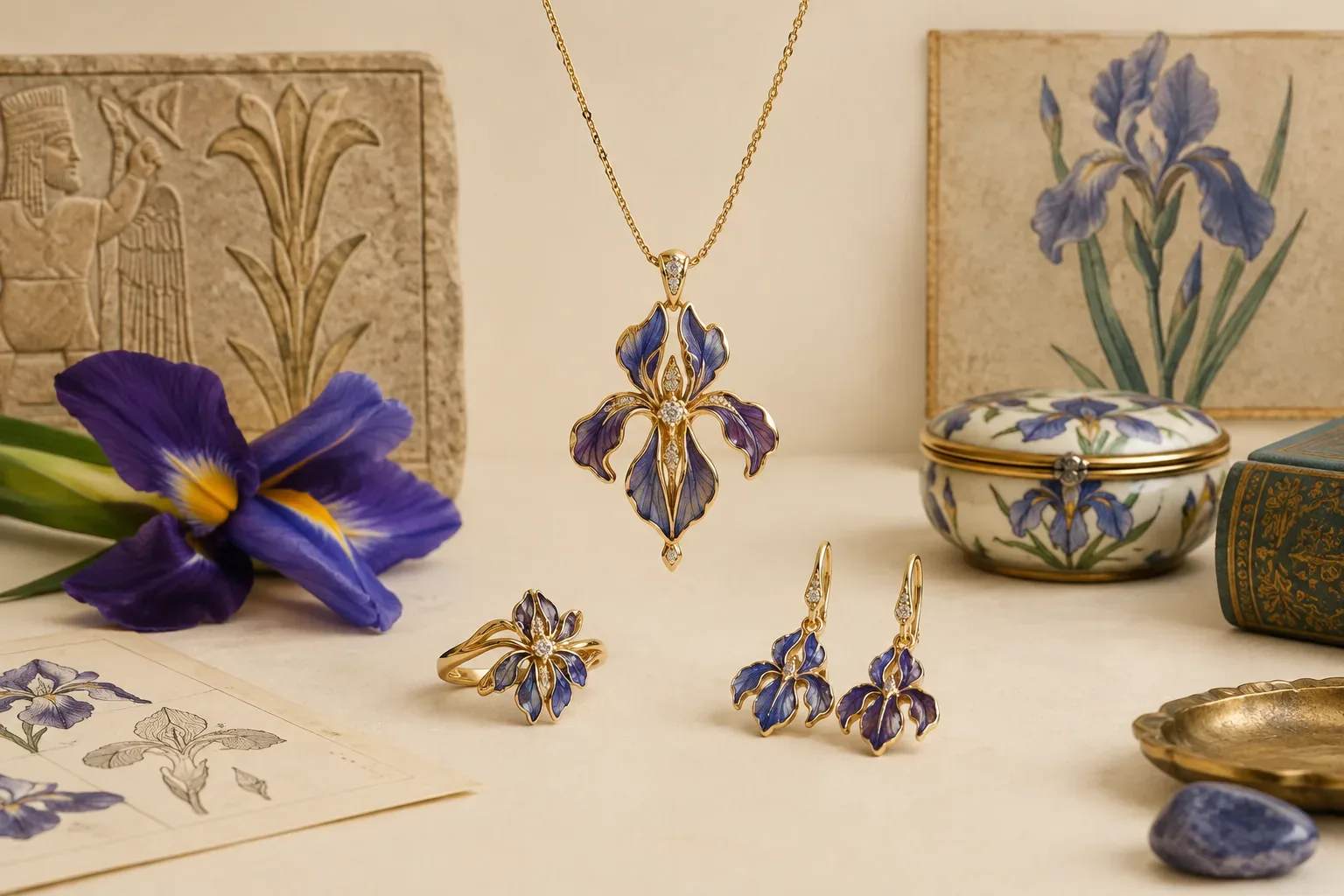
In jewellery the iris motif is expressed in three overlapping ways: as a stylised floral motif worked in metal and enamel, as a botanical miniature or cameo, and more loosely through color and gemstone choices that echo iris hues. Museum collections documented by the Victoria and Albert Museum show that jewellery-makers have long used techniques such as enamel, engraving, filigree, and stone inlay to render flowers, whether stylised or naturalistic. These same techniques are employed for iris designs seen in brooches, pendants, rings, and hair ornaments.
Designs may be literal, showing recognisable petal shapes, or abstracted into flowing lines and color fields typical of Art Nouveau-inspired pieces. Gemstones commonly chosen for floral pieces include sapphires, blue topaz, and lapis when a blue iris effect is desired, or amethysts and other purple-hued stones for a purple iris look. The V&A’s resources on gemstones provide useful context for how stone color and cutting contribute to a floral effect in jewellery across periods.
Beyond motif and color, the iris also appears as a birth-flower motif in contemporary botanical jewelry lines and in mass-produced charms and pendants that translate botanical imagery into small-scale wearable forms. These contemporary uses often blend historical craft techniques with modern manufacturing and finish choices.
Selecting and gifting iris jewelry—practical, respectful guidance
Decide first whether you want a piece rooted in historical style or a modern personal symbol. If historical authenticity matters, look for makers, museum reproductions, or antique pieces whose provenance and technique are documented, and consult museum catalogue notes or reputable dealers for context. If you are choosing a modern piece for its personal meaning, focus on design, materials, and the message you want to convey rather than assuming a single historical meaning.
Material and quality considerations matter both for longevity and for ethical buying. If gemstones are used to evoke iris colors, consult reputable guides to gemstone types, treatments, and imitations. The Victoria and Albert Museum’s A–Z of Gemstones provides background on historical and decorative uses of stones; the U.S. Federal Trade Commission cautions that modern gemstone treatments and imitations should be disclosed by sellers. Ask a seller for certification or treatment disclosures when the stone’s value or rarity is important.
When gifting, be explicit about intended meaning if that matters. For example, if you intend the piece as a token of hope or remembrance, include a note explaining that intention so the recipient knows whether to view the flower as a purely decorative motif or as a symbolic gesture. Consider the recipient’s style and cultural background. Botanical motifs may carry particular significance in some cultures; if in doubt, ask sensitively or choose a neutral design.
For everyday wear, choose construction and materials that match the recipient’s lifestyle. Solid metals, secure settings, and reputable chains reduce the risk of loss or damage. For heirloom or investment pieces, seek documented provenance, and consider professional appraisal and insurance.
Care, buying tips, and ethical notes
Care for iris-themed jewelry as you would other fine pieces: avoid harsh chemicals, store items separately to prevent abrasion, and have settings checked periodically. Enamel and delicate filigree designs benefit from careful handling. If the design has a plated finish, follow the maker’s care recommendations to preserve the plating.
Ask sellers about gemstone treatments and the metal content of pieces. The U.S. Federal Trade Commission provides guidance on the importance of disclosure for treatments, enhancements, and imitations; reputable dealers will provide clear information and documentation on request. If purchasing antique iris jewellery, request condition reports and, where possible, provenance documentation.
If sustainability or ethical sourcing is a priority, ask about metal recycling, responsible sourcing of gemstones, and maker practices. Contemporary makers often note these details in product descriptions; museum catalogues such as the Victoria and Albert Museum’s materials provide contextual understanding of traditional techniques versus modern production.
Frequently asked questions
Is the iris motif historically associated with a single meaning?
No. Historical records and museum catalogues show that floral motifs—including the iris—have carried different meanings depending on period, region, and social context. Museums like the Victoria and Albert Museum document how meanings change with fashion, funerary practice, and social signaling rather than being fixed.
Can wearing iris jewelry convey a specific message?
Wearing iris jewelry can convey a personal message chosen by the wearer or giver—such as hope or remembrance—but these are modern interpretations and not universal historical facts. If a particular meaning matters, explain it when gifting or choose a design that visually supports that meaning.
What gemstones best evoke an iris look?
Stones with blue or purple hues such as sapphire, blue topaz, or amethyst are commonly used to evoke iris colors. Consult reputable guides to gemstone types and ask sellers about any treatments or imitations; the Victoria and Albert Museum provides context on gemstone use and the U.S. Federal Trade Commission advises on treatment disclosures.
How can I verify the quality of an iris-themed antique piece?
Request condition reports, provenance information, and, where applicable, professional appraisal. Museum catalogues and reputable dealers provide context for technique and period. Ask explicitly about repairs, restorations, and any later modifications.
Are there cultural sensitivities to consider when gifting floral jewelry?
Yes. Floral symbolism varies by culture, and some flowers carry specific religious or social connotations in certain communities. If such context could matter to the recipient, check sensitively or select a neutral design.
Sources and further reading
- Bedazzled: A History of Jewellery — Victoria and Albert Museum
- An A-Z of Gemstones — Victoria and Albert Museum
- Buying Gemstones, Diamonds, and Pearls — Federal Trade Commission