Meaning at a glance
This article explains the documented history and changing contexts of Sumerian jewelry techniques, separates cultural and religious evidence from later popular interpretations, and gives practical guidance for choosing and wearing Sumerian-inspired pieces today.
What the archaeological and museum record shows
Evidence for the materials, forms, and social roles of jewelry from the Sumerian city-states of southern Mesopotamia comes primarily from archaeological finds and the way those objects are presented and interpreted in museum collections. The Victoria and Albert Museum summarizes how jewelry history reflects changing social and cultural contexts, and museum collections provide the tangible evidence that scholars use to reconstruct craft, trade, and design practices of early complex societies.
From that archaeological and curatorial record we understand that jewelry associated with Sumerian contexts often involved worked metals and imported stones, that certain pieces were found in elite or ritual settings, and that techniques for shaping metal and producing beads were sufficiently developed to allow fine detail and repeated patterns. The material record in museum and excavation reports is the closest we have to direct evidence for how these objects were made, used, and valued in their original settings.
Identifying cultures and periods precisely
When writing about Sumerian jewelry techniques it is important to keep periods and cultural labels separate. "Sumerian" refers to the peoples and city-states of southern Mesopotamia documented in archaeological layers and inscriptions; later Mesopotamian cultures, neighboring regions, and revivalist fashions each have their own material signatures and historical contexts. Museum catalogues and broad overviews of jewelry history distinguish these layers and caution against collapsing them into a single, timeless tradition.
For readers, that means a necklace, bead type, or metalworking approach found in an early Sumerian tomb may not be identical to objects from later Assyrian, Babylonian, or Persian workshops, even if later cultures adopted or adapted similar motifs. The Victoria and Albert Museum emphasizes that examining objects in their precise archaeological and curatorial context is essential to avoid anachronism.
What is documented about Sumerian techniques: craft and trade
The surviving objects and the way museums describe them document a few broad technical facts: metalworking reached a level where small, decorative items could be made with defined shapes and repeated ornament; beads and inlaid stones were common decorative devices; and some materials were acquired through long-distance exchange. The Victoria and Albert Museum's presentation on jewelry history highlights how materials and techniques change over time and across networks, which is the basis for interpreting Sumerian-era objects.
Trade is part of the documented picture because gemstones and certain raw materials in the Mesopotamian archaeological record are not locally sourced. Museum treatments of gemstones provide context for how materials moved across regions, how their rarity influenced value, and why certain stones became markers of status or identity in early cities. In short, the archaeological record and its museum interpretation show a combination of local metalworking skill and participation in wider exchange networks for materials.
Documented meanings versus later or modern interpretations
Museum and archaeological evidence can show context of use—whether a piece was found in a grave, a temple deposit, or a domestic setting—and iconography that connects objects to ritual or status. Those contexts provide documented, culture-specific meanings: for example, a piece found in a high-status burial and associated with other prestige goods is plausibly connected to social rank in that culture. The Victoria and Albert Museum's work on jewelry and changing social contexts underscores the caution required when attributing meaning solely from appearance.
Modern interpretations that assign universal symbolic meanings to a given motif or gemstone often extend beyond what the material evidence supports. Contemporary fashion, revivalist design, or spiritual storytelling may ascribe new meanings to Sumerian motifs—meanings that are valid in modern personal or cultural practice but are not the same as the documented functions and beliefs of ancient Mesopotamian peoples. Distinguish clearly between what archaeological context and museum interpretation show and what later designers or wearers choose to emphasize.
How motifs, gemstones, and traditions appear in jewelry
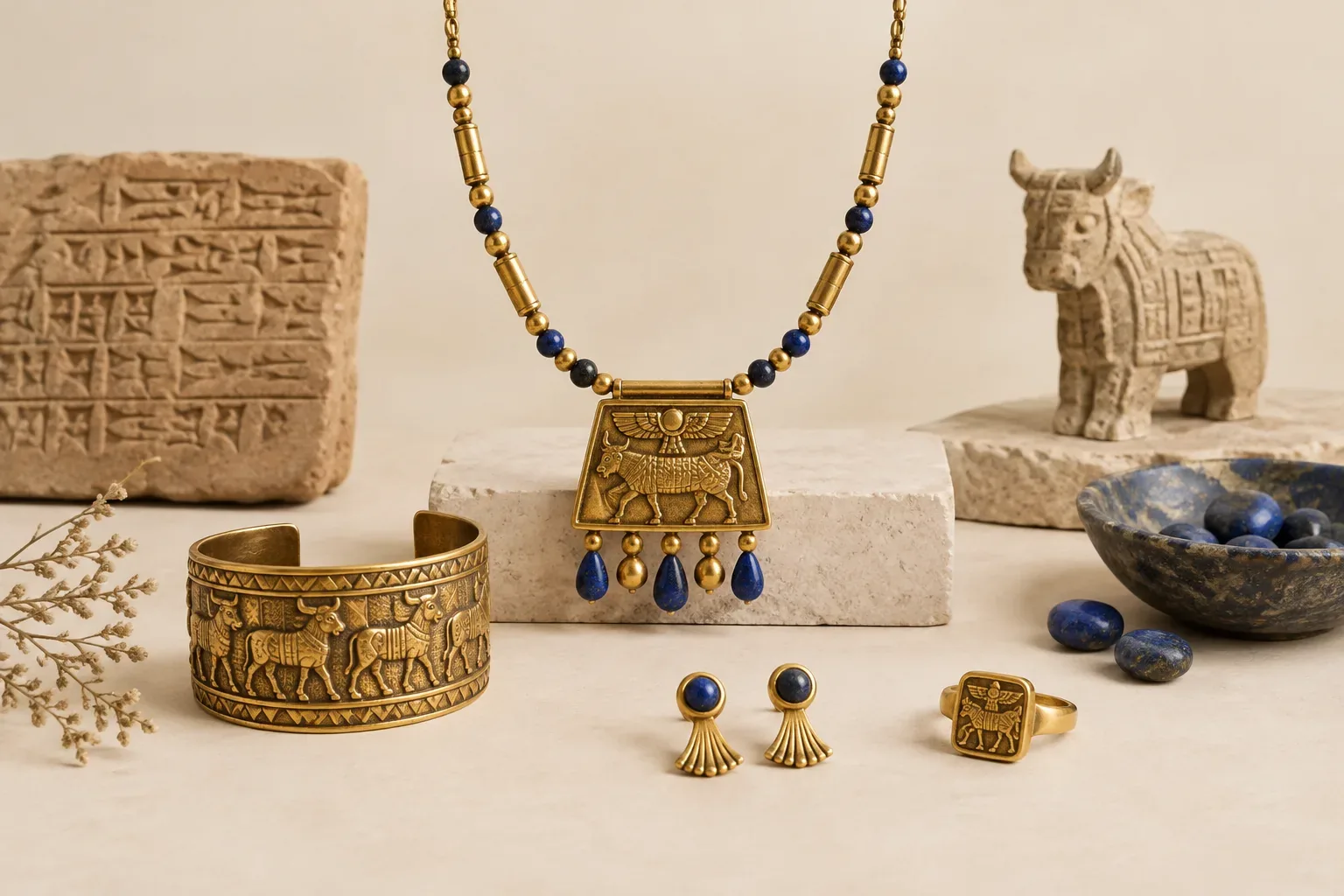
Motifs associated with Sumerian and early Mesopotamian objects appear in jewelry as stylized forms, repeated geometric bands, and inlaid small stones or glass. Museums that catalogue ancient jewelry point out the recurring use of beads and inlay as visual texture and as ways to combine materials with different colors and lusters. These design choices are visible in surviving objects and in museum displays that group comparable pieces together to show continuity and variation.
Gemstones and similar materials appear as beads, inlays, and accents in many pieces that survive from Mesopotamian contexts. The Victoria and Albert Museum’s material guides help identify historically significant stones and explain how the availability and perceived value of a material shaped its use in decorative objects. In modern jewelry inspired by Sumerian examples, designers commonly evoke ancient palettes and silhouettes while using contemporary methods and modern gem equivalents.
Practical guidance for selecting or gifting Sumerian-inspired jewelry
If you are choosing a piece inspired by Sumerian techniques or motifs, consider the distinction between an object that copies archaeological detail and a design that respectfully adapts historical forms. A respectful choice begins with provenance: look for makers who acknowledge inspiration sources, do not misrepresent ancient artifacts as originals, and credit cultural origins appropriately. Museum literature on jewelry history stresses the importance of context and the ethical presentation of historical styles.
Assess materials and disclosure carefully. The U.S. Federal Trade Commission provides guidance on buying gemstones, diamonds, and pearls that stresses transparent disclosure of treatments, imitations, and synthetics. Whether you purchase an antique, a museum-quality reproduction, or a contemporary design inspired by Sumerian art, ask the seller for clear information about material treatments and the stone's origin. This helps ensure the piece meets your expectations in appearance, durability, and value.
For gifting, match the level of historical reference to the recipient's interests. If the recipient appreciates history and archaeology, a well-documented reproduction or a piece made by a maker who explains the inspiration can be meaningful. If the recipient prefers modern minimalism, an accessory that borrows a single motif or color palette may be more wearable. Either way, provide the contextual story you were given by the maker or seller so the recipient can understand the distinction between ancient usage and modern interpretation.
Care, conservation, and ethical considerations
Antique pieces and historically informed reproductions require care appropriate to their materials. Museums advise that metal, stone, and organic components age differently; professional conservation is recommended for valuable or fragile pieces. If a piece is described as an archaeological object, request documentation of provenance and any conservation work performed.
Finally, consider the ethics of cultural respect and representation. Avoid buying or gifting items that are marketed by implying stolen or illicit archaeological provenance. Support makers and institutions that make clear, documented attributions and that treat cultural heritage responsibly. The museum perspective on jewelry history encourages recognizing both the original cultural context and the modern maker’s role.
Frequently asked questions
Are Sumerian jewelry techniques the same as modern methods?
No. The archaeological record shows that ancient Mesopotamian artisans worked metals and stones with their contemporary technologies and trade networks. Modern makers may imitate or adapt ancient styles, but contemporary production often uses different tools, treatments, and legal standards for disclosure. Museum literature stresses the difference between historic technique and modern reproduction.
How can I tell if a piece is an authentic ancient object or a modern reproduction?
Authentic archaeological objects should come with clear provenance and curatorial documentation. Reputable museums and dealers provide records of findspot, conservation, and ownership history. If provenance is unclear or if a seller claims dramatic archaeological origins without documentation, seek expert verification. For buying guidance on treated or synthetic gems, consult consumer protection resources such as the Federal Trade Commission.
What gemstones did Sumerian-era jewelry use?
Museum discussions of gemstones indicate that ancient Mesopotamian jewelry often incorporated stones and glass that were valued for color and rarity, with some materials acquired through trade. Museum catalogs and gemstone guides provide historical context for which materials were prized, but exact inventories vary by site and period.
Is it respectful to wear Sumerian-inspired jewelry today?
Wearing historically inspired jewelry can be respectful if the piece is honestly represented and its cultural origins are acknowledged. Choose makers who credit their sources, avoid buying items marketed as illicit archaeological finds, and be clear whether a piece is a reproduction, an inspired design, or an original artifact.
What should I ask a seller before buying Sumerian-style jewelry?
Ask for documentation about materials, treatments, and provenance. Request disclosure of any synthetic or treated stones. For items marketed as antiques or archaeological, ask for provenance records. Use consumer guidance from the Federal Trade Commission to know what sellers should disclose about gemstones and treatments.
Where can I learn more about the historical context of these designs?
Museum exhibitions and object catalogues are the best places to start for historical context because they connect specific artifacts to archaeological information and expert interpretation. The Victoria and Albert Museum provides accessible overviews of jewelry history and gemstone contexts that are useful starting points.
Sources and further reading
- Bedazzled: A History of Jewellery — Victoria and Albert Museum
- An A-Z of Gemstones — Victoria and Albert Museum
- Buying Gemstones, Diamonds, and Pearls — Federal Trade Commission