Meaning at a glance
This guide explains documented historical context for studs and gemstone meanings as recorded by the Victoria and Albert Museum, separates those historical uses from later personal or popular interpretations, and gives practical, respectful guidance—based on museum and consumer-protection sources—for choosing metals, gemstones, settings, and price priorities when buying stud earrings.
What the historical record shows
The long history of personal adornment is not static. The Victoria and Albert Museum describes jewellery’s evolving roles across different cultures and periods, where objects that look like small studs have served as status markers, identity signals, and decorative accents rather than a single universal meaning. Museum research highlights that forms, materials, and social contexts change over time: a simple metal pin, a gem-set button, and a decorative motif each appear at different moments and carry different social weight depending on the culture and period.
Because studs are a compact form, they recur in many eras where practicality and discreet decoration mattered. The V&A collection and exhibitions show how small, close-to-skin pieces were used for everyday wear in some times and as luxury statements in others. When you read historical accounts in museum resources, note that a given object’s role is tied to the society that produced and used it, not to a universal symbolic meaning.
Documented cultural meanings versus later or popular interpretations
Museum documentation often records why a piece was made and how it was used, but it does not always support later, generalized claims about what an object 'means' today. The Victoria and Albert Museum emphasizes changing social context; meanings recorded in one culture or century do not automatically transfer to another. For example, a stone or motif might have been an emblem of rank in one society, a protective charm in another, and a purely fashionable choice in a later period.
Modern retail descriptions and popular articles frequently layer new meanings—romantic, spiritual, or trend-related—onto historic objects. Those contemporary interpretations can be meaningful to the wearer, but they are different in kind from meanings documented by museum research. Treat museum evidence and modern personal or marketing narratives as distinct: use the former to understand origin and documented usage, and recognize the latter as individual or cultural reinvention.
How motifs, gemstones, and traditions appear in stud earrings
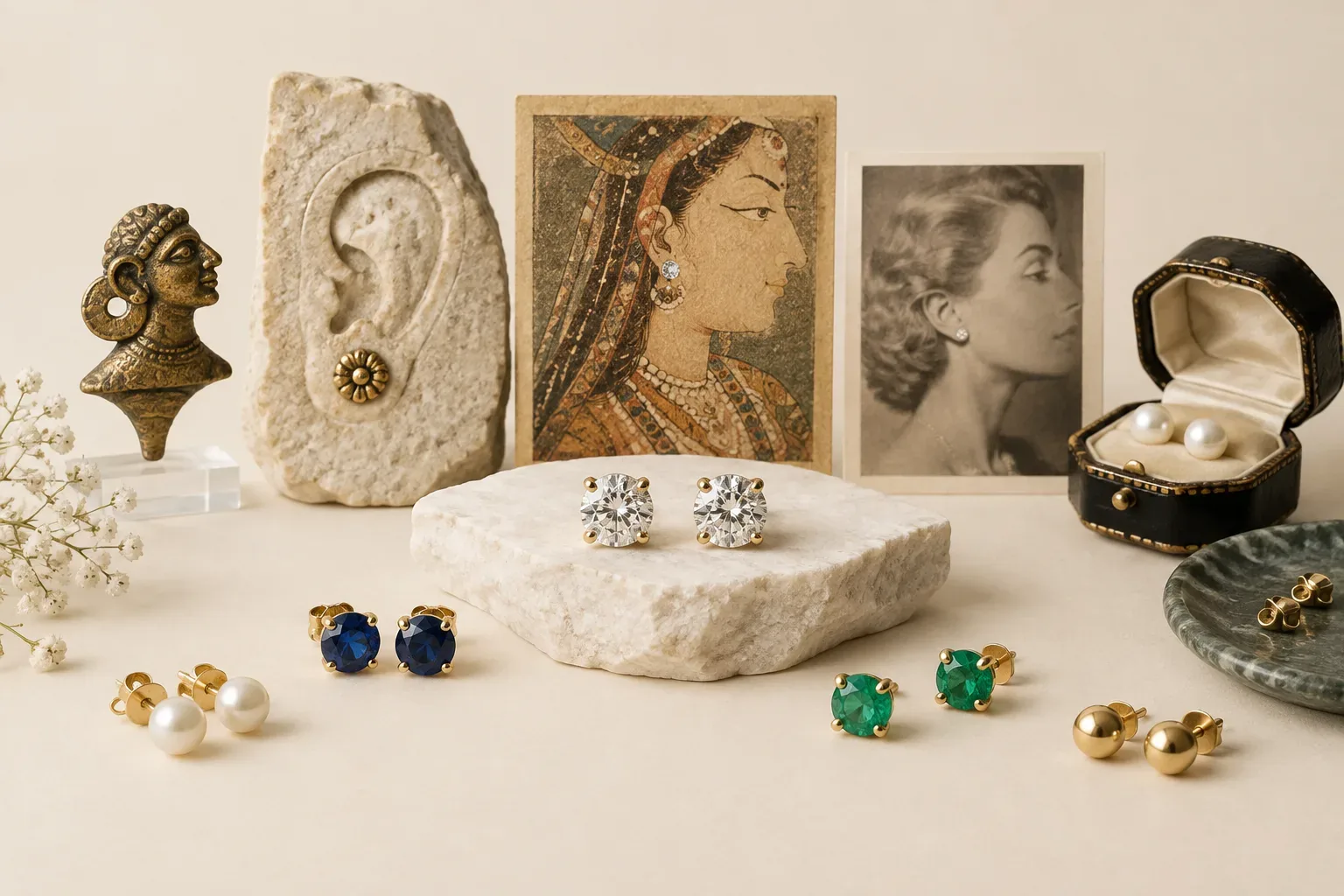
Stud earrings show up in a few basic forms: plain metal studs or buttons, gems set flush or prong-set into a small mount, and small motif shapes such as flowers, stars, or symbolic icons. The Victoria and Albert Museum’s writings on gemstones and jewellery forms explain that gem-set studs were a common way to showcase small but valuable stones because the setting protects the stone and keeps the silhouette low-profile for everyday wear.
Gemstones used in studs can be natural, treated, or synthetic; the V&A’s A–Z of Gemstones outlines both the mineral identities and the long cultural histories assigned to particular stones. Historically, some stones were prized for color, rarity, or purported properties, and those preferences influence modern aesthetics—people still select diamonds, sapphires, pearls, or colored gems for how they look and for historical associations. Motifs derived from religious or cultural traditions also appear in small studs, but the meaning of those motifs in their original context may differ from present-day interpretations.
Materials, quality indicators, and price questions
When evaluating studs for quality, consider the metal, the construction, and the stone. Metal choice affects durability, allergic potential, and cost. Construction quality—how securely a stone is set, how smoothly edges are finished, and how well the post and backing fit—determines long-term comfort and safety. Heavier or denser materials and finer workmanship typically increase price.
For gemstones, price reflects identity (diamond, sapphire, etc.), size, color, clarity, and whether the stone is natural, treated, or lab-grown. The Victoria and Albert Museum’s gemstone guide is useful for understanding traditional preferences and the visual qualities that have mattered historically. The U.S. Federal Trade Commission requires sellers to disclose treatments and synthetics, and it advises consumers to ask about treatments, imitations, and origin. That disclosure requirement is a key practical safeguard: a lower price can reflect a synthetic or heavily treated stone rather than poor value in craftsmanship.
Ask the seller how the stone is set and what backing type is used. For daily-wear studs, secure settings and robust backs (for example, threaded or comfortably fitting friction backs) reduce the chance of loss. Price will reflect tradeoffs—spend more on metal and secure setting if you prioritize longevity, and allocate budget to the gemstone if its identity and natural origin are your priority.
Practical selection and respectful gifting guidance
Start by clarifying use: will the studs be for daily wear, special occasions, or symbolic gifting? For everyday wear choose low-profile settings and stable gems, and for sensitive ears select hypoallergenic metals or pieces with known metal content. The wearer’s lifestyle matters: athletes and people who wear uniforms often need low-profile, secure studs that won’t catch or bend.
When gifting motifs that have cultural or religious significance, do the homework. The Victoria and Albert Museum’s research demonstrates that contexts matter, so if a motif originates in a religious practice or a cultural tradition, learn what it signified historically and whether wearing it outside that context could be sensitive. If in doubt, choose an aesthetically appealing, neutral design or ask the recipient if they have preferences. For meaningful gifts, combine thoughtful research with clear communication rather than assuming a motif’s meaning.
Before purchase, request written information about metal content and gemstone treatments, and confirm the return or resizing policy. The Federal Trade Commission’s guidance means sellers should state whether gems are natural, lab-grown, or treated; use those disclosures when comparing offers. Keep receipts and documentation with the gift so the recipient can learn details and, if necessary, return or exchange the piece.
Care, wearability, and long-term considerations
Small studs are often straightforward to care for, but their small settings mean stones can become loose without notice. Periodically check settings and backs, and have a professional jeweller resecure stones as needed. Store studs in a way that prevents rubbing or tangling with other pieces to avoid scratches and wear.
Consider insurance or an appraisal for high-value stud pairs. If a pair will be worn daily, budget for occasional maintenance. For sentimental or heirloom pieces, documentation of materials and provenance supports future conservation and, if relevant, helps preserve documented meanings tied to the object’s history.
Frequently asked questions
What should I ask the seller when buying stud earrings?
Ask for written details about the metal composition, the type and origin of any gemstone, whether the stone is natural, treated, or lab-grown, and about the backing type and construction. Also confirm the return policy and any warranty. The Federal Trade Commission requires disclosure of treatments and synthetics, so sellers should be able to provide clear information.
How do I know if a gemstone is treated or synthetic?
Request documentation from the seller and ask if the stone is natural, treated, or lab-grown. The U.S. Federal Trade Commission advises that such disclosures must be made; reputable sellers will provide this information and, for higher-value stones, laboratory certificates.
Are expensive studs always better?
Not necessarily. Higher price can reflect better metal purity, heavier metal weight, finer craftsmanship, or a higher-quality or rare gemstone. Decide whether longevity and metal quality or gemstone identity matters most to you, and review seller disclosures to understand what you are paying for.
What backing is best for daily wear?
Choose a backing that fits securely and feels comfortable; for active daily wear, a robust friction back or a threaded/screw-back reduces the chance of loss. Check that the post and back sit flush and do not irritate the ear.
Is it okay to give culturally significant motif studs as a gift?
It can be appropriate if you have researched the motif’s cultural or religious context and are confident the recipient will welcome it. The Victoria and Albert Museum’s work shows that meanings are context-dependent, so err on the side of asking or choosing a neutral design when unsure.
Sources and further reading
- Bedazzled: A History of Jewellery — Victoria and Albert Museum
- An A-Z of Gemstones — Victoria and Albert Museum
- Buying Gemstones, Diamonds, and Pearls — Federal Trade Commission