Meaning at a glance
This guide explains the documented history and shifting meanings of the eternity-ring motif as reported by museum research, separates those historical uses from modern personal interpretations, and offers practical online-shopping advice—how to evaluate photos, read policies, and spot red flags—so you can choose or gift an eternity ring confidently and respectfully.
What the historical evidence shows (and how sources are used)
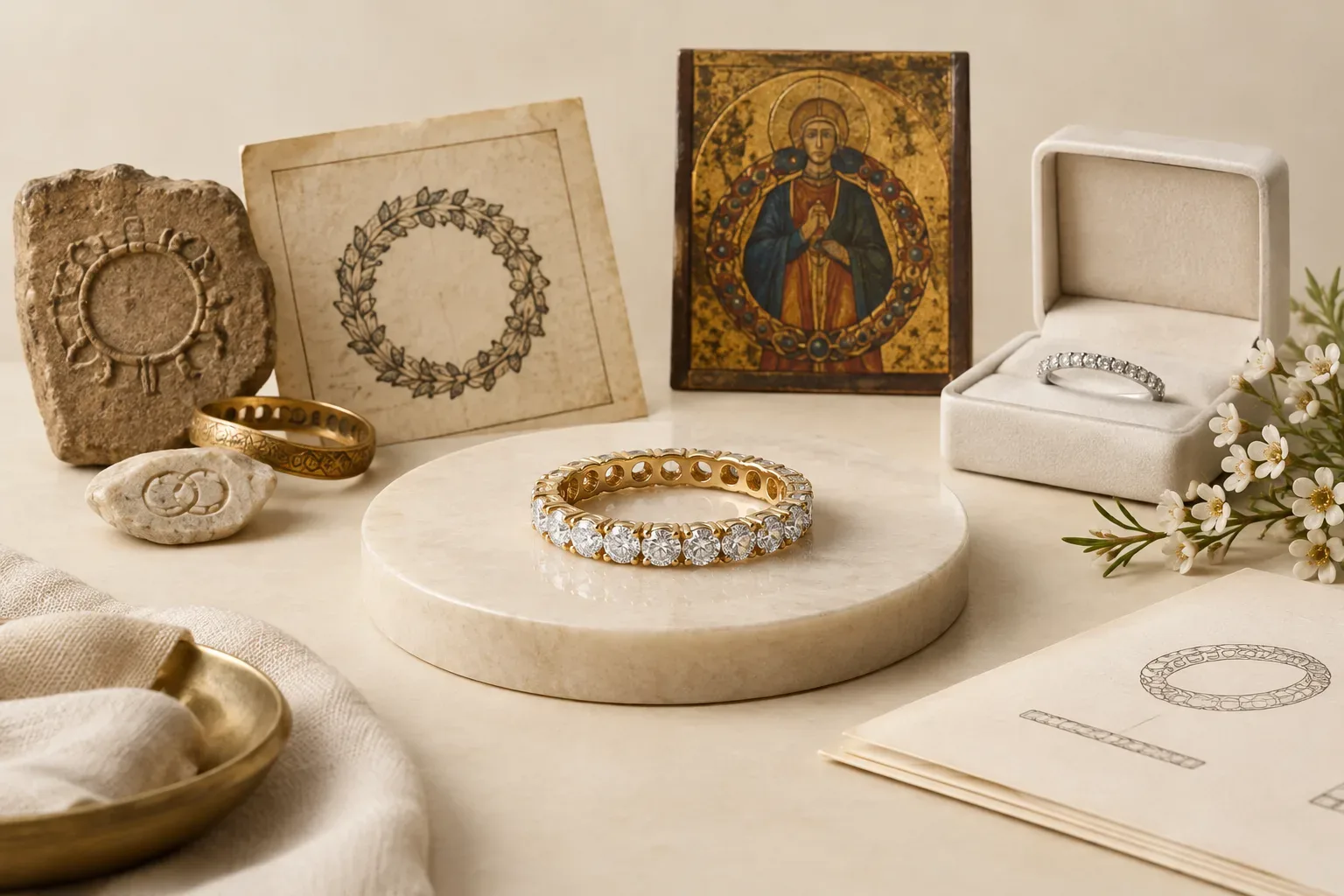
Museum collections and scholarship make clear that rings and repeating band motifs have long histories and changing uses across cultures and periods. The Victoria and Albert Museum (V&A) discusses jewellery as an object type whose form and social meanings evolve over time rather than carrying one fixed significance, and its materials and collections illustrate those shifts. Using the V&A’s work as the touchstone for historical claims helps keep the guide tied to documented examples rather than modern legend.
Archaeological and museum records cited by the V&A show repeated circles, continuous bands and repeating symbols appearing in multiple places: in ancient cultures where rings could signify rank or amuletic protection, in classical and medieval Europe where bands were worn for personal adornment and social signalling, and in later periods where gemstones and metalworking techniques changed available styles. The V&A’s A–Z of Gemstones also provides context for which stones were prized, where they were sourced from, and how their use changed with cutting and setting technologies.
Documented historical meanings versus modern personal interpretations
What is documented in museum records is not always the same as contemporary popular meaning. The V&A emphasizes that jewel meanings are historically contingent: similar shapes could mean different things in different cultures and periods. For example, continuous bands or repeating motifs in museum collections often relate to craftsmanship, status, or symbolic language of a specific time and place rather than a single universal concept of 'eternity.'
Modern shoppers and gift-givers frequently interpret an all-stone band as a symbol of unbroken commitment or 'eternal' love. That interpretation is a valid modern personal meaning, widely accepted in many present-day contexts, but it is a contemporary reading rather than a single documented historical function. Treat modern symbolic meanings as personal or cultural choices rather than universal facts.
How the motif, gemstones, and traditions appear in jewellery
In modern jewelry the term 'eternity ring' most often describes a band set with a continuous row—or in many designs a near-continuous row—of gemstones. These bands may be fully set around the circumference (sometimes called full or true eternity rings) or partially set across the top half (half-eternity rings) depending on design and practicality for resizing. The repeated stone work creates the visual effect of an unbroken line of sparkle that invites symbolic interpretations.
Gemstone choice and setting style influence both meaning and care. Historical and museum resources such as the V&A’s A–Z of Gemstones help identify typical stones used in rings and their technical differences. Diamonds are a modern favorite for brilliance and durability, while colored gems such as sapphires, emeralds, and rubies carry their own histories and visual characters. The stone cut, setting (channel, prong, or bezel), and metal (gold, platinum, or silver) determine how the ring looks, how comfortable it sits, and how it can be resized or repaired.
Photos and product descriptions: what to expect when buying online
High-quality listings make buying an eternity ring online considerably safer. Look for multiple photos showing the full circumference of the ring, close-ups of the setting and stone girdles, and images of any hallmarks or maker’s marks inside the band. Photo lighting should be neutral (not overly bright) so you can judge colour and sparkle without misleading enhancement.
Product descriptions should state the metal type and its purity, total gemstone carat weight and per-stone sizes where relevant, stone species and whether stones are natural, lab-grown, or treated, and whether the ring is a full- or half-eternity design. If the seller references a gemstone report or diamond grading certificate, the report issuer should be named and a copy should be available on request. The Federal Trade Commission (FTC) provides buyer guidance on disclosure: sellers must not misrepresent treated stones, synthetic stones, or imitations, and reputable sellers disclose treatments and origins of gems.
Policies, paperwork, and consumer protections
Before you buy, read the seller’s return policy, warranty terms, shipping insurance, resizing policy, and any customs or taxes for international orders. A reasonable return or exchange window is essential for a ring purchase because fit and appearance need to be checked in hand. Check whether the seller will resize a full-eternity ring—many full-eternity bands are difficult or impossible to resize without removing stones, and the product page should make that clear.
Ask for documentation. For diamonds and higher-value colored stones, ask whether a laboratory report is provided and which laboratory performed the report. For many treatments or synthetics, the FTC requires clear disclosure, and a trustworthy seller will provide transparent documentation about treatments, whether stones are natural or lab-grown, and any enhancements.
Red flags to watch for
Beware of listings with sparse or overly stylized photos, vague materials descriptions, missing contact information, or sellers that refuse to provide documentation on request. Extremely low prices can indicate imitation or undisclosed treatments. If a listing claims a significant grading report but cannot supply a copy on request, treat that as a serious warning. Sellers that force 'final sale' language with no returns on a first-time online purchase are higher risk.
Also be cautious about sizing and resizing claims. Full-eternity rings and channel-set continuous bands are often not easily resized; a seller should clearly state whether resizing is available and at what cost. If you need an alternate size, confirm return or exchange terms before purchase rather than assuming resizing is included.
Practical and respectful selection and gifting guidance
Choose purpose and context first. Eternity rings are commonly given for anniversaries, milestone birthdays, or as stacking additions to an engagement or wedding set, but there is no single rule. Consider the recipient’s existing jewelry, metal and stone preferences, and whether they wear rings daily. If you are unsure about sizing or style, a half-eternity band or a ring with a simple shared aesthetic can be a safer, more flexible choice.
Be culturally respectful. Jewelry customs vary across communities. Different cultures place rings on different fingers or attach different meanings to gifting. If the ring has a public or ceremonial meaning in the recipient’s culture or religion, enquire discreetly and respectfully with family or an informed friend rather than assuming that a modern Western reading applies.
If you are buying as a surprise, plan for resizing or exchange. Budget for insurance or appraisal if the ring is high value. Ask the seller about gift packaging and whether any personalization (engraving) will affect returnability. Finally, document the purchase: save photos, receipts, and any certificates in case you need appraisal, resale, or insurance later.
Putting it together: a simple buying checklist
Before you click buy, confirm you have clear, multiple photos including hallmarks; a complete written description of metal, stone species, stone weight, and whether stones are treated or lab-grown; a named lab report for significant stones if claimed; a fair return, resizing, and warranty policy; transparent contact details; and a price that matches the stated materials and paperwork. If any of these items is missing or contradicts other information, ask the seller to clarify or walk away.
Final thoughts
An eternity ring online shopping guide is most useful when it couples an awareness of the motif’s documented, context-dependent history with practical steps to verify the product and the seller. Museum scholarship such as that available through the Victoria and Albert Museum helps place the motif in historical perspective while consumer-protection guidance from agencies such as the FTC explains what sellers are expected to disclose. Together these perspectives let you choose or gift an eternity ring informed by both cultural understanding and sound shopping practice.
Frequently asked questions
What should photos of an eternity ring include?
Photos should show the full ring circumference, close-ups of the stones and setting, any hallmarks inside the band, and neutral lighting so colour and details are not misrepresented. If a seller advertises a grading report, ask to see a copy.
How can I tell whether the stones are natural, treated, or lab-grown?
Sellers should state whether stones are natural, lab-grown, or treated in the product description. For significant stones, reputable sellers will provide a laboratory report naming the testing lab. The FTC requires clear disclosure of treatments and imitations, so lack of disclosure is a red flag.
Can full-eternity rings be resized?
Many full-eternity rings are difficult or impossible to resize without removing or resetting stones. A trustworthy seller will state resizing options and costs clearly; if the listing is silent on resizing, ask before purchase.
What return and warranty policies should I expect?
Expect a clear return window or exchange policy for ring fit and appearance, a warranty for workmanship for a reasonable period, and information about shipping insurance and customs if buying internationally. Avoid sellers with strict 'no returns' rules on first-time purchases.
Are very low prices a sign of a fake or treated stone?
Extremely low prices can indicate imitation, undisclosed treatments, or poor quality. Compare prices across reputable sellers and check whether documentation is provided; absence of paperwork or evasive answers about materials is a red flag.
How should I gift an eternity ring respectfully?
Consider the recipient’s personal and cultural preferences, ask discreetly about finger and metal preference if you can, and plan for resizing or exchange. Avoid assuming a single symbolic meaning; discuss the gesture afterwards if the ring has cultural or religious implications for the recipient.
Should I insure an eternity ring bought online?
If the ring is high in monetary or sentimental value, buy appraisal documentation and consider insurance. Keep receipts, photos, and any lab reports to support an insurance claim or future resale.
Sources and further reading
- Bedazzled: A History of Jewellery — Victoria and Albert Museum
- An A-Z of Gemstones — Victoria and Albert Museum
- Buying Gemstones, Diamonds, and Pearls — Federal Trade Commission