Meaning at a glance
Get rings professionally sized and consider band width, knuckle fit, temperature and metal when building a stack; historical contexts recorded by the Victoria and Albert Museum show jewelry meanings change over time, and the FTC advises asking about gemstone treatments and imitations.
Why size and fit matter with stacking rings
Stacking rings are worn together in multiples on one finger or across fingers, and small differences in individual ring fit add up. Too-tight rings will pinch or stick when worn together; too-loose rings will rotate, spin, or slip off when neighboring bands press against them. Fit affects comfort, longevity of the jewelry, wear patterns, and how gemstones present visually in a group.
Because stacking relies on multiple contact points, the same ring that feels fine alone can become uncomfortable or unstable in a stack. For this reason, measurement and testing with the actual pieces you intend to combine are more important than trusting a single number in isolation.
Historical evidence and changing contexts
Museum scholarship emphasizes that jewelry styles and meanings are historically contingent. The Victoria and Albert Museum has documented how jewelry functions and fashion have changed with social context, technology, and taste, rather than being fixed across cultures or eras.
Across recorded histories, people have worn multiple rings for reasons that include status display, religious or commemorative function, and personal ornament. The V&A’s work on jewellery history traces these shifting uses and shows that stacked or multiple-ring wearing has recurred in different forms rather than originating as one single tradition.
When discussing historical evidence it is important to identify each culture or period precisely. For example, historical European signet and mourning rings played specific roles in their own contexts; the fact that people in other periods wore several rings does not mean they followed the same symbolic rules or sizing practices as modern stackers. The V&A’s exhibition and writings are useful for understanding these situated changes in meaning and style.
Separating documented historical meanings from modern interpretations
Documented historical meanings—such as the use of mourning rings to commemorate a death in specific Western periods, or the regulated display of rank through jewelry in certain courts—are matters of recorded social practice and are discussed by museum scholarship like that of the Victoria and Albert Museum.
Modern personal interpretations of stacking rings—such as assigning a specific color or stone to a life event, or using stacks as informal mood rings—are contemporary practices and personal choices rather than universal or historically mandated meanings. It is respectful and accurate to distinguish museum-documented functions from present-day symbolism that individuals or designers attach to stacks.
How stacking appears in jewelry: motifs, gemstones, and construction
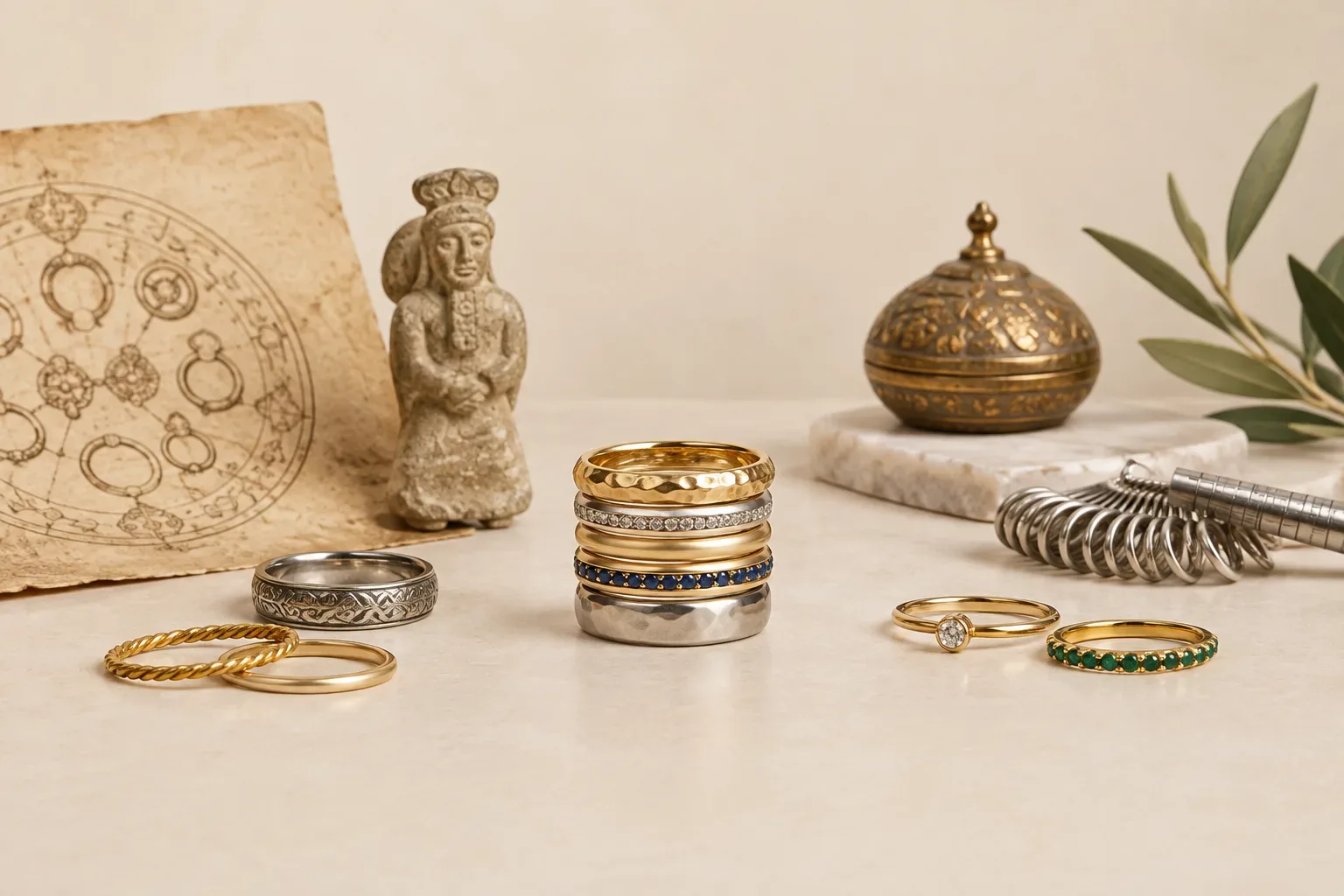
Stacked rings appear in many forms: slim plain bands, textured or patterned metal bands, thin gem-set rings often called stacking bands, and commemorative or engraved rings. Designers may use matching motifs across a set or deliberately mix metals and motifs for contrast. The Victoria and Albert Museum’s resources on gemstones and jewellery history describe how gemstones and settings have been used differently over time to achieve visual effect and social meaning.
Gemstones in stacks are typically set in low-profile settings to allow adjacent rings to sit flush; alternatively, bezel-set stones and flush-set accents are popular because they reduce catching. When mixing gemstones, consider color harmony and hardness. The V&A’s A–Z of Gemstones is a helpful reference for understanding historical and material contexts for different gems, including their behavior in daily wear and their traditional uses in jewelry making.
Construction details that affect fit include band thickness, internal profile (flat vs comfort-fit), and whether a ring has a tapered or contoured inner edge. Comfort-fit bands have a rounded interior that can feel easier on the finger when multiple rings press together, while flat interior bands may sit differently in a stack.
Practical measurement and fit advice
Professional sizing is the single most reliable first step. A trained jeweler will use calibrated ring sizers or a mandrel and can assess how a proposed stack will behave together. If you are measuring at home, measure at the end of the day when fingers are warm, avoid measuring in cold conditions when fingers are smaller, and remember that a sizer that slides on smoothly may still be too loose once the rings are combined.
Consider band width when choosing a size. Wider bands take up more finger surface and commonly require a slightly larger size for comfortable wear; conversely, extremely narrow bands can feel tighter when placed next to wider pieces. If you plan a very mixed stack—for example, a wide comfort-fit band beside several slim bands—test the combination before finalizing sizes.
Account for the knuckle. If your knuckle is significantly larger than the base of your finger, a slightly larger size may be needed so that rings slide over the knuckle without pinching at the base. Some wearers prefer a fit that is snug at the base but still slides over the knuckle, while others prioritize easier removal and choose a looser fit.
If you buy online, request a return or resizing policy and ask whether rings can be resized later without damaging gemstone settings or the design. Try on the actual ring combinations if possible; many jewelers will assemble a trial stack in-store so you can evaluate movement and comfort. If you cannot try rings together, order one representative piece first and test fit before buying additional pieces intended for the same stack.
Material considerations and disclosure
Metals, gemstones, and treatments affect how rings wear together and how they should be sized. Softer metals like gold of higher karat are more prone to wear and can deform slightly over time, which changes fit. If you plan frequent wear, discuss metal hardness and long-term durability with the seller.
The Federal Trade Commission recommends that buyers ask about gemstone treatments and imitations and expect clear disclosure. Treatments can affect a stone’s appearance and value, and some treatments can be damaged during resizing or repair. When stacking rings with multiple gemstones or mixed metals, ask the seller for treatment disclosures and for recommendations on care to avoid damaging settings or adjacent stones during maintenance.
Selection and gifting guidance
When selecting stacking rings as gifts, think about the recipient’s existing jewelry and lifestyle rather than assuming a universal code. Ask whether they typically wear rings on the same finger, how many rings they usually wear together, and whether they prefer subtle or statement looks. If you cannot ask directly, choose versatile pieces: slim bands in a neutral metal and low-profile settings are safe starting points.
For a personalized gift, consider a starter set: one central ring with one or two complementary slim bands. Include a receipt and information about resizing and returns so the recipient can adjust fit if needed. If you’re combining different metals as a stylistic choice, be mindful that some people have metal sensitivities, and mixing metals can complicate future repairs or resizing.
Be respectful of cultural and religious practices. Since the historical meanings of rings vary by time and place, avoid assuming that a particular combination carries the same meaning for the recipient as it did historically. If a ring carries specific religious or cultural symbolism, consult the recipient or an expert from that tradition before gifting.
Care, adjustments, and when to consult a jeweler
Regular inspection is important when rings are worn together. Check for loosened settings, friction wear where bands contact, and any changes in fit. If narrowing or resizing is needed, consult a professional jeweler, especially for rings with gemstones, intricate settings, or mixed metalwork.
Some adjustments, such as adding a slight bevel or a sleeve to a ring in a stack, can improve comfort without full resizing. A jeweler can recommend reversible solutions like ring guards or silicone inserts if temporary change in fit is preferred. For permanent resizing, be aware that resizing can alter the appearance of engraved or patterned bands and that stones close to the shank may complicate the process.
Frequently asked questions
How should stacking rings fit individually?
Each ring should feel secure at the base of the finger without cutting circulation and still be able to slide over the knuckle with manageable pressure; test rings together because the combined effect can change how individual bands feel.
Do wider bands need a different size?
Wider bands often require a slightly larger size for comfort because they contact more of the finger surface; consider trying the exact wide band with your intended stack before committing.
Can I resize one ring in a stack later?
Many plain metal rings can be resized, but rings with full pavé, complex settings, or mixed metals may be difficult or risky to alter; ask your jeweler about the specific piece before purchasing.
When is professional sizing necessary?
Professional sizing is advisable whenever possible, especially if you have knuckle-size differences, plan a mixed-width stack, or buy rings that contain gemstones or detailed work that could be affected by resizing.
How do gemstone treatments affect stacking and resizing?
Some treatments can be sensitive to heat, solvents, or mechanical stress; the Federal Trade Commission recommends asking about treatments and disclosure because certain treatments might be affected during repair or resizing.
What if I want to gift stacking rings but don’t know the size?
Choose adaptable options such as slim low-profile bands, include a clear return or resizing policy, or give a gift certificate and suggest a shared appointment to size and select rings together.
Sources and further reading
- Bedazzled: A History of Jewellery — Victoria and Albert Museum
- An A-Z of Gemstones — Victoria and Albert Museum
- Buying Gemstones, Diamonds, and Pearls — Federal Trade Commission