Meaning at a glance
Explain the documented history and changing contexts of the solar eclipse motif, separate cultural or religious evidence from later popular interpretations, and give practical guidance for choosing and wearing the motif in modern jewelry.
Short answer
Solar eclipse jewelry meaning is best described as historically variable and often modernly personal: museum collections show celestial motifs—including sun and moon imagery—appearing in many periods, but direct, consistent evidence that any culture used an "eclipse" motif with one single meaning is limited. The most reliable conclusion is that eclipse imagery draws on long-standing human interest in the sun and moon; modern wearers layer personal, aesthetic, or symbolic meanings onto that motif. This article explains the documented history and changing contexts, separates historically attested meanings from later or contemporary interpretations, and offers practical guidance for choosing and gifting eclipse-inspired jewelry.
What historical evidence shows
Museum scholarship and collections demonstrate that celestial themes have been part of jewellery design for many centuries, appearing in varied forms from antiquity through the modern era. Curatorial surveys of jewellery history make clear that motifs referencing the sun, moon, stars and other celestial phenomena recur because they carry visual power and resonate with changing fashions and technologies rather than a single, stable meaning (Victoria and Albert Museum, Bedazzled: A History of Jewellery).
The Victoria and Albert Museum's work on jewellery history emphasizes how motifs and materials shift with social context, patronage, and technology. For example, advances in enamelling, gem cutting and metalworking allowed jewelers across periods to depict complex natural and celestial forms more convincingly, and the popularity of any motif often reflects broader cultural interests—scientific curiosity about the heavens at one moment, sentimental uses of moon imagery at another—rather than an unbroken symbolic tradition (Victoria and Albert Museum, Bedazzled: A History of Jewellery).
Evidence in museum collections tends to identify the presence of celestial imagery (sun discs, crescent moons, star motifs and coronas or rays) rather than a clearly documented, cross-cultural meaning specifically labeled as an "eclipse" symbol. That means historians and curators can trace styles and techniques and relate them to fashion and technology, but direct documentary sources tying a single, uniform belief about eclipses to a particular jewellery type are scarce in the general survey literature (Victoria and Albert Museum, Bedazzled: A History of Jewellery).
Separating documented historical meanings from modern interpretations
Documented historical meanings are the ones that curators and primary sources can support: for instance, the V&A notes how mourning jewellery, romantic lockets and celestial fashion trends each had specific social uses in particular periods. If a museum catalogue identifies a piece as Victorian sentimental jewellery using moon imagery to signify yearning or memory, that interpretation is tied to documented context and sources (Victoria and Albert Museum, Bedazzled: A History of Jewellery).
Modern personal interpretations are distinct. Contemporary descriptions that present eclipse jewellery as shorthand for transformation, balance, or spiritual rebirth are often recent layers of meaning applied by designers, marketers, or wearers rather than phrases traced back to a single historically documented tradition. Those modern layers are valid as personal symbolism but should not be treated as universally historical.
Where historical sources are silent, it is appropriate to frame meanings as plausible or contemporary rather than factual history. For example, a necklace that pairs a black stone and a bright halo may evoke an eclipse to a modern viewer; museums can document the style and materials but cannot always document the original owner’s intention unless there are supporting records (Victoria and Albert Museum, Bedazzled: A History of Jewellery).
How eclipse motifs, gemstones, and techniques appear in jewellery
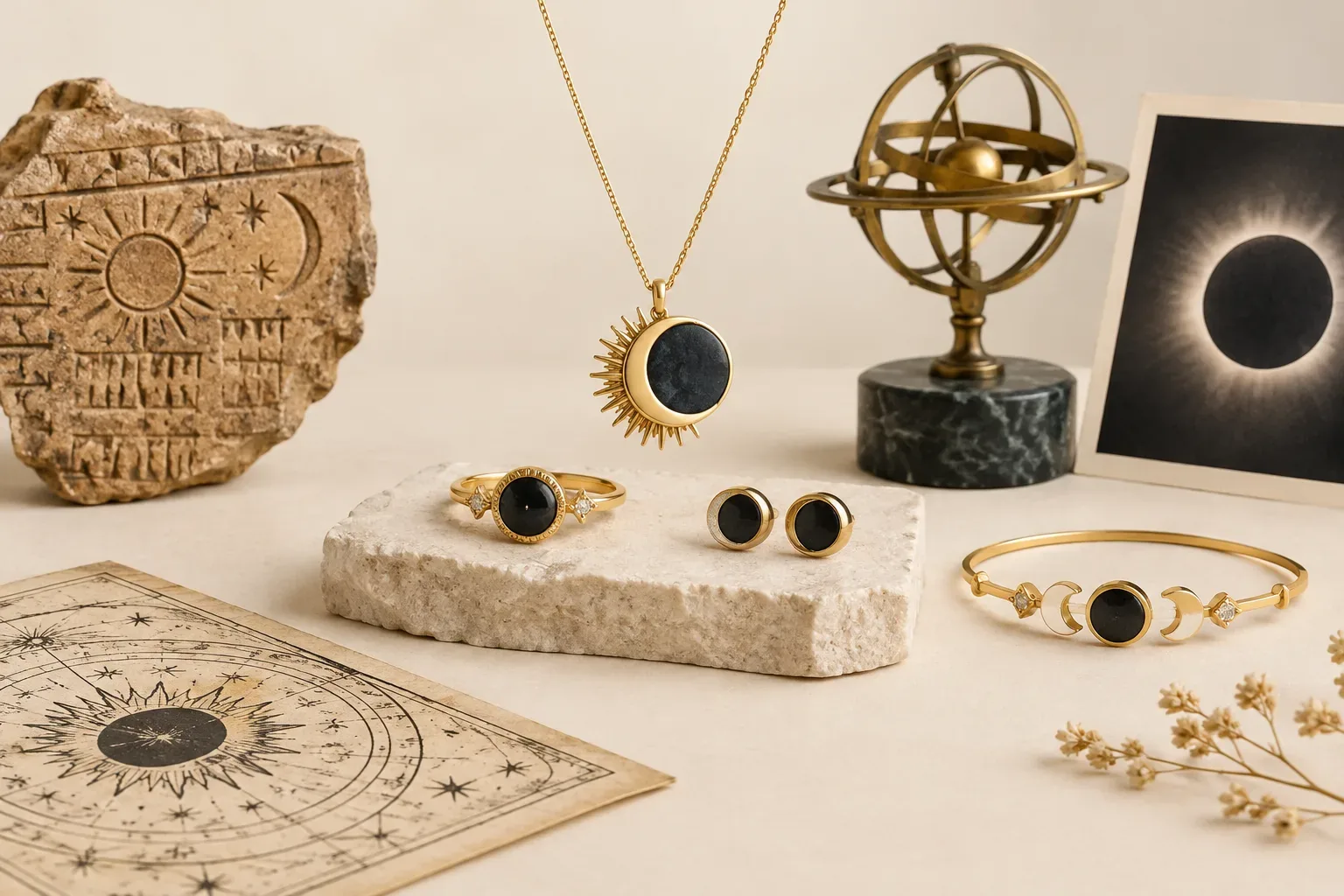
Eclipse-inspired designs typically use a combination of contrasting colors and textures to suggest obscuration and corona. Designers often depict these ideas with a dark central stone or enamel disc surrounded by rays, halos, or inset gems to simulate sunlight peeking around the moon. Period and contemporary pieces achieve this effect through enamelling, pierced metalwork, relief carving, and gem-setting techniques that are familiar across jewellery history (Victoria and Albert Museum, Bedazzled: A History of Jewellery).
Gemstones and materials commonly used to suggest darkness or lunar light include onyx, jet, black enamel and dark-colored tourmaline to represent shadowed areas, and diamonds, white sapphire, seed pearls, opals or moonstone to suggest light, corona or the moon’s glow. The V&A’s A–Z of Gemstones provides helpful descriptions of these stones and their traditional uses in jewellery, which designers draw on when composing contrast-based motifs (Victoria and Albert Museum, An A–Z of Gemstones).
Techniques that historically allowed jewelers to convey celestial effects—such as pavé settings for sparkling coronas, cabochon cutting for moonlike surfaces, and guilloché beneath translucent enamel—are all documented in museum literature as part of the crafts repertoire that makers use to evoke the heavens (Victoria and Albert Museum, Bedazzled: A History of Jewellery). These technical choices inform how an eclipse concept is rendered: simple silhouette pendants, elaborate brooches showing sun-and-moon faces, or modern minimalist charms that imply alignment rather than literal representation.
Practical and respectful selection or gifting guidance
Match the piece to the recipient’s tastes and knowledge: if the person values historical authenticity and museum-backed stories, choose designs that clearly reference historical styles and materials and can be explained as such. If they prefer contemporary symbolism, select a piece with a clear modern message from the maker or designer. Avoid assuming that an eclipse motif carries the same cultural or religious weight for every wearer.
Consider materials and disclosure. When gemstones or treatments are important to you or the recipient, rely on transparent seller information. The U.S. Federal Trade Commission emphasizes that consumers should expect accurate disclosure about gemstone treatments, simulants, and whether a piece is natural or lab-grown, so ask sellers for clear statements on treatments and origin before purchasing (Federal Trade Commission, Buying Gemstones, Diamonds, and Pearls).
Be mindful of cultural and religious sensitivities. Some communities attach particular sacred meanings to celestial events; if you are gifting to someone whose faith or cultural background makes certain celestial events significant, ask respectfully about preferences before presenting a symbolic gift. If you are unsure, choose a design that emphasizes aesthetic beauty or personal meaning rather than claimed spiritual authority.
Choose quality appropriate to the occasion. For an everyday wearable piece, well-made plated metals and simulated stones can be meaningful and affordable. For heirloom intentions, opt for solid metals and properly certified gemstones. The V&A’s museum perspective on jewellery history reminds us that jewellery’s social roles have ranged from fashion to sentiment to status, so let the intended role guide material choices (Victoria and Albert Museum, Bedazzled: A History of Jewellery).
If you want an example to examine style and scale before buying, museum reproductions and contemporary artisan pieces are useful references. For a contemporary commercial example showing how modern makers combine sun-and-moon shapes into an "eclipse" effect, see a typical solar eclipse pendant on a contemporary maker’s product page as an example of current design vocabulary (Solar Eclipse Necklace, Rimossa).
Caring for eclipse-inspired jewellery
Care depends on materials. Use a soft cloth for gold and silver and avoid ultrasonic cleaners for delicate opals or treated stones. For plated pieces, limit exposure to moisture and perfumes to prolong finish. If a piece includes glued components, treat it gently and consult a professional jeweller for repair rather than attempting household fixes.
When buying gemstones, request full disclosure of any treatments or enhancements, since care and durability depend on those facts. The Federal Trade Commission guidance underscores the importance of asking sellers about treatments to make informed choices and to understand long-term care needs (Federal Trade Commission, Buying Gemstones, Diamonds, and Pearls).
Final note
Solar eclipse jewelry meaning sits at the intersection of long-standing celestial imagery recorded in museum collections and the individual meanings people assign today. Museums like the Victoria and Albert Museum document how motifs and materials shift with fashion, technology and social use, which helps place eclipse-inspired pieces in historical context. At the same time, modern wearers and designers give the motif fresh significance. Choosing or gifting an eclipse piece is an opportunity to combine respect for historical nuance, material honesty, and sensitivity to the recipient’s beliefs and tastes.
Frequently asked questions
Is there historical proof that people wore "eclipse" jewellery for specific beliefs?
Direct evidence that a single, clearly defined "eclipse" motif carried one uniform belief across cultures is limited. Museum research shows celestial imagery in many periods, but curators emphasize that meanings shift with social context and technology; when a documented interpretation exists it is typically tied to a particular culture, maker or occasion rather than an across-the-board tradition (Victoria and Albert Museum, Bedazzled: A History of Jewellery).
Which gemstones best suggest an eclipse in a piece of jewellery?
Designers commonly use dark stones such as onyx or jet to suggest shadow and moonstone, opal, pearls or diamonds to suggest light or a corona. The V&A’s A–Z of Gemstones provides background on these stones and how jewellers historically used them for contrast and effect (Victoria and Albert Museum, An A–Z of Gemstones).
How can I be sure a gemstone is natural and treated-free?
Ask the seller for full disclosure about treatments, enhancements and whether the stone is natural, lab-grown or a simulant; the U.S. Federal Trade Commission advises consumers to expect accurate information on gemstone treatments and origin so they can make informed purchases (Federal Trade Commission, Buying Gemstones, Diamonds, and Pearls).
Could giving eclipse jewellery be offensive to someone’s culture?
Possibly—celestial events have special meanings in some religious and cultural traditions. If you suspect a piece might touch on sacred beliefs, ask the recipient sensitively or choose a neutral or purely aesthetic design. Research and respectful conversation are better than assumptions.
Are modern eclipse designs faithful to historical styles?
Some modern pieces explicitly reference historical techniques and styles, while others use the eclipse idea as a contemporary graphic motif. Museums note that designers borrow historical motifs but adapt them to modern tastes and technologies (Victoria and Albert Museum, Bedazzled: A History of Jewellery).
How should I care for an eclipse pendant that mixes dark enamel and small diamonds?
Clean gently with a soft cloth and avoid harsh chemicals. If the piece contains delicate stones such as opal or glued elements, consult a professional jeweller for cleaning and repairs, and follow any specific care guidance the seller provides.
Sources and further reading
- Bedazzled: A History of Jewellery — Victoria and Albert Museum
- An A-Z of Gemstones — Victoria and Albert Museum
- Buying Gemstones, Diamonds, and Pearls — Federal Trade Commission