Meaning at a glance
This guide outlines the limited documented historical context for fossil motifs in jewelry, distinguishes museum-documented facts from later personal and popular meanings, and gives practical advice for authenticating, selecting, and caring for sea urchin fossil jewelry.
Quick answer
A responsible sea urchin fossil jewelry buying guide explains the documented history and changing contexts of fossil motifs, separates museum-documented cultural evidence from later popular or personal interpretations, and offers practical advice for assessing authenticity, requesting treatment disclosures, and caring for fossil-based pieces.
What the historical record shows (and what it doesn't)
Museum research into jewellery emphasises that materials and motifs shift meaning across time and cultures; the Victoria and Albert Museum (V&A) places jewellery in social and historical context and documents how collectors and makers have used natural materials to express taste, identity, and memory. The V&A’s resources on jewellery history show that fashions and the choice of organic materials respond to changing social interests and scientific discoveries rather than having a single, stable symbolism.
That background helps explain why fossil and natural-history themes appear in some historic jewellery: interest in collecting natural specimens and in showing connections to the natural world influenced 18th- and 19th-century tastes. However, the specific archaeological or ethnographic evidence tying sea urchin fossils to particular ritual uses or to a consistent symbolic meaning across cultures is limited in the published museum literature cited by this guide. In short, while museums document the broader role of natural specimens in jewellery history, they do not provide a single, well-documented cultural narrative that makes a universal claim about the sea urchin fossil motif.
Documented meanings versus modern and personal interpretations
Documented meanings recorded by museums and historical research are typically about general trends—for example, that Victorian collectors prized natural specimens or that makers incorporated unusual materials to signal scientific curiosity or social status. Those are contextual observations, not culture-spanning symbolic claims. The V&A’s work on jewellery history helps you place fossil motifs within these broader patterns.
Modern interpretations often layer new personal, regional, or commercial meanings on top of an object. Contemporary wearers and designers may associate sea urchin fossils with the sea, resilience, longevity, or ancestral memory, but those are contemporary symbolic readings rather than museum-documented historical functions. Treat those modern associations as personal or stylistic choices rather than universal or historically proven meanings.
How sea urchin fossils and similar motifs appear in jewellery today
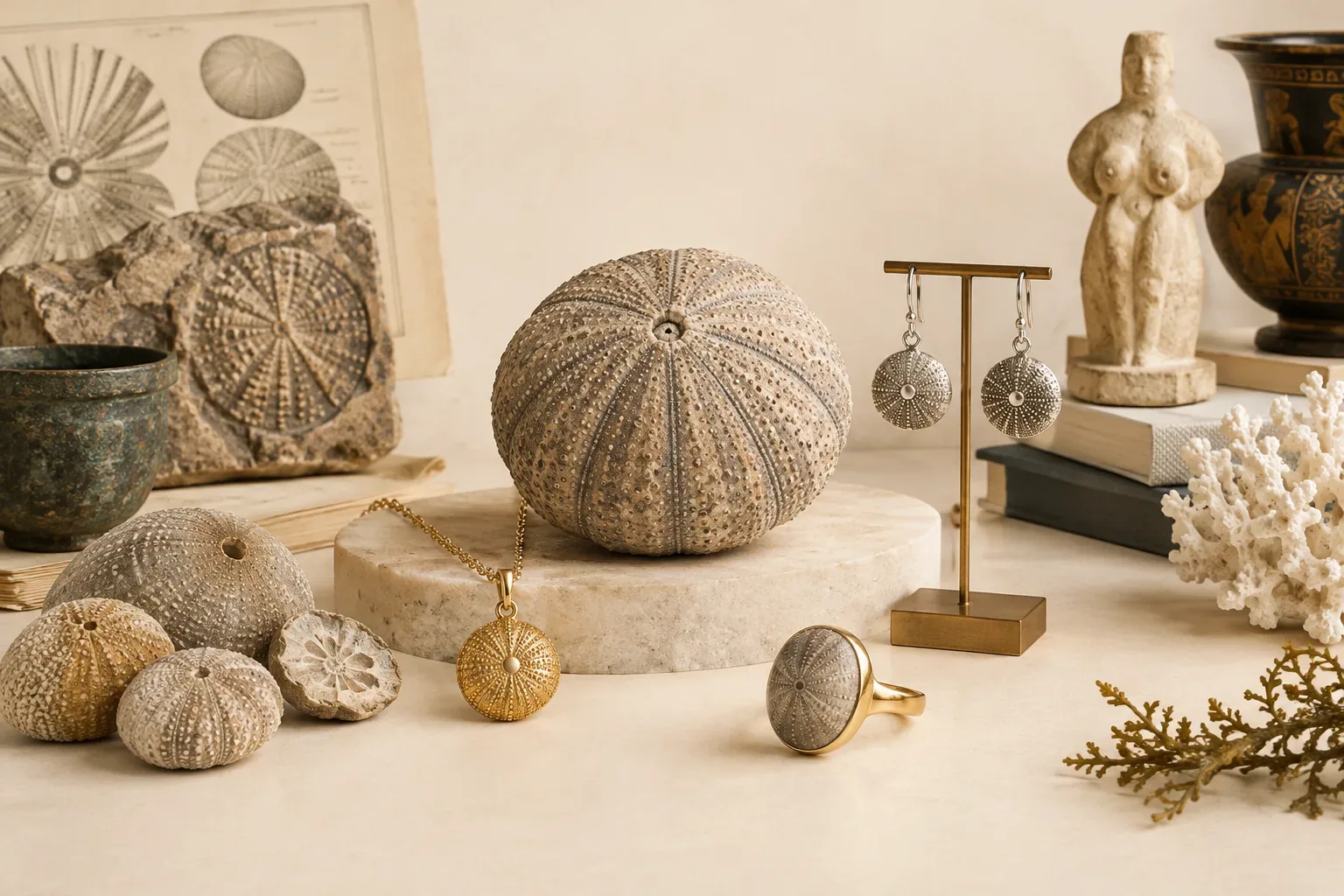
Designers and artisans use sea urchin fossils and fossilised echinoid material in several common ways: whole or partial fossil specimens set as pendants or brooches, polished cross-sections used as inlaid cabochons in rings and bracelets, and fossil fragments drilled as beads for necklaces. Contemporary settings range from minimalist bezels that highlight the fossil surface to ornate mounts that combine metalwork with gemstones.
Some pieces emphasise the natural surface with minimal alteration, while others polish or stabilise the material and pair it with metals or stones to create a refined look. Because contemporary makers vary in how much they alter the fossil, visual examination and seller documentation are important for understanding whether the piece is presented as a natural specimen or as a modified/treated material.
Authenticity, treatments, and what sellers should disclose
When assessing authenticity, ask the seller for provenance (where the specimen was sourced), clear photographs showing the fossil’s surface and profile, and any professional reports if available. Natural fossils typically show traces of matrix, growth patterns, and small imperfections that are difficult to reproduce perfectly in synthetic imitations. Sellers who work with reputable dealers or lapidaries may supply documentation about stabilisation or any added backing or adhesives.
Federal guidance on buying gemstones, diamonds, and pearls highlights that sellers should disclose enhancements, imitations, and treatments. The U.S. Federal Trade Commission (FTC) advises that consumers be told when a material has been treated, dyed, stabilised, or is an imitation. Apply the same expectation to fossils: ask explicitly whether a fossil has been stabilised with resin, dyed to enhance contrast, or combined with composite materials, and request that this be stated in writing before purchase.
Practical tests and professional help
A few non-destructive checks you can reasonably perform from photographs or in person include examining magnified images for tool marks and consistent grain that might indicate a cast or replica, checking for obvious seams where natural and synthetic materials meet, and noting whether the fossil’s surface shows natural pitting and weathering. These observations are not conclusive; many high-quality treatments are subtle and require specialist equipment to detect.
For high-value pieces, ask for an independent assessment from a qualified gemmologist or a conservator with experience in organic materials. A professional can test for resins, stabilising agents, and dyes, and can advise on the piece’s overall condition and long-term stability.
Selection and ethical gifting guidance
Decide first what the fossil motif means to you or the recipient. If the buyer values natural history authenticity, prioritise documented provenance and minimal alteration. If the buyer wants a durable, wearable object for everyday use, look for professionally stabilised pieces mounted in protective settings and ask the maker about long-term wearability.
Be culturally and environmentally respectful when gifting. Avoid claiming a single cultural symbolism for sea urchin fossils; instead, explain the modern or personal meaning you attach to the piece. If provenance is unclear, avoid implying that a fossil has archaeological or ritual significance for a specific culture. When possible, choose sellers who provide transparent sourcing information and who follow legal and ethical collecting practices.
Care and maintenance for fossil jewellery
Treat fossil material as organic and potentially porous. Protect pieces from strong household chemicals, acidic cleaners, and prolonged exposure to direct sunlight or heat, which can affect stabilising resins or natural material. Remove fossil jewellery before swimming in chlorinated or salt water to avoid salt or chlorine damage to metal mountings and to any stabilisers.
Clean fossils gently with a soft, dry cloth or a soft brush and mild, diluted soap if needed, drying thoroughly afterwards. Avoid ultrasonic cleaners and steam cleaning, which can penetrate porous organic materials and disrupt adhesives or stabilising treatments. For valuable or fragile items consult a professional conservator or a jeweller experienced in organic materials before attempting restoration or repair.
Buying checklist and red flags
Before you buy, ask the seller for provenance information, treatment disclosures, clear photos of the fossil from multiple angles, and any professional reports. Confirm the return policy and whether treatment disclosures are written into the sales invoice. For higher-value purchases, seek an independent assessment.
Red flags include sellers who refuse to disclose treatments or provenance, pieces sold with vague language like "natural look" without specifications, prices that seem inconsistent with comparable documented pieces, and obvious reproduction signs such as uniform texture that lacks natural variation. When in doubt, pause the purchase and obtain more documentation.
Final considerations
Sea urchin fossil jewellery sits at the intersection of natural history and contemporary design. Museum research shows that materials and motifs carry changing meanings over time, so value statements about fossil jewellery should make clear whether they are historically documented, modern interpretations, or personal associations. Use provenance, treatment disclosures (as advised by the FTC), and professional advice to guide purchase decisions, and select mounts and maintenance routines that reflect the object’s fragility and the recipient’s tastes.
Frequently asked questions
Are sea urchin fossil jewellery pieces authentic fossils or man-made replicas?
They can be either. Authentic fossil pieces are natural specimens that may be stabilised or mounted; replicas are cast or manufactured to imitate fossil texture. Ask the seller for clear provenance, photographs, and written disclosure of any treatments or composites. For high-value items, obtain an independent assessment from a qualified gemmologist or conservator.
Do sellers have to disclose treatments or stabilisation?
Yes. Guidance from the U.S. Federal Trade Commission (FTC) recommends that sellers disclose enhancements, imitations, and treatments for gemstones and similar materials, and the same expectation applies to fossils used in jewellery. Ask for written disclosure of any resins, dyes, adhesives, or other stabilising procedures before purchase.
How should I care for sea urchin fossil jewellery?
Treat fossil jewellery gently: avoid harsh chemicals, prolonged sun or heat exposure, and ultrasonic or steam cleaning. Clean with a soft cloth or soft brush and mild soap when needed, and store pieces separately to prevent abrasion. For valuable or fragile items, consult a conservator or jeweller experienced with organic materials before any repair or deep cleaning.
Can I wear fossil jewellery every day?
That depends on how the fossil is prepared and set. Professionally stabilised fossils mounted in protective settings are more wearable than untreated, delicate specimens. Confirm with the seller how the piece was treated and how the maker recommends wearing it, and follow conservative care practices to prolong its life.
Is it respectful to gift a fossil jewellery piece with claimed cultural significance?
Be cautious. If a seller or label asserts that a fossil has specific cultural or ritual significance, request supporting documentation. Avoid attributing cultural meanings without evidence and consider choosing a piece with clear provenance and transparent descriptions. When in doubt, explain your personal meaning for the piece to the recipient rather than asserting an unverified cultural claim.
Sources and further reading
- Bedazzled: A History of Jewellery — Victoria and Albert Museum
- An A-Z of Gemstones — Victoria and Albert Museum
- Buying Gemstones, Diamonds, and Pearls — Federal Trade Commission