Meaning at a glance
Documented sources show that jewelry motifs and gemstones acquire changing meanings through time; there is little museum-documented evidence that real fish fossils carried established symbolic roles across specific historic cultures, and most symbolic uses today are personal or modern reinterpretations. Buyers should check provenance, disclosure of treatments, and stylistic context when selecting or gifting fish fossil jewelry.
Natural history in brief: what a fish fossil is and why people make jewelry from them
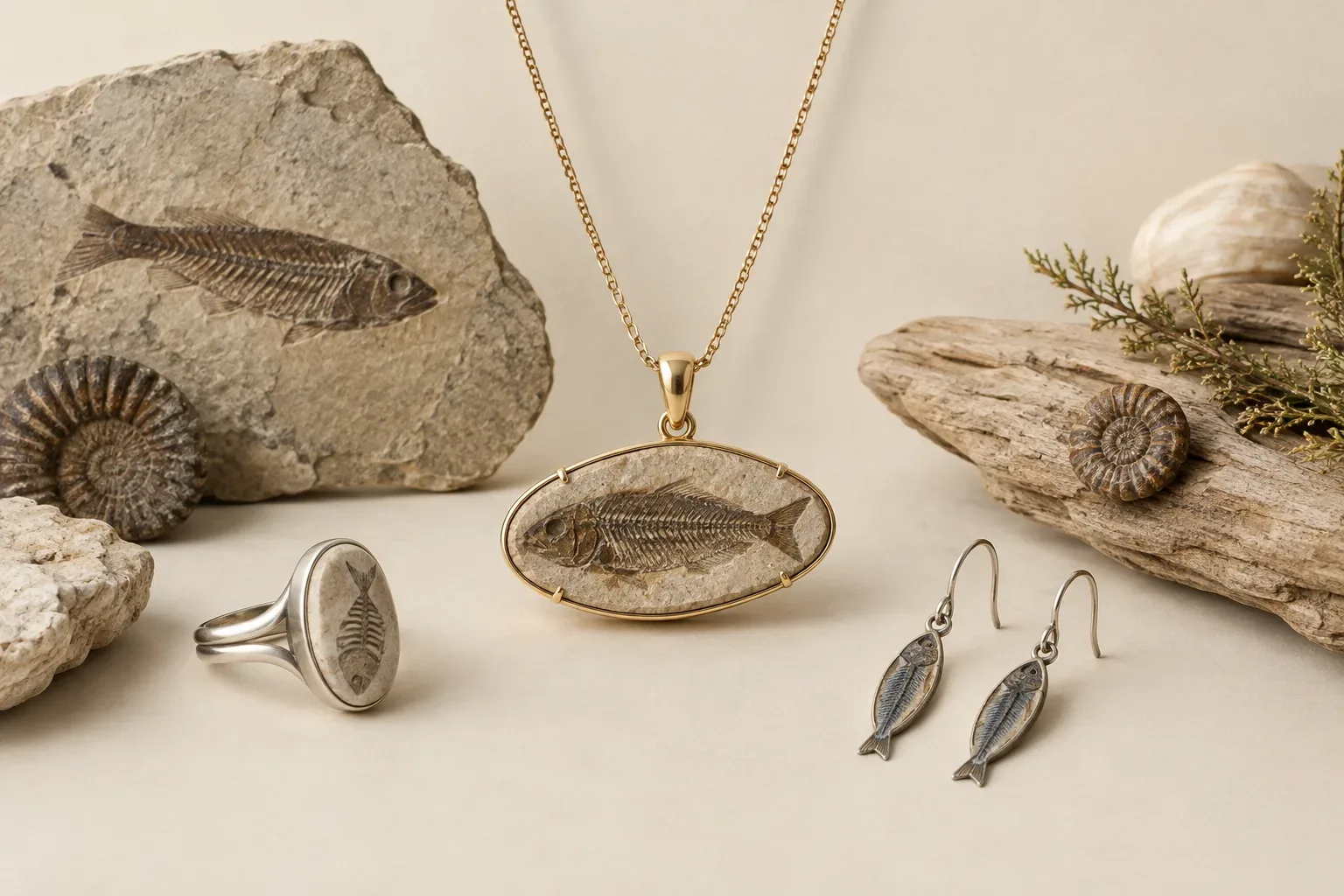
A fish fossil is the mineralized or otherwise preserved remains and impressions of an ancient fish. Fossils are naturally durable objects that can be displayed whole (as a slab) or worked—cut, polished, stabilized and mounted—so they can be worn as pendants, brooches or cufflinks. The aesthetic appeal is often a mix of pattern, texture and the idea of deep time: the wearer carries an ancient remnant of life.
Collectors and jewellery makers are attracted to fish fossils for the distinctive visual contrast between bone impressions, mineral matrix, and the stone that hosts the fossil. Those physical qualities make fossils suitable for a range of settings, from simple bezel mounts to museum-style miniature frames.
What the historical record actually shows
When historians and museums examine jewellery across eras, they show that motifs and materials take on different meanings in different cultures and periods rather than maintaining universal symbolic content. The Victoria and Albert Museum frames jewellery as a social and material practice whose meanings shift with fashion, technology and social circumstance, and whose recorded examples concentrate on popular motifs and gem materials used in identifiable historical contexts rather than an exhaustive inventory of every possible natural object used as ornament.
Importantly, the V&A's accessible histories and reference materials document many traditional motifs and gemstone usages but do not present a body of evidence that real fish fossils constituted a recurring, discrete symbolic tradition across named ancient cultures. In short, museum literature supports the idea that jewellery meanings change and are contestable, and it does not identify a continuous, cross‑cultural symbolic role for fossil fish in premodern jewelry.
Documented historical meanings versus modern interpretations
Documented historical meanings are those that appear repeatedly in period sources, surviving objects, or well‑attested historical commentary. The V&A demonstrates how such meanings are tied to context—for example, mourning jewellery or religious signets in particular eras—because the objects and their contexts survive in substantial numbers and are described in contemporaneous records. For fish fossils, that kind of repeatable documentary evidence is lacking in the V&A materials supplied for this article.
Modern interpretations are personal, artistic, or market‑led associations people make today. Contemporary wearers and designers often ascribe meanings such as longevity, connection to nature, or a love of paleontology to fish fossil pieces. These are valid personal symbols but they are not the same as historical, culturally documented meanings. Make that distinction explicit when you describe a fossil piece to someone else: say whether you mean a traditional, historically attested meaning or a modern, personal one.
How the motif and the fossil material appear in jewelry
Fish fossil jewellery appears in several practical forms. Some makers set small polished slabs or cross‑sections of matrix containing visible fish impressions into metal bezels. Others mount whole thin slabs behind glass in pendants and brooches to show the specimen intact. Designers also use cast or carved fish motifs that reference fossils without using real fossil material; those motifs follow the long tradition of figurative ornament in jewellery history described by the V&A.
From a gem‑and‑material perspective, fossil pieces may be presented like other lapidary items: cut to shape, polished, and sometimes stabilized with resins or adhesives so they survive handling. The Victoria and Albert Museum’s overview of gemstones and historic jewellery underscores that how a material is worked and displayed affects its social meaning and value. For buyers, therefore, consider whether a piece uses an unaltered fossil, a stabilized specimen, a repaired fossil, or a purely decorative cast motif inspired by fossils.
Responsible selection, disclosure and gifting
Ask about provenance and treatment. The Federal Trade Commission requires sellers to disclose treatments, imitations and enhancements for gemstones and similar materials, and that principle applies in practice to fossil materials: legitimate sellers should explain whether a fossil has been stabilized, repaired, or combined with other substances. If a seller does not volunteer that information, ask directly and insist on a written description before purchase.
Prioritize reputable sellers and transparent descriptions. Museum shops, natural‑history dealers who publish provenance, and established independent jewellers who document materials and treatments offer the clearest buying path. If you are buying as a gift, explain whether the symbolic meaning is historical or personal and, if appropriate, include a note that explains the piece’s provenance and any modern interpretation you intend to convey.
Be respectful of contexts. Because fish shapes and fish iconography can have religious or cultural resonances in some traditions, avoid claiming universal sacred meaning for a fossil piece. If you plan to gift a fossil to someone whose cultural or religious identity might intersect with aquatic symbols, ask or choose an alternative motif if you are unsure. If the item is intended as a memorial or sentimental token, be explicit about its personal meaning to avoid misleading historical claims.
Care, wear and longevity
Treat fossils like delicate lapidary material. Fossils can be brittle, especially along fracture lines or in areas of matrix with different hardness. Avoid exposure to strong chemicals and continuous moisture; remove fossil jewellery for showering or swimming unless the maker confirms it has been stabilized and sealed for such wear.
Ask the seller about recommended care and about repair options. Good sellers will provide care instructions and will explain whether a fossil can safely be re‑mounted or repaired by a lapidary or jeweller without damage. If a fossil is mounted under glass, check that the setting protects rather than traps moisture or allows rubbing that could abrade the specimen.
Frequently asked questions
Does a fish fossil piece have a single historical meaning?
No. Museum literature on jewellery history shows meanings change by time and place, and there is not a documented, cross‑cultural historic meaning for real fish fossils; most symbolic significance attached to fossil fish today is modern or personal.
How can I be sure a fossil in jewellery is authentic and not an imitation?
Buy from reputable sellers who disclose provenance and treatments. Ask whether the specimen has been stabilized, repaired or combined with other materials and request written confirmation. The Federal Trade Commission recommends that sellers disclose treatments and imitations for gem materials, and the same transparency is good practice for fossils.
Is it respectful to gift fish fossil jewelry as a symbol?
Yes, if you are clear about intent. Avoid asserting a universal sacred meaning. If the recipient's cultural or religious background engages fish symbolism, ask or choose a design with clearly documented meaning to avoid unintended offence.
How should I care for fossil jewelry?
Treat fossils like fragile lapidary materials: avoid chemicals and prolonged moisture, remove pieces for strenuous activity, and follow the maker’s care instructions. If a fossil is stabilized, confirm whether it is safe for everyday wear.
Can museums help me research the historical meaning of a jewelry symbol?
Yes. Museum catalogues and interpretive texts—such as the Victoria and Albert Museum’s resources on jewellery history and gemstones—are useful starting points to verify whether a meaning is historically documented or a modern interpretation.
Sources and further reading
- Bedazzled: A History of Jewellery — Victoria and Albert Museum
- An A-Z of Gemstones — Victoria and Albert Museum
- Buying Gemstones, Diamonds, and Pearls — Federal Trade Commission