Meaning at a glance
Document the ruby’s long presence in jewellery history, keep historical meanings separate from modern personal symbolism, and provide clear, practical guidance on warning signs, cleaning, safe storage, when to consult a professional, and respectful gifting considerations.
Quick answer
Documented sources show that rubies have appeared in many jewellery traditions and social contexts; separating that documented history from later personal meanings helps us choose and care for ruby pieces responsibly. For repair and maintenance: inspect settings and stones regularly, clean gently with warm water and mild soap, avoid risky treatments like ultrasonic cleaning for rubies with fractures or fillers unless a gem specialist confirms it is safe, and consult a qualified jeweller or gemologist when you see loose stones, chips, worn prongs, or signs of treatment. Ask sellers about treatments and provenance and keep written records of appraisals.
What the historical record shows (and how we know it)
Museum research and exhibitions place rubies within many different jewellery traditions rather than attributing a single meaning to the stone. The Victoria and Albert Museum highlights how gemstones and jewellery change social role and meaning across periods and places, with rubies recurring as valued colours and materials in a wide range of objects and settings according to its materials on jewellery history and its A–Z of gemstones.
That documentation indicates two important points for repair and maintenance: first, rubies have long been set into the kinds of mounting styles (prong, bezel, pavé and mixed settings) that require routine mechanical inspection; second, historical pieces may carry older repairs, non‑original mountings, or surface treatments that affect how you should care for them. The V&A’s treatment of gem history stresses changing social contexts and techniques rather than a single, unchanging symbolic meaning.
Historical meanings versus modern personal interpretation
When historians and curators describe ruby jewellery, they document how rubies were used and valued in specific cultures and periods. According to the Victoria and Albert Museum, those documented uses often relate to display, status, craftsmanship and the technical capabilities of jewellers at the time. These are historical facts about use and context rather than universal symbolic claims.
Separate from those documented uses are the many modern personal or commercial interpretations of rubies—love, passion, protection and so on—that circulate today. These modern meanings can be powerful and meaningful to wearers, but they are not equivalent to the specific historical evidence recorded by museums. Keep the difference in mind when you research provenance or explain a piece’s past: museum documentation tells us what objects meant in particular times and places, while individual wearers assign contemporary personal meaning.
How rubies and their motifs appear in jewellery
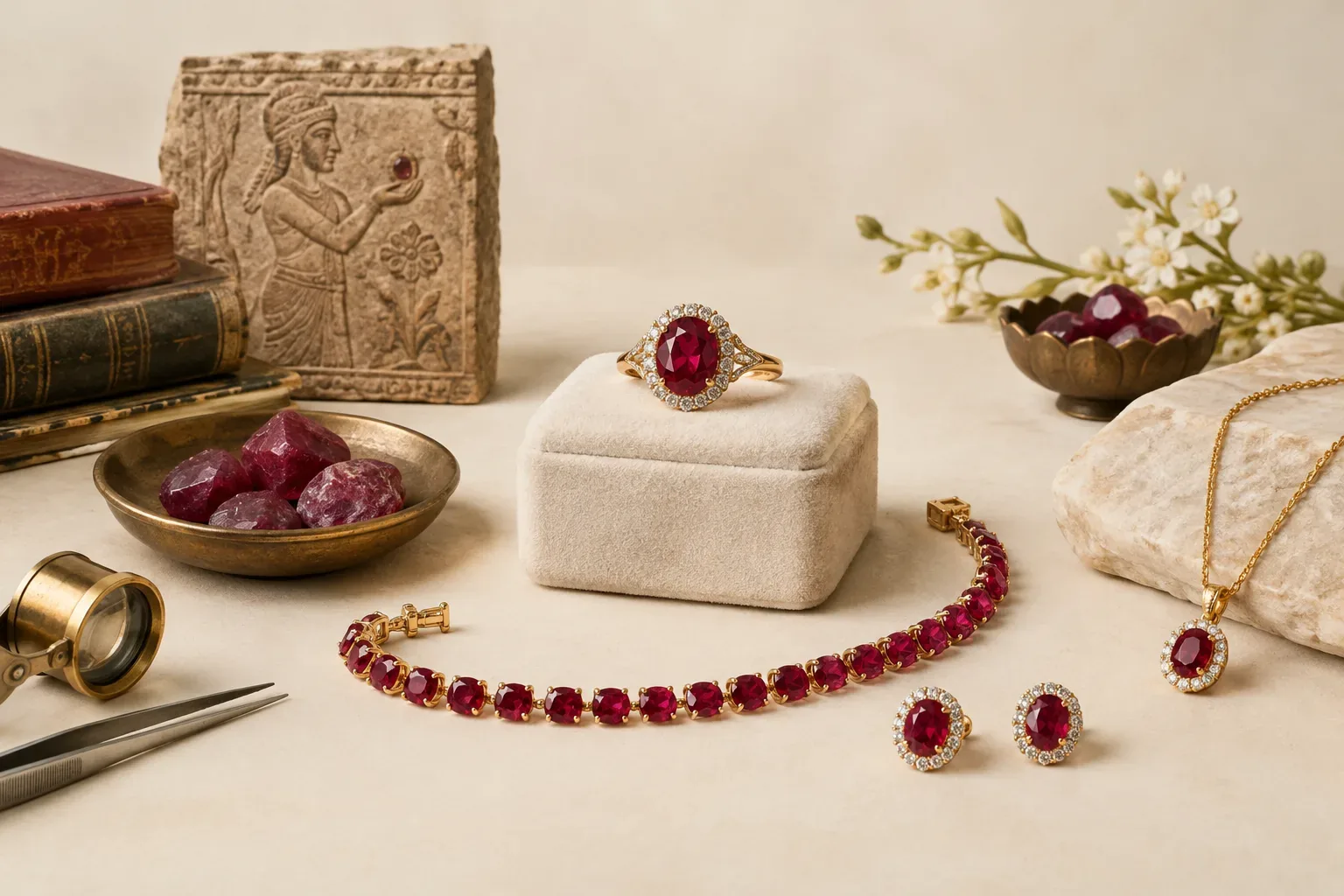
In practical terms, rubies most commonly appear as centre gemstones in rings, pendants and brooches and as accent stones in necklaces and bracelets. Historical and modern makers also combine rubies with diamonds and coloured gemstones or set them into motif-driven designs such as floral, heraldic, religious or geometric patterns. The Victoria and Albert Museum’s resources on gemstones and jewellery history describe how makers used available cutting, setting and metalwork techniques to feature coloured stones like rubies in a variety of forms.
Because ruby hardness (a characteristic that influences how a stone wears) and traditional cutting and setting techniques affect how a piece behaves over time, the form the ruby takes in a piece—cabochon, mixed cut, cushion, oval or small faceted accent—changes both its visual role and the types of maintenance it may need. Historical jewellery may include older settings or adhesive repairs that require specialist attention.
Warning signs that a ruby piece needs repair
Look first at the mounting: worn, thin or missing prongs; a bent or cracked bezel; or a loose stone that moves when you tap the setting gently can all indicate immediate risk of loss. A stone that sounds dull (lacking the expected brightness for its cut) or shows obvious chips, deep scratches or a changed surface texture needs a closer look.
Other warning signs include a ring that no longer fits because the shank is bent or worn, visible solder joins that are cracking, or discolouration or corrosion of the metal around settings. If a ruby appears unusually cloudy, shows surface deposits you cannot remove with gentle cleaning, or has been sold without disclosure of obvious treatments, bring it to a professional for assessment rather than attempting aggressive home repairs or cleaning.
Basic cleaning and everyday care
For routine cleaning, warm water, mild dish soap and a soft brush are safe for most rubies set in common metals; rinse well and dry with a soft cloth. Store ruby jewellery separately to avoid abrasion from harder stones such as diamonds or from metal-to-metal contact. Remove ruby jewellery during heavy manual work, sports or exposure to household chemicals, and avoid wearing it in environments where it can be struck or scratched.
Be cautious with ultrasonic or steam cleaning. Many rubies are heat-treated, fracture-filled, or have other enhancements that can be damaged by ultrasonic vibration or high heat; ask a qualified jeweller or gemologist whether a particular stone and setting are suitable for those cleaning methods. The Federal Trade Commission advises buyers to ask about treatments and disclosures for gemstones, and treatment status can affect safe-cleaning choices.
When to get professional help and what to expect
See a professional jeweller or gemologist when you detect looseness, chips, lost stones, bent settings, or when you suspect a stone has been fracture-filled or otherwise treated. A trained professional can confirm whether a stone is natural, treated or synthetic and advise on appropriate cleaning, repair, or replacement. For high‑value, antique or historically important pieces, seek a conservator or a jeweller who documents conservation steps and uses reversible techniques where possible.
Common professional services include tightening or re-tipping prongs, re-setting stones, repairing or replacing bezels, removing old adhesives, polishing metal, and providing appraisal and documentation. For stones that have been filled or treated, professionals may recommend different approaches than for untreated stones. Ask for a written estimate and documentation of any interventions, and keep records of appraisals, photos, and lab reports for insurance and future care.
Choosing and gifting ruby jewellery respectfully
When selecting or gifting ruby jewellery, consider the recipient’s personal tastes, the piece’s intended use, and any cultural context. If you are buying a historical or antique ruby, check provenance, previous repairs, and any lab reports available. Ask the seller to disclose treatments, parentage of any replacement stones, and whether the setting is original. The Federal Trade Commission requires truthful disclosure of gemstone treatments and imitations, so request written confirmation when possible.
For everyday wearers choose sturdy settings such as bezel or secure prongs and consider lower-profile mounts to reduce snagging. For heirloom or ceremonial gifts, prioritise documented provenance, written appraisals, and, if appropriate, conservation-standard repairs. Respect cultural meanings by asking the recipient or researching the specific tradition—museum sources like the V&A clarify that meanings vary by culture and period, so avoid assuming a single symbolic interpretation.
Final recommendations
Maintain a regular inspection routine, clean gently with mild soap and water, avoid risky home treatments for suspected filled or heavily included rubies, and consult a qualified jeweller or conservator for any mechanical damage or complex work. Keep written records, ask about treatment disclosures, and choose settings that match how the wearer will use the piece. Distinguish documented historical roles of rubies from modern symbolic meanings, and treat provenance and conservation as part of responsible ownership.
Frequently asked questions
How often should I have my ruby jewellery professionally inspected?
Have everyday-worn ruby rings and bracelets inspected every six to twelve months and less frequently worn pieces checked at least once every two years; inspect visually at home more often and bring any item showing looseness, chips or bent settings in immediately.
Is it safe to clean a ruby with an ultrasonic cleaner?
Not always. Ultrasonic cleaning can damage rubies that are fracture-filled or heavily included. Ask a qualified jeweller or gemologist about a stone’s treatment status before using ultrasonic or steam cleaning; otherwise, use warm soapy water and a soft brush.
What should I ask a seller when buying a ruby piece?
Request written disclosure of any treatments or filling, documentation of provenance or previous repairs if available, and a written estimate or appraisal for insurance. The Federal Trade Commission advises buyers to seek truthful disclosure of treatments and imitations.
Can a chipped ruby be repaired?
Minor chips or surface damage can sometimes be polished or re-cut by a skilled lapidary, but that changes the stone’s shape and weight. For significant damage on a valuable or historic gem, consult a conservator or experienced jeweller to weigh repair versus conservation and documentation options.
How should I store ruby jewellery to prevent damage?
Store ruby pieces separately in soft pouches or lined compartments to prevent abrasion from other gems and metals, and keep them away from extreme heat and prolonged sunlight. For valuable collections, climate-stable storage and insurance documentation are sensible precautions.
Sources and further reading
- Bedazzled: A History of Jewellery — Victoria and Albert Museum
- An A-Z of Gemstones — Victoria and Albert Museum
- Buying Gemstones, Diamonds, and Pearls — Federal Trade Commission