Meaning at a glance
This guide explains the documented history and shifting contexts of rose gold jewelry, distinguishes historical meanings from modern personal interpretations, describes how the metal and related motifs appear in pieces, and gives practical guidance for selecting, verifying and gifting rose gold today.
What the historical record shows
Museum scholarship emphasizes that jewellery materials and finishes shift in meaning as fashions, technologies and social contexts change. The Victoria and Albert Museum (V&A) documents how different metals and surface treatments became fashionable in particular periods and places and how taste and social use shaped jewellery’s roles. The V&A’s materials make it clear that what people read as style or symbolic meaning at one moment often derives from changing social contexts rather than a fixed, universal meaning.
The V&A’s work on jewellery history shows recurring cycles: metals and colours that appear as distinctive in one era are later revived or reinterpreted in another. That history helps explain why rose-coloured metals have been used at different times as a fashion statement, a sign of modernity, or a complementary color for certain gemstones. The V&A also documents how sentimental motifs and settings—lockets, portrait patterns, and mixed-metal combinations—carry different associations across cultures and periods.
Documented historical meanings versus modern interpretations
Documented historical meanings are what contemporary records, makers’ notes and museum research show people intended or used. The V&A’s cataloguing and exhibitions record how particular metals and motifs functioned socially—for example as indicators of status, mourning, or fashion—within specific cultures and periods. Those documented meanings are tied to context: a metal tone that signalled modernity in one place and time might have been neutral or practical in another.
Modern interpretations—such as reading rose gold as inherently romantic, youthful, or gendered—are contemporary personal and marketing-led meanings. These interpretations are valid for individual wearers and gift-givers, but they are not universal historical facts. Distinguishing the two matters when you choose or gift jewellery: you can honour a documented historical use where appropriate, and you can also rely on modern personal meaning when that better serves the wearer.
How the metal, motifs and gemstones appear in jewellery
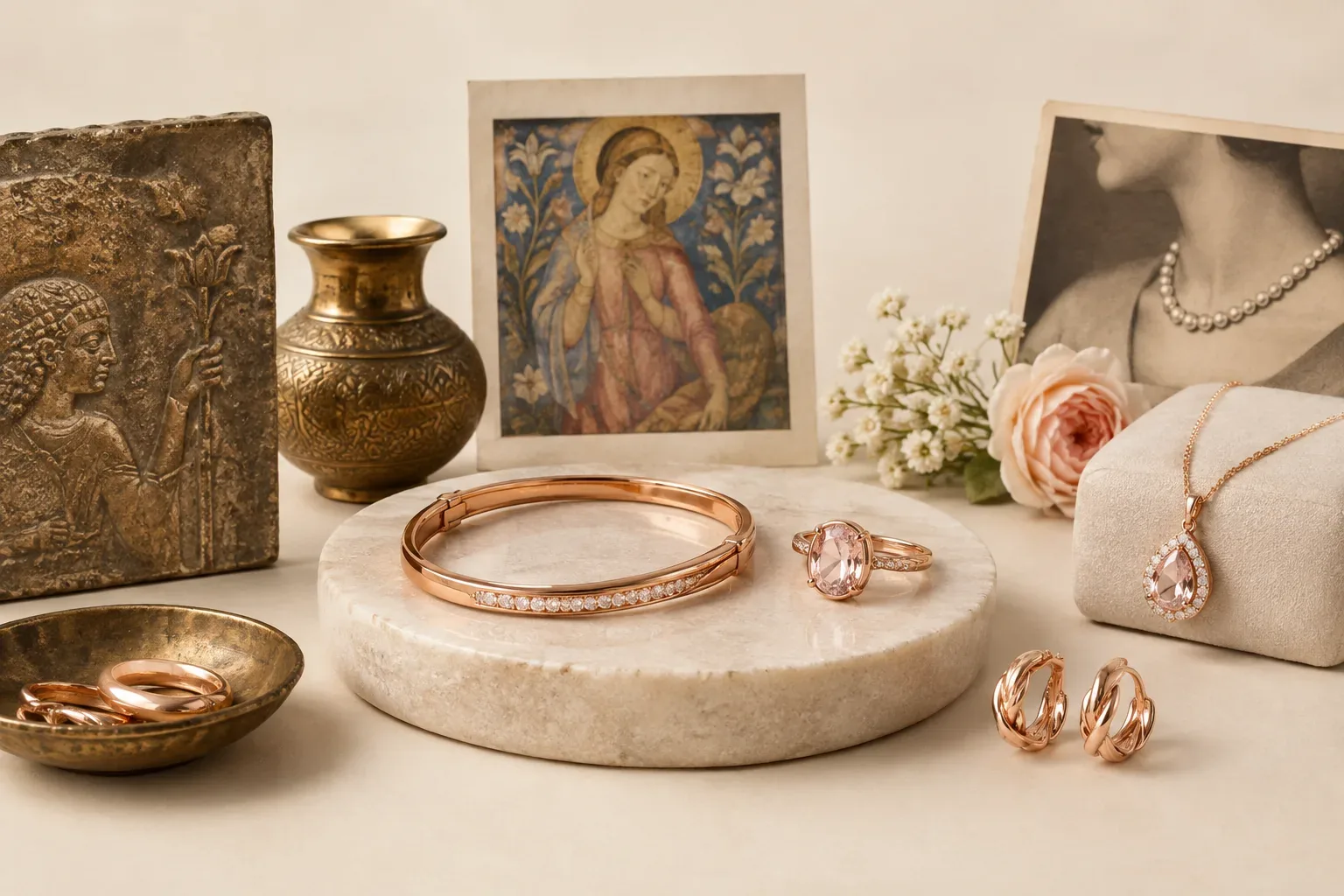
Rose-coloured metal appears in jewellery either as an alloy (where the metal itself has a warm tone) or as a surface finish or plating applied to a different underlying metal. Makers use the warm colour to set off certain gemstones, to create mixed-metal designs, or to produce a specific fashionable look.
The V&A’s resources on gemstones emphasise that jewelers have long paired metal colours with particular stones for visual effect and social meaning. Warm-toned metals are often chosen to deepen the appearance of warm-coloured gems and to soften the contrast with pale stones. The way a motif—such as a locket, floral carving, or a signet—uses rose-coloured metal will affect how that motif is read, so designers often calibrate metal tone to the motif’s intended emotional or stylistic message.
Because modern manufacturing allows both solid-colour alloys and thin plated finishes, the same motif can be produced at very different price and durability points: a solid alloy piece may age and patina differently from a plated item, and the two will demand different care and carry different long‑term value.
Evaluating quality and price
When assessing quality and relative price, consider four main factors: the metal composition and whether the colour is from an alloy or a surface treatment, workmanship and finishing, any gemstones or decorative work, and condition or provenance for vintage pieces. These factors combine to determine both the retail price and the long-term value and durability of a piece.
Confirm whether the warm colour is integral to the metal or is a plating. The Federal Trade Commission (FTC) advises consumers to ask sellers about material treatments and imitations and to require clear disclosure. Sellers should state if a piece is plated, vermeil, filled, or a solid alloy; this disclosure affects expected wear and the piece’s resale value.
Look for hallmarks and maker’s marks that indicate metal content and origin. Hallmarks and reliable maker’s stamps are part of how dealers and assayers communicate quality. For gemstones, consult guides such as the V&A’s A–Z of Gemstones for historical context and basic identification; documented gem quality—cut, clarity, colour, and carat—affects price independently of the metal.
Craftsmanship matters: solder joins, settings, and finishing tell you whether the piece will wear well. Heavier, well-finished settings generally cost more but also better protect gemstones and maintain structural integrity. For vintage pieces, condition and provenance affect price and cultural value, but any restoration or plating performed later should be disclosed.
Best uses and styling considerations
Rose-coloured metals are versatile. They can read as contemporary when used in minimalist settings, as romantic in floral or locket motifs, or as warm and less contrasting when paired with pale skin tones or cooling silver. Whether used for engagement rings, wedding bands, earrings, necklaces, or everyday pieces, the choice should reflect who will wear it and how they live.
Consider wearability: daily-wear items like wedding rings and bracelets need durable settings and either solid alloys or thick, well-disclosed platings. Statement pieces and occasional-wear items can be more experimental with finishes and mixed metals. For gemstone settings, think about contrast: coloured gems often look richer against warm-toned metal, while very pale gems can be softened by it.
Be mindful of cultural and personal meanings. A motif that is sentimental in one culture may be purely decorative in another. Use the documented historical context (as described in museum resources) to inform meaningful choices for commemorative gifts, and rely on the recipient’s personal taste for everyday or fashion purchases.
Practical buying and gifting guidance
Ask direct questions before you buy: is the piece a solid alloy or plated? If plated, how thick is the coating and what base metal is used? Does the piece carry hallmarks or maker’s marks? The FTC recommends getting clear disclosure about treatments and imitations; request that those disclosures be written or included on a receipt.
For higher-value purchases, request documentation for gemstones and metal content and consider an independent appraisal. If you are buying vintage, ask about provenance and any restoration or replating that has been done. For gifts, consider the recipient’s daily habits—if they are active or work with their hands, choose more durable constructions or avoid pieces that will require frequent replating.
Respect personal and cultural preferences. If the piece is intended to mark a cultural or religious milestone, use museum-backed research or consult a knowledgeable source to confirm whether the motif, metal or combination is appropriate for that tradition. If you are unsure, choose a neutral or personalized approach—select a design that references the recipient’s own preferences rather than assuming broader meanings.
Care, maintenance and verification
Care depends on whether the colour is an alloy or a plating. Plated pieces may need replating over time; solid-alloy items will develop a patina and may be polished if desired. Clean gently and avoid harsh abrasives that can wear finishes and thin platings. For any chemical treatments or repairs, seek a professional jeweller with experience in colored metals.
Verify larger purchases with paperwork and consider insurance where appropriate. Keep receipts, any certification, and photographs. If the seller makes claims about historical significance or provenance, ask for supporting documentation, and, if necessary, obtain a second opinion from a qualified appraiser.
Final takeaway
Use the documented history and museum research on jewellery as a guide to the cultural contexts that have given rise to rose-coloured metals, but rely primarily on clear disclosures about construction and on personal or recipient preference when selecting or gifting. Verify material and treatment with the seller, consider craftsmanship and gemstones when assessing price, and match the durability of the piece to how it will be worn.
Frequently asked questions
Is rose gold real gold?
A piece described as rose gold may be a warm-coloured gold alloy or a plated finish on another metal. Ask the seller for hallmarks and disclosures; the Federal Trade Commission recommends that consumers get written disclosure about treatments and whether a piece is plated or solid.
How can I tell if rose gold is plated or solid?
Look for hallmarks and maker’s marks, ask the seller for written confirmation, and check the finish at edges and inside settings where plating is more likely to show wear. For high-value purchases, obtain documentation or an independent appraisal.
Does the colour affect durability?
Yes. A warm colour that comes from an alloy behaves differently from a thin plating. Platings can wear with everyday use and may require replating; alloyed metals will patina and can often be polished. Ask about construction and expected wear before purchasing.
Is rose gold appropriate for engagement rings?
Rose-coloured metals are used for engagement rings by many people and can be durable if the piece is well made. Match the construction and setting to the wearer’s lifestyle and verify the metal and gemstone settings before committing to a long-term purchase.
What should I ask a seller when buying rose gold jewellery?
Request written disclosure about whether the piece is a solid alloy or plated, any gemstone treatments, hallmarks or maker’s marks, return and warranty terms, and independent documentation for high-value items, following FTC guidance on material disclosure.
Sources and further reading
- Bedazzled: A History of Jewellery — Victoria and Albert Museum
- An A-Z of Gemstones — Victoria and Albert Museum
- Buying Gemstones, Diamonds, and Pearls — Federal Trade Commission