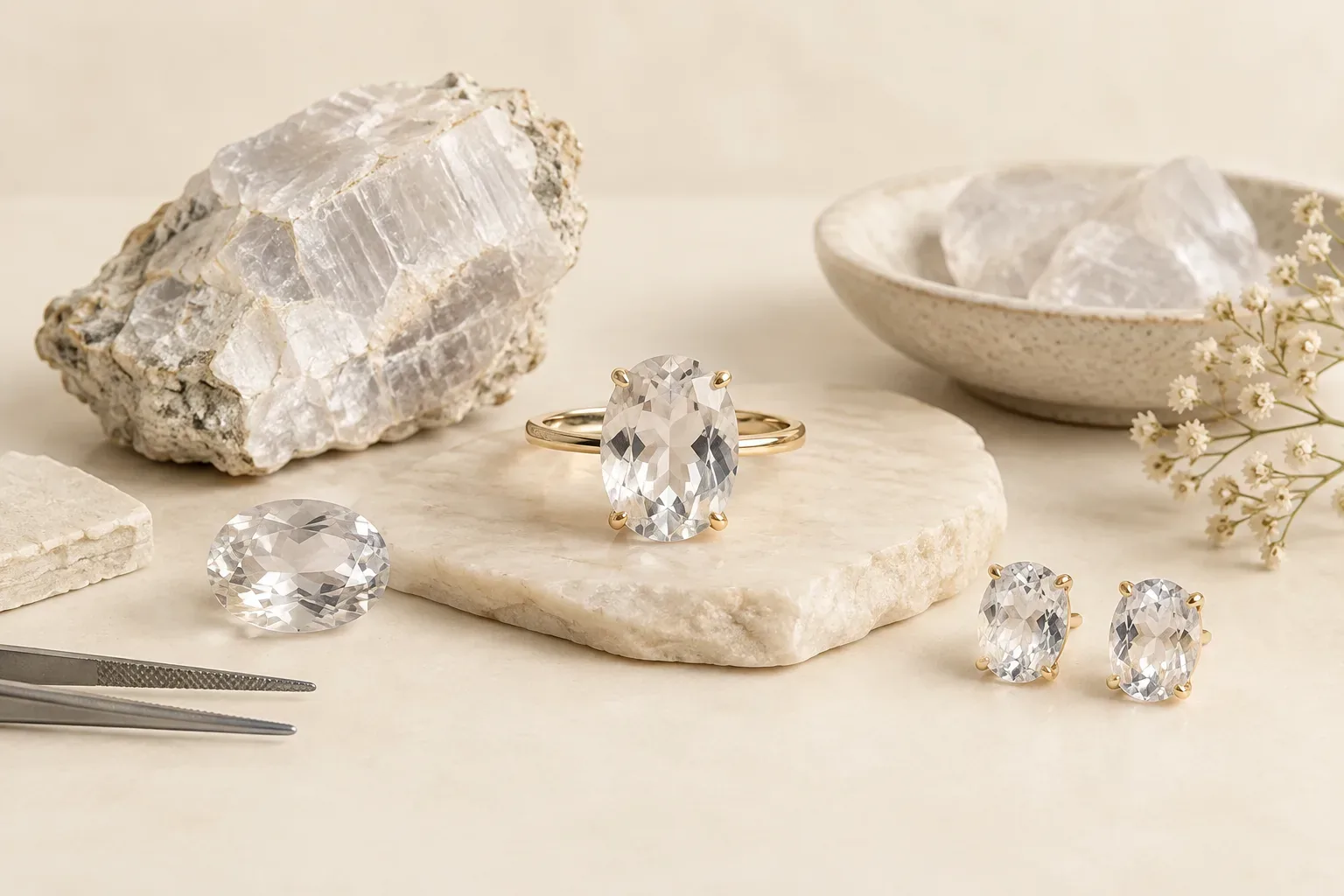
Meaning at a glance
Petalite is a lithium aluminum silicate occasionally faceted as a colorless or pale gem; because it has distinct cleavage and modest hardness, identification, setting choice, and careful care should come before applying modern symbolic meanings.
What petalite is (scientific and gemological overview)
Petalite is a mineral composed of lithium aluminum silicate that can occur as gem-quality crystals. When faceted for jewelry it is most often colorless, white, or very pale in tints of pink, yellow, or gray. Authoritative gem and mineral references describe its geological occurrence and the contexts in which gem material has been recovered, which helps collectors and jewelers place petalite among other lithium-bearing gemstones.
Gemological organizations and museums that document gem recovery and mineral identity emphasize the stone’s physical characteristics—its crystal structure, relative softness compared with traditional jewelry gems, and pronounced cleavage—rather than long histories of cultural symbolism. Those physical traits determine where and how petalite is practical to use in jewelry and how it should be handled.
Historical evidence and cultural record
Major professional and museum references that summarize gems recovered from geological contexts focus on petalite’s occurrence and mineralogy rather than on long-established symbolic roles. The Gemological Institute of America (GIA) documents gem recovery from sedimentary and other rocks and notes which gem varieties are recovered and studied, including lesser-known lithium-bearing minerals when they appear as gem material. The Smithsonian National Museum of Natural History describes gem and mineral identity in terms of geology, rarity, and suitability for jewelry use.
Neither the GIA nor the Smithsonian presents a well-documented record of petalite being central to specific ancient religious systems or long-standing cultural traditions in the way that, for example, lapis lazuli or jade are documented in particular cultures. Existing references therefore treat petalite primarily as a mineralogical and gemological subject rather than as an element with a widely recorded historical symbolism.
Documented history versus modern interpretations
Documented history: Professional resources such as the GIA and the Smithsonian record petalite as a mineral and a sometimes faceted gem. Their coverage centers on geological occurrence, recovery, optical properties, and factors that affect suitability for jewelry. Those factual records form the documented historical and scientific basis for understanding petalite.
Modern interpretations: Outside scientific and museum literature, contemporary sellers, designers, and wearers have ascribed modern symbolic ideas to petalite—often using language about clarity, calm, or emotional balance. These are personal and contemporary interpretations rather than meanings attested across historical cultures. When you encounter symbolic claims about petalite, treat them as modern values or marketing language unless an authoritative historical source is cited.
How petalite appears in jewelry
Because gem-quality petalite is usually colorless or very faintly tinted, jewelers present it as a delicate, light-reflecting stone. It is occasionally faceted into standard shapes—rounds, ovals, cushions, and step cuts—to emphasize clarity and brilliance. Its neutral color makes it easy to pair with various metal colors and to complement colored accent stones.
Practical jewelry decisions follow from petalite’s physical properties. Petalite has notable cleavage planes and a Mohs hardness that is lower than many traditional faceting gems. For that reason, bezel settings, protective halos, or low-profile mounts are common choices, and highly exposed prong-set pieces intended for daily wear are less typical unless the setting offers edge protection. Designers also use petalite in pendants, earrings, and brooches where the risk of impact is lower than in rings.
Buying petalite: what to check before you pay
Treat petalite purchases like any other gemstone purchase: ask about origin, treatments, and whether the stone is natural, lab-grown, or an imitation. Government consumer guidance on buying gemstones stresses clear disclosure of whether a gem is natural or lab-created and whether it has been treated to alter color or clarity; reputable sellers will provide that information. If a seller cannot or will not disclose basic information, treat that as a red flag.
Because petalite can be colorless or lightly tinted, ask for a reliable identification if colorless material is offered at a price close to more valuable colorless gems. Certification from a recognized lab or a clear, documented report from a respected gemological authority can reduce uncertainty about identity and treatments. For unusual gems like petalite, experienced dealers and independent gem labs are useful resources to confirm that the material is what it is claimed to be.
Selection and respectful gifting guidance
If you’re selecting petalite as a gift, consider the recipient’s lifestyle first. Because petalite is more fragile than many everyday-wear gems, avoid choosing elaborate prong-set rings for someone who does manual work or who prefers low-maintenance jewelry. Pendants and earrings are safer daily-wear choices, and simple halo settings or bezels increase durability.
Respectful gifting also means being transparent about the gem’s nature. If the symbolism or calming qualities are important to the recipient, present them as modern personal meanings rather than ancient mandates. When gifting, include care instructions and any identification paperwork to help the recipient understand and protect the stone and to preserve its practical and sentimental value.
Care, cleaning, and storage
Care for petalite by minimizing exposure to hard knocks, harsh chemicals, and abrupt temperature changes. Because it has cleavage and only moderate hardness, surface-abrasion and breakage are realistic risks if the stone is struck or subjected to improper cleaning.
For routine cleaning, use a soft cloth or a gentle brush with warm soapy water; rinse well and dry thoroughly. Avoid steam cleaners, ultrasonic cleaners, and strong chemical cleaners unless a qualified gemologist has confirmed that the specific stone and setting can tolerate such methods. Store petalite jewelry separately from harder gemstones and metals, ideally wrapped in soft fabric or kept in a padded compartment to prevent scratching and chipping.
Identification and appraisal points
If you need formal identification or valuation, consult a recognized gem laboratory or an experienced professional gemologist. Professional reports will note critical identification features—such as optical properties and cleavage—and will state whether any treatments or enhancements are present. Because petalite is less common in the jewelry market, a professional opinion helps avoid misidentification with visually similar stones.
When insuring petalite jewelry, provide the insurer with any lab reports and an appraisal that reflects the stone’s market position. Appraisal documents should be explicit about the gem’s identity, weight, cut, clarity, and setting to ensure correct replacement coverage.
Conclusion
Petalite jewelry meaning in contemporary practice leans toward themes of clarity and calm, but those are modern associations layered over a gemological story that matters more for wearability: petalite is a lithium aluminum silicate that can be faceted as a colorless or pale gem and that requires thoughtful setting and care because of its cleavage and moderate hardness. Use scientific identification, protective settings, and conservative care to enjoy petalite’s clear, quiet beauty while recognizing that symbolic meanings are personal rather than historically universal.
Frequently asked questions
Is petalite a good stone for an engagement ring?
Because petalite has notable cleavage and a lower hardness than traditional engagement gems, it is generally not recommended for everyday-wear engagement rings unless the setting provides strong protection and the wearer accepts extra care and caution.
How do I clean petalite jewelry safely?
Clean petalite with warm soapy water and a soft brush or cloth, rinse thoroughly, and dry. Avoid ultrasonic and steam cleaners and harsh chemicals unless a qualified gemologist confirms the specific piece can tolerate those methods.
Does petalite have historical symbolic meanings?
Major museum and gemological sources document petalite’s mineralogy and use as a gem but do not record widespread historical cultural symbolism; modern symbolic claims are contemporary interpretations rather than established historical facts.
How can I be sure the petalite I buy is genuine?
Ask for disclosure about origin and treatments and, for greater certainty, request a report from a recognized gemological laboratory or buy from reputable dealers who provide verifiable identification.
Is petalite treated or lab-grown?
Treatments and lab-grown alternatives exist in the broader market for gemstones; the Federal Trade Commission requires sellers to disclose whether a gem is natural, lab-grown, or treated, so confirm that information before purchasing.
Sources and further reading
- Gems Recovered from Sedimentary Rocks — Gemological Institute of America
- Gems and Minerals: Beauties and Building Blocks — Smithsonian National Museum of Natural History
- Buying Gemstones, Diamonds, and Pearls — Federal Trade Commission