Meaning at a glance
Explain the documented history and changing contexts of the pearl cuts and settings motif, separate cultural or religious evidence from later popular interpretations, and give practical guidance for choosing and wearing the motif in modern jewelry.
Quick answer — what this article shows
Pearl cuts and settings describe how pearls are formed or shaped for jewelry and how they are mounted to balance appearance with protection. Museums document long histories of pearl use and changing tastes, while consumer regulators stress buyer protections around treatments and imitations. This article lays out the documented historical uses and meanings of pearls, clarifies where modern personal interpretation begins, explains common ways pearls appear in jewelry, and offers practical, respectful guidance for choosing and gifting pearls today.
Documented historical evidence: who used pearls and how
The Victoria and Albert Museum (V&A) shows that pearls have played a visible role in many societies because of their rarity and lustre, appearing in personal adornment and court dress across different periods. Museum displays and catalogues trace pearls in ancient Mediterranean and Asian contexts, in Renaissance and later European court jewellery, and in the complex fashions of the 17th–19th centuries. The V&A’s historical surveys emphasize shifting social meanings: pearls have signalled wealth, status and fashionability at particular times and places rather than carrying a single universal meaning.
Historic jewellery forms that the V&A documents include seed-pearl embroidery and clustered pearl pendants in European court and mourning jewellery, back-set or hemispherical pearls in certain 19th-century brooches, and the later prevalence of matched-string pearl necklaces as cultured pearls became commercially available. These observations are drawn from museum collections and scholarship described by the V&A and help us see how settings and display conventions changed with taste, technology and social context.
Separating documented cultural meanings from modern interpretation
Museum documentation provides evidence for meanings attached to pearls in specific times and places, such as their use as status markers in elite dress. It does not support claims that a single symbolic meaning applies everywhere or for all eras. The V&A’s approach is to contextualise jewellery within social, economic and fashion histories rather than to assign timeless symbolism.
Modern personal interpretations — such as viewing a pearl as a symbol of purity, wisdom or mourning — are valid emotional meanings for wearers and givers today, but they are different from the historically documented associations recorded by museums. When choosing or gifting pearls, keep these two layers distinct: you may embrace a personal or contemporary symbolism, but that should be presented as interpretation rather than as an historically universal fact.
How 'pearl cuts' are described and how pearls appear in jewellery
Unlike faceted gemstones, most pearls are formed rather than cut. Museum gemstone guides such as the V&A’s discuss variety in pearl forms: perfectly round cultured pearls, naturally irregular baroque shapes, flat-backed mabe (half-pearl) forms used for cabochon-style settings, and small seed pearls employed for delicate surface embellishment. Collections and curatorial notes document how different shapes were preferred at different times — for example, strings of closely matched round pearls gained new prominence after cultured pearls became widely available.
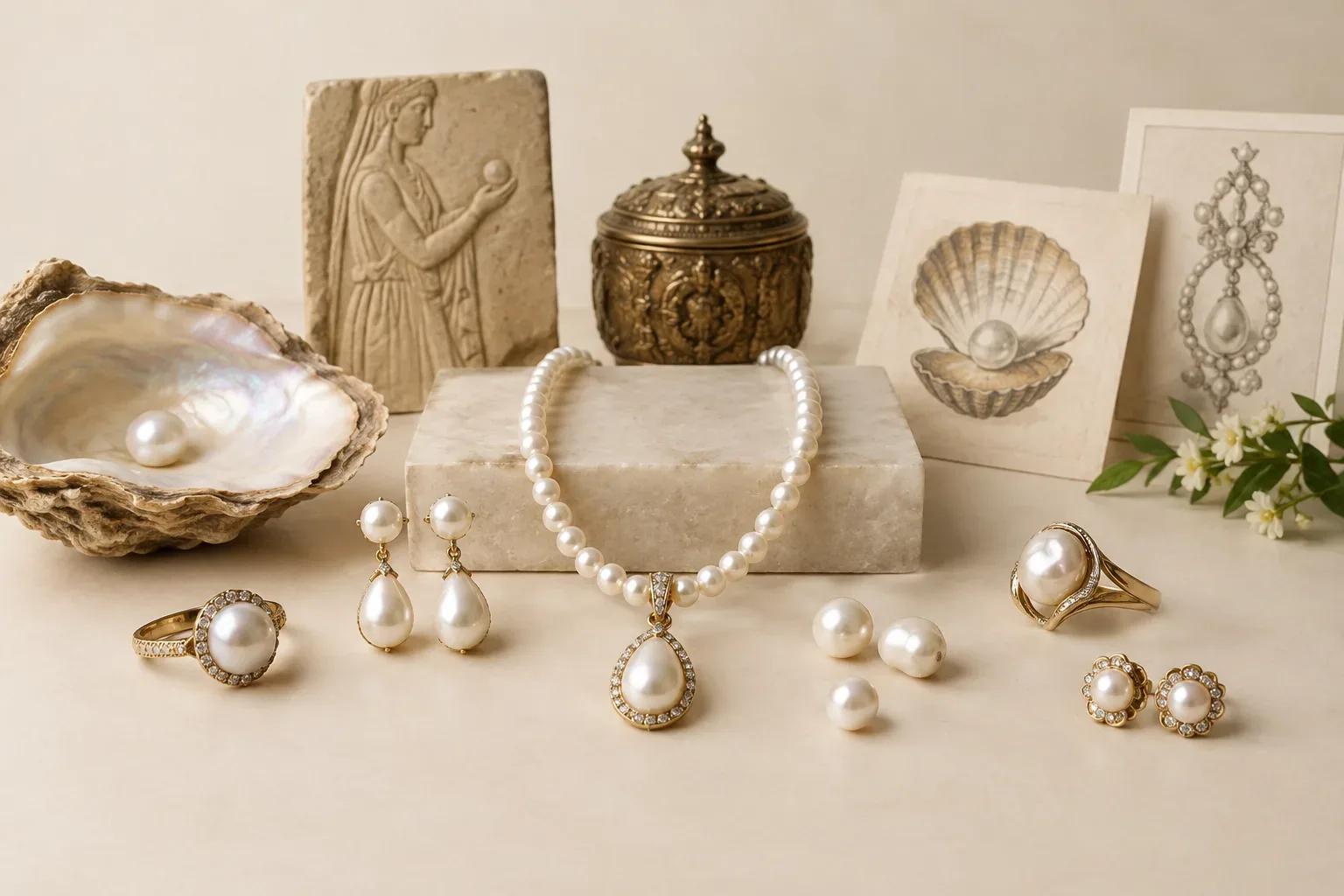
In jewellery, pearls appear in many motifs and constructions. They are strung as necklaces, used as focal mounts in rings and brooches, clustered into sprays or caps, and incorporated into elaborate designs where small seed pearls add texture. Historical pieces on display at the V&A show a range of settings intended either to display the pearl’s surface or to protect more fragile examples: some pearls are exposed on prong or peg mounts for maximum visibility; others are set into metal cups, backs or bezels that shield their weaker sides.
Common settings and why they matter for durability and aesthetics
Settings serve two main purposes: to show off a pearl’s lustre and shape, and to protect the organic material from knocks, abrasion or exposure. Historically and today, jewellers use settings that range from simple drilled-and-peg mounts for rings and earrings to bezel or cup mounts that support and partially enclose the pearl. The V&A collections illustrate that settings evolved as tastes and technologies changed, sometimes favouring delicate display and sometimes favouring protective mounts in everyday wear.
Where durability is a priority, choose settings that minimise contact with hard surfaces and expose less of the pearl’s vulnerable underside. Conversely, purely display-focused settings will show more of the pearl but require more careful handling. Match the setting to the intended use: a piece designed for special occasions can favour visibility, while one intended for daily wear should prioritise protection.
What to ask and look for when buying pearls (consumer protections)
The Federal Trade Commission (FTC) advises buyers to ask sellers about treatments, origin and any imitations or enhancements. Because pearl value and working methods vary, request clear, written information about whether pearls are natural, cultured, dyed, filled, or assembled from components (for example, mabe pearls with backing). The FTC’s guidance supports getting disclosures in writing and buying from reputable sellers who will state treatments and provide return or repair options.
Ask about how the pearl was mounted and whether the setting is designed for everyday wear. If you plan to wear the item frequently, prefer secure mountings and inquire about maintenance services. If matching strands or sets is important, request to see many examples so you can judge colour, orient and luster across several pearls; museum and trade descriptions both highlight the importance of visual matching for traditional pearl strings.
Practical, respectful guidance for choosing and gifting pearls
When choosing or gifting pearl jewellery, align the piece’s function with its setting: choose protective mounts for pieces meant to be worn often and more revealing mounts for special-occasion jewellery. Think about the recipient’s lifestyle — whether they will appreciate low-maintenance protection or value an open, display-first design — and discuss these practicalities rather than assuming symbolic meanings.
Be culturally respectful. The V&A shows that pearls’ roles varied by culture and context; avoid asserting a single symbolic meaning as if it applied everywhere. If a pearl motif has specific significance within the recipient’s cultural or religious background, check that meaning first or choose neutral wording about beauty and quality. When in doubt, focus on the craftsmanship, origin and the giver’s personal sentiment rather than on unverified universal symbolism.
Care, maintenance and long-term value considerations
Because pearls are organic and their surface can be more delicate than faceted gemstones, conservation and jewellery professionals emphasise protective handling and appropriate settings in museum descriptions. Consider setting and repair options that allow for maintenance without risking the pearl’s surface. Keep written records of any treatments or repairs and store pearl jewellery so pieces do not rub against harder items.
For resale or inheritance value, documented provenance and clear seller disclosure about treatments matter. The FTC recommends obtaining written statements about treatments, origin and seller terms to avoid surprises later. Museums and collectors also value provenance and careful documentation when assessing historical or market significance.
Bringing history and personal meaning together
Use historical documentation to inform but not to constrain your choice. The V&A’s accounts of changing fashions show how taste, technology and cultural context shaped pearl use; that history can inspire designs and help you choose a setting that honours a period’s style. At the same time, allow room for the recipient’s modern interpretation: a gift can combine historical awareness (for example, a Victorian-inspired setting) with an explicitly expressed personal message about the relationship or occasion.
In short, choose pearls and settings that suit the practical life of the wearer, confirm material facts with the seller, and frame any symbolic language as contemporary meaning rather than a claim of universal cultural authority.
Conclusion
Pearl cuts and settings are decisions of form and function shaped by history, technology and personal taste. Museum documentation, especially from institutions such as the Victoria and Albert Museum, helps us see how meanings and settings have changed over time, while consumer guidance from the Federal Trade Commission reminds buyers to get clear, written disclosure about treatments and origin. Combining those evidences with thoughtful attention to durability, setting choice and cultural respect will help you select pearl jewellery that is beautiful, appropriate and long-lived.
Frequently asked questions
Can pearls be cut like faceted gemstones?
Pearls are organic and are usually used in jewellery in their formed shapes rather than being faceted; museum sources describe a range of natural and worked pearl forms such as round cultured pearls, baroque shapes and flat-backed mabe types used for specific mounts. These forms are shaped or selected for mounting rather than cut in the way faceted gemstones are.
Which settings protect pearls best for everyday wear?
Settings that support and partially enclose the pearl — such as cup or bezel-style mounts — reduce exposure to knocks and abrasion and are considered more protective than fully exposed mounts. Match the setting to the wearer’s lifestyle: a protective setting is wiser for frequent wear, while open settings prioritise display for occasional use.
How do I know if a pearl has been treated or is an imitation?
The Federal Trade Commission recommends asking sellers for clear, written disclosures about treatments, whether pearls are natural or cultured, and whether items include assembled components or imitations. Reputable sellers should provide that information and offer return or repair terms if disclosures are incomplete.
Are there cultural taboos or special meanings I should know when gifting pearls?
Museum documentation shows pearls have carried different meanings in different cultures and periods; there is no single universal symbolism. If you suspect a pearl motif has particular cultural or religious significance for the recipient, check with a reliable source or the recipient themselves rather than assuming a meaning.
What should I ask a seller about matching pearls for a necklace or set?
Request to see multiple examples of the pearls to judge consistency of colour, orient and lustre, and ask about the matching process the seller uses. For important purchases, obtain written confirmation of origin and any treatments, since matching often affects both appearance and value.
Sources and further reading
- Bedazzled: A History of Jewellery — Victoria and Albert Museum
- An A-Z of Gemstones — Victoria and Albert Museum
- Buying Gemstones, Diamonds, and Pearls — Federal Trade Commission