Meaning at a glance
This guide explains the limited documented history and modern contexts for palladium in jewelry, distinguishes historical meanings from contemporary personal or marketing-driven interpretations, and gives practical guidance on assessing quality, price factors, gemstone compatibility, and gifting considerations.
Quick answer
Palladium's presence in jewelry today is a largely modern development rather than a well-documented ancient cultural practice; buyers should treat symbolic meanings as contemporary or personal choices, rely on objective checks like hallmarks, written disclosures, gemstone treatment reports, and reputable sellers, and match the metal's practical properties and maintenance needs to how the piece will be worn and cared for.
What the historical record shows
Surveys of jewelry history held and published by institutions such as the Victoria and Albert Museum show that across cultures and periods people have chosen metals for social, technological, and aesthetic reasons. The V&A's overviews document how gold, silver, bronze and later alloys and plated metals have shifted in use and meaning from ancient Egypt and classical antiquity through medieval Europe and into modern manufacturing and design contexts.
Those museum surveys make clear that metals acquire social meanings within specific cultural and economic contexts rather than carrying universal symbolism. The same surveys also indicate that some metals long associated with jewelry have centuries of use in particular societies, while other metals become important only in more recent times as technology, mining, and markets change. In other words, long-standing symbolic associations exist for some metals in certain cultures, but the historical record for palladium in jewelry is comparatively thin and its use is primarily a modern phenomenon.
Separating documented meanings from modern interpretations
When studying meanings attached to jewelry materials, it helps to keep two categories distinct: documented historical meanings tied to particular cultures or periods, and meanings that arise later through marketing, personal choice, or contemporary fashion. The V&A shows many clear, historically documented associations — for example, how certain metals or gemstones were used to signal rank, religious belief, or trade connections in a specific culture and time.
By contrast, for palladium there is little in the way of documented, long-standing cultural symbolism recorded by museum surveys. Modern attributions — for example, that palladium symbolizes a particular value such as 'modernity', 'minimalism', or 'non-traditional commitment' — should be treated as contemporary interpretations. These are often meaningful at a personal or social level today but they are not the same as deep-rooted cultural or religious traditions documented in historical sources.
How palladium appears in jewelry (motifs, settings, and styles)
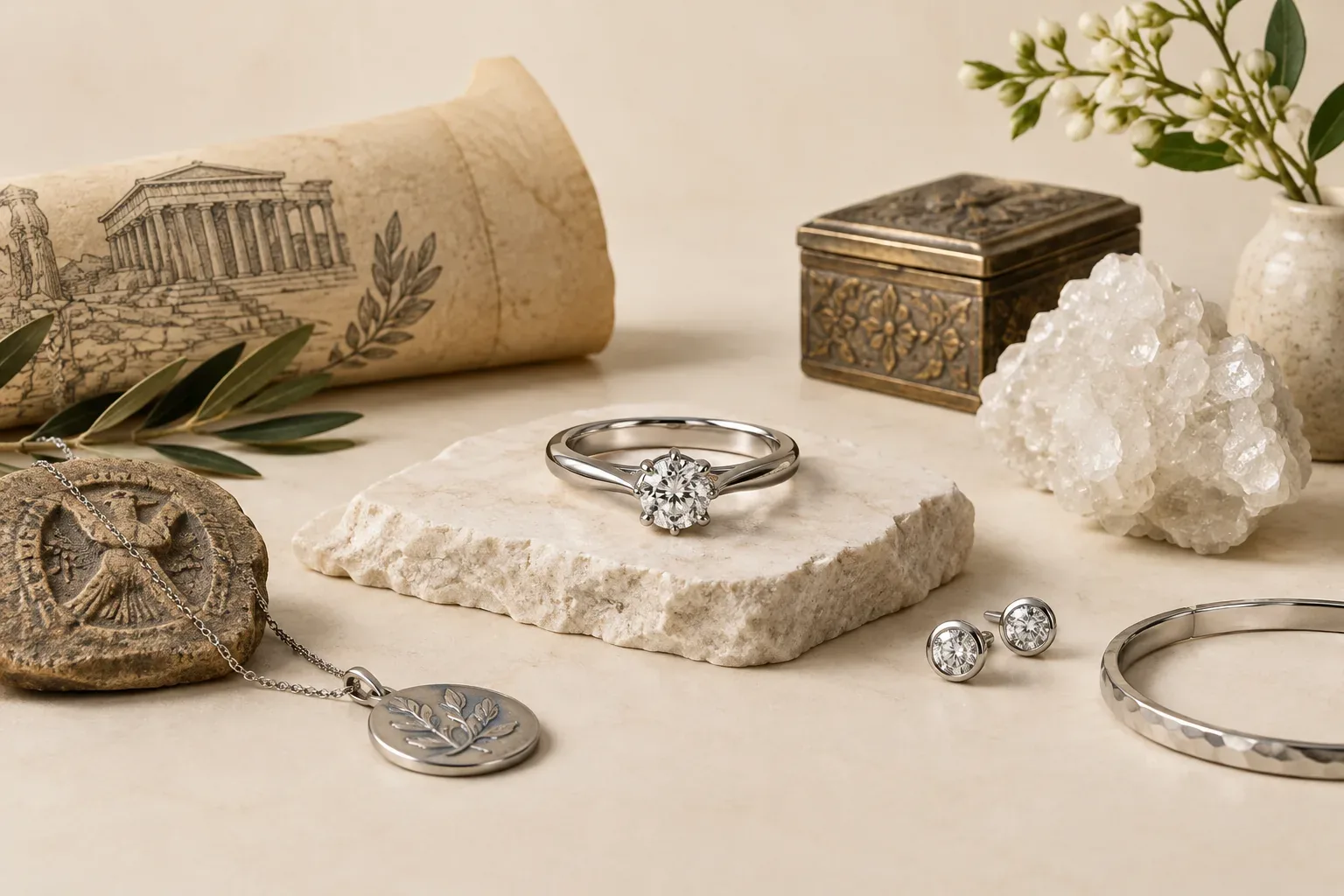
In current practice, jewelers and manufacturers use palladium as the metal for settings, bands, and structural components of pieces. It appears in wedding bands, rings that hold gemstones, earrings, and other forms where a white or silvery metal is desired. Designers may present palladium in plain metal motifs (such as smooth bands or hammered textures) and in settings that show off gemstones in prong, bezel, or channel styles.
Gemstones in palladium settings are presented and mounted in the same formal ways as they are in other white metals. The Victoria and Albert Museum's material on gemstones and jewellery construction explains that the chosen setting both protects a gem and contributes to a piece's visual and symbolic effect. When considering palladium jewelry, pay attention to how the metal is used structurally: whether it is the primary visible surface, an internal core, or combined with other metals or finishes.
Quality indicators to check before buying
Because different markets and manufacturers use different practices, buyers should seek objective information from the seller. Look for official hallmarks or maker's marks and ask for documentation of metal purity or composition. Reputable sellers will provide clear written information about the metal content and any surface treatments or plating used on the piece.
Ask for and keep written confirmation of weight (usually in grams), the declared metal purity, and any warranty or return policy. If the piece contains gemstones, request a written description of the gems, including whether they have undergone laboratory-treated processes; guidance from the Federal Trade Commission highlights that sellers must disclose material treatments, imitations, and important factors affecting gemstones' value. When in doubt, ask for a third-party appraisal or laboratory report for significant purchases.
Price considerations without hard numbers
Market prices for metals and finished jewelry change over time and are affected by supply, demand, and broader economic conditions. Rather than relying on a single quoted price, compare similar pieces from multiple reputable sellers and confirm what is included in the price: the raw metal, setting work, gemstones, certification, and any after-sales services such as resizing or engraving.
Because different retailers package services differently, a lower sticker price might exclude important costs such as sizing, appraisal, or a gem report. For peace of mind on larger purchases, ask for a written item breakdown so you can compare like for like across offers.
Best uses and gemstone compatibility
Palladium is used by designers for a range of pieces from plain bands to gem-set rings. Consider the wear patterns and the recipient's lifestyle when choosing a piece: rings and bracelets that experience daily wear need different design treatments and settings than occasional-wear pendants or earrings. When a piece holds gemstones, consider the stone's hardness, setting security, and care requirements; the V&A's guide to gemstones provides context on how different gems have been used historically and how their material properties affect mounting and care.
If choosing palladium for a ring intended as an engagement or wedding band, think about matching the metal visually and technically to any partner rings or existing jewelry. If the recipient has sensitive skin or known metal allergies, ask the seller about purity and potential alloying elements, and request any available testing or certification that speaks to hypoallergenic properties.
Gifting and selection guidance—practical and respectful choices
Select a piece that reflects the recipient's personal taste rather than assuming a metal choice carries a universal symbolic message. Ask discreetly about their preferences regarding metal color, weight, and daily habits to choose an appropriate style and size. If you cannot confirm ring sizing, consider buying from a seller with an accessible resizing policy or a reasonable return window.
Include information and care instructions with the gift. For example, provide the purchaser's or jeweler's paperwork listing metal composition and gemstone reports, the seller's contact for future questions, and any recommended cleaning or maintenance practices. This shows respect for the item's value and the recipient's ability to care for it responsibly.
Care, maintenance, and resale considerations
All jewelry requires basic care and occasional professional inspection. When buying, ask whether any plating or surface treatments were applied, because such finishes may require different care or re-finishing over time. Keep sales receipts, certificates, and any appraisals in case you later need professional servicing or wish to insure the piece.
If you are buying with resale or inheritance in mind, obtain an independent appraisal for pieces of significant value and make sure documentation of metal content and gemstone treatments is preserved. The Federal Trade Commission underscores the importance of sellers disclosing material treatments and imitations; that same disclosure aids future buyers and appraisers when assessing resale value.
Summary
Palladium jewelry should be approached as a modern metal choice whose meanings today are largely personal or contemporary rather than deeply rooted in historical tradition. Use objective checks—hallmarks, written disclosures, gemstone reports, and reputable sellers—to assess quality and price. Match the piece and its care requirements to how it will be worn, and include clear documentation when gifting. For historical context and broader material and gemstone guidance, consult established museum resources such as the Victoria and Albert Museum and consumer protection guidance such as the Federal Trade Commission's advice on buying gemstones.
Frequently asked questions
Is palladium a traditional metal for wedding bands?
Palladium is primarily a modern choice rather than a metal with long-documented traditional use in wedding jewelry; whether it makes a good wedding band depends on the couple's personal taste, lifestyle, and the practical checks described in this guide.
How can I be sure a palladium piece is genuine?
Ask the seller for hallmarks or maker's marks, written confirmation of metal composition and weight, and any available laboratory reports; reputable sellers will provide clear documentation and return or warranty terms.
Do gemstone treatments need to be disclosed when buying palladium jewelry that contains gems?
Yes; the U.S. Federal Trade Commission requires sellers to disclose significant treatments, imitations, or conditions that affect a gemstone's value, so request written information about any treatments and consider third-party verification for valuable stones.
What should I consider when gifting palladium jewelry?
Consider the recipient's style, metal preferences, daily habits, and ring size; include documentation such as the seller's paperwork and care instructions, and buy from a retailer with reasonable resizing and return policies to avoid awkward exchanges.
How should I care for palladium jewelry?
Follow the jeweler's care advice and keep documentation about any surface treatments; routinely inspect settings for security and have significant pieces professionally serviced as recommended by the seller or a qualified jeweler.
Will palladium jewelry match other white metals in my collection?
Palladium is presented as a white or silvery metal and can be visually compatible with other white metals, but finishes and surface treatments affect exact tone; compare pieces in natural light and ask the seller about any coatings or alloys that might change appearance over time.
Sources and further reading
- Bedazzled: A History of Jewellery — Victoria and Albert Museum
- An A-Z of Gemstones — Victoria and Albert Museum
- Buying Gemstones, Diamonds, and Pearls — Federal Trade Commission