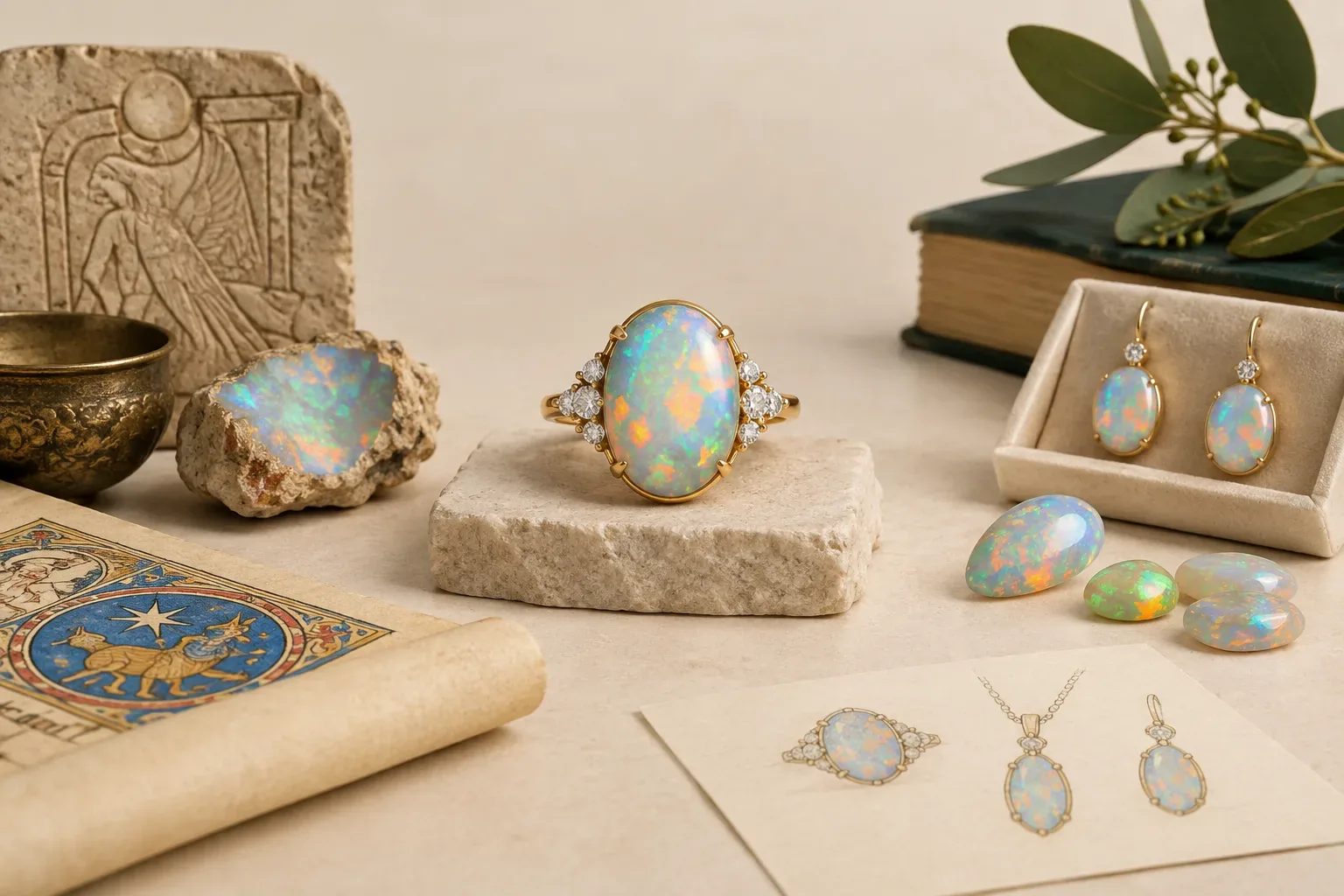
Meaning at a glance
This article explains the documented history and changing contexts of opal quality and value factors, separates museum-documented historical meanings from later popular or personal interpretations, outlines how opals are used in jewelry, and gives practical guidance for choosing, buying, and gifting opal pieces while pointing to required disclosures about treatments and assembled stones.
Historical evidence: where and when opals appear in the record
Documentation in museum collections and interpretation demonstrates that opals have featured in many different cultural and chronological settings rather than having one single, constant meaning. The Victoria and Albert Museum records opals and other gemstones within broad jewelry histories, illustrating use in periods such as antiquity, the Renaissance, and Victorian Britain and showing that tastes and symbolic associations changed with social context and technology.
Museum presentation and cataloguing emphasize objects and their social histories: for example, the Victoria and Albert Museum situates gemstones within court and devotional jewelry, personal adornment, and changing fashionable styles, rather than endorsing any single symbolic meaning for a stone across time. Those materials are the primary documented record for how jewelers and wearers used opals in specific periods; they are evidence of practice, not proof that a single symbolic interpretation was universal.
Archaeological finds and curated collections collected by museums like the Victoria and Albert Museum preserve evidence that gem use is historically contingent. The V&A's approach helps us identify which periods and cultures placed opals or similar materials into jewelry, and how those stones were set and valued within particular fashions and technologies of making.
Documented historical meanings versus modern interpretations
When museum sources report on the past, they distinguish what is documented (ownership, context, workmanship, recorded patron meanings) from later storytelling and popular belief. The Victoria and Albert Museum’s resources reflect documented practice—who made and wore pieces and how they were worn—rather than endorsing later folkloric claims that circulate about opals.
Modern personal or popular interpretations—such as reading stones as universal talismans, astrological tokens, or fixed moral signs—are not the same thing as the documented uses and social meanings preserved in museum collections. These contemporary readings may be meaningful to individuals, but they are modern layers of meaning that often post-date the objects and the documented contexts that museums record.
In short, use museum documentation to understand how opals were used and regarded in particular times and places; treat personal or popular interpretations as contemporary choices about symbolic meaning rather than as historical certainties.
What gem qualities determine opal value today
The main, observable qualities that buyers and appraisers use are play-of-color (the visible flashes of color within the stone), the brightness of that play-of-color, the pattern and balance of colors across the stone, the body tone or background color (dark, light, or transparent), and the stone’s overall condition, size, and cut. Bright, well-distributed play-of-color against a darker body tone typically increases desirability among collectors and buyers.
Other practical factors affecting value include durability and stability (some opals are relatively fragile or may craze), whether the stone is solid or assembled (for example, doublets and triplets combine thin opal with backing and a cap), and whether the stone has been treated to enhance appearance. The Federal Trade Commission emphasizes that treatments, imitation stones, and assembled stones must be disclosed to buyers, and that accurate descriptions are a consumer-rights requirement.
Origin can influence market value for some buyers, but origin claims should be supported by reliable documentation; again, sellers are expected to disclose material facts that affect value and durability, such as treatments, assembly, and the presence of stabilizing resin or backing.
How opals and their quality motifs appear in jewelry
Throughout documented jewelry history, opals have served most commonly as centre stones in rings, brooches, pendants, and earrings. The Victoria and Albert Museum’s recordings of jewelry styles show how makers set stones to display optical effects and to fit prevailing fashions of each period: stones might be bezel-set for protection, clustered with accent gems for Victorian effect, or used in simpler mounts to emphasize colour play.
The practicalities of mounting also reflect value factors: more valuable opals are often set to protect edges and faces, with settings designed to reduce exposure to knocks and sudden temperature changes. Lower-cost assembled opals—where a thin slice of opal is glued to a backing or capped—appear in settings that may be less concerned with long-term stability, and museums document assembled techniques as part of changing manufacture and market practices.
Design motifs and the visual emphasis on play-of-color—whether displayed as a single dramatic stone or as a patterned inlay—are ways makers translate the gem’s optical qualities into wearable objects. Museum collections show these shifts in emphasis across centuries and styles.
Practical guidance for selecting, buying and gifting opal jewelry
Start by identifying the attributes you or your intended recipient value most: pronounced, bright play-of-color; a specific color palette (reds are often prized where present); dark body tone for contrast; or a more translucent or pale stone. Inspect the stone under natural and mixed light to judge how consistent and bright the play-of-color is. Ask the seller to show the opal under different lighting and to point out any areas where color is absent.
Always ask for full, written disclosure about treatments, assembly, and origin. The Federal Trade Commission requires sellers to disclose material treatments and imitations; for opals this includes assembled stones such as doublets and triplets and any stabilizing or color-enhancing treatments. If a seller is reluctant to confirm these facts in writing, treat that as a red flag.
Consider durability and setting choice. Opals are softer and more brittle than many other gemstones; if the piece is intended for regular wear, choose a protective mounting such as a bezel or a design that shields the stone’s edges. For heirloom or investment purchases, ask about the option of a protective setting and whether the stone is solid or assembled.
If buying as a gift, match the style and practical needs of the recipient. Choose a mount and metal that reflect their daily activities—for active wearers prefer protective settings; for collectors or occasional wearers a more open setting may better display the stone. Given the variety of modern personal meanings attached to opals, discuss any symbolic intent you wish to convey so the recipient understands whether your gift is intended as a personal token or a purely aesthetic choice.
For higher-value purchases, seek documentation from a reputable dealer and ask about the possibility of independent gemological assessment; always obtain a clear return policy. Maintain reasonable expectations: two stones with similar play-of-color may vary greatly in price because of differences in body tone, pattern, size, and whether they are solid or assembled.
Care, display and long-term considerations
Opals require gentle care. Avoid sudden temperature changes and prolonged exposure to chemicals, acids, or household cleaners. Remove opal jewelry during tasks that risk knocks or abrasion. Store opal pieces separately to prevent scratches from harder gems and metals.
If your opal is an assembled stone, be aware that the adhesive layer or backing can fail over time. Inspect assembled opals periodically for lifting or cloudiness and take them to a trusted jeweller if you observe changes. For museum-grade pieces, conservation practice focuses on controlled humidity and light; for everyday wear, reasonable care and protective settings reduce long-term risk.
Finally, treat symbolic claims as personal choices. If you or your recipient ascribe special meaning to opals, make that clear at gifting and, where appropriate, include a note about whether the symbolism is a personal sentiment rather than a documented historical fact recorded in museum holdings.
Closing thought
Opal quality and value factors combine visible gem properties with manufacturing history and market disclosure. Use museum documentation to understand historical uses and social context, use consumer-protection guidance to insist on transparent selling practices, and choose settings and styles that fit the wearer’s life and the stone’s durability. That approach keeps your purchase both informed and respectful of the different layers of meaning—historical, market, and personal—that opals carry today.
Frequently asked questions
What are the primary factors that determine opal value?
The primary factors are play-of-color (its brightness and pattern), body tone or background color, pattern and color distribution, size and cut, and whether the stone is solid or assembled. Treatments and assembly also affect value and must be disclosed by the seller.
How can I tell if an opal is assembled or treated?
Ask the seller for written disclosure. Many assembled opals (doublets and triplets) show a visible layered structure at the edge. The Federal Trade Commission requires sellers to disclose such facts. If in doubt, request inspection under magnification or an independent assessment.
Are opals durable enough for everyday rings?
Opals are generally softer and more brittle than many gemstones and are vulnerable to knocks and sudden temperature changes, so choose protective settings (such as bezels) for everyday wear and avoid activities that risk abrasion or impact.
Should I expect certification when buying an opal?
For higher-value purchases, documentation and an independent appraisal or lab report add confidence. At a minimum, ask for a written description from the seller that discloses treatments, assembly, and any origin claims, as recommended by consumer-protection guidance from the Federal Trade Commission.
How should I care for opal jewelry?
Avoid exposing opals to chemicals, cleaners, and extreme temperature changes. Store them separately from harder stones and metals, remove them before manual work, and have assembled stones checked periodically for lifting or adhesive failure.
Sources and further reading
- Bedazzled: A History of Jewellery — Victoria and Albert Museum
- An A-Z of Gemstones — Victoria and Albert Museum
- Buying Gemstones, Diamonds, and Pearls — Federal Trade Commission