Meaning at a glance
This article shows how to plan a mother-focused multi-flower jewelry gift by mapping each child to a birth flower, balancing motifs and gemstones, confirming engravings and materials, and timing delivery for greatest meaning.
Historical evidence and cultural context
Written and material cultures show that people have used flowers to signal feelings, seasons, and social messages in many different times and places. The broad sweep of how flowers became symbolic and seasonally meaningful is discussed in research and collections held by the Smithsonian Libraries and Archives, which frames plant symbolism within changing human-plant relationships and seasonal histories. The Smithsonian emphasizes how plant choices reflect cultural uses and seasonal rhythms rather than a single universal language.
The idea of cataloguing flower meanings into lists and printed guides is part of a later, largely printed-cultural phenomenon. The Library of Congress documents that floriography—using printed lists and guidebooks to attach specific meanings to flowers—rose in prominence with nineteenth- and early twentieth-century print culture, and that published meanings vary by period and by the author of a given guide. The Library of Congress stresses that those printed meanings are products of particular places and markets rather than a single ancient system.
Botanical and horticultural sources such as documents from the Royal Horticultural Society provide plant identification, seasonality, and pollination context that are essential when choosing a flower motif for a wearable object. The Royal Horticultural Society’s work makes clear that some flowers are highly seasonal or fragile, which has influenced how and when their forms were adapted into lasting decorative media such as metalwork, enamel, and gem cutting.
Documented historical meanings versus modern personal interpretation
Documented meanings come from archival and published sources. For example, nineteenth-century floriography can be cited for the meanings given to certain blooms in particular printed guides, but those guidebooks are not authoritative for all cultures or centuries. The Library of Congress notes that meanings vary by period and source, so a flower associated with one sentiment in a Victorian handbook may have different connotations in another place or era.
Modern, personal, or family interpretations are different in kind and are equally valid for gift-giving. A mother may prefer that a child’s flower represent a nickname, a shared memory, or a color rather than a published symbolic definition. When planning a gift, treat published meanings as background context and prioritize the recipient’s own associations and preferences. This approach recognizes the documented history without claiming universality.
How birth-flower motifs and gemstones appear in jewelry
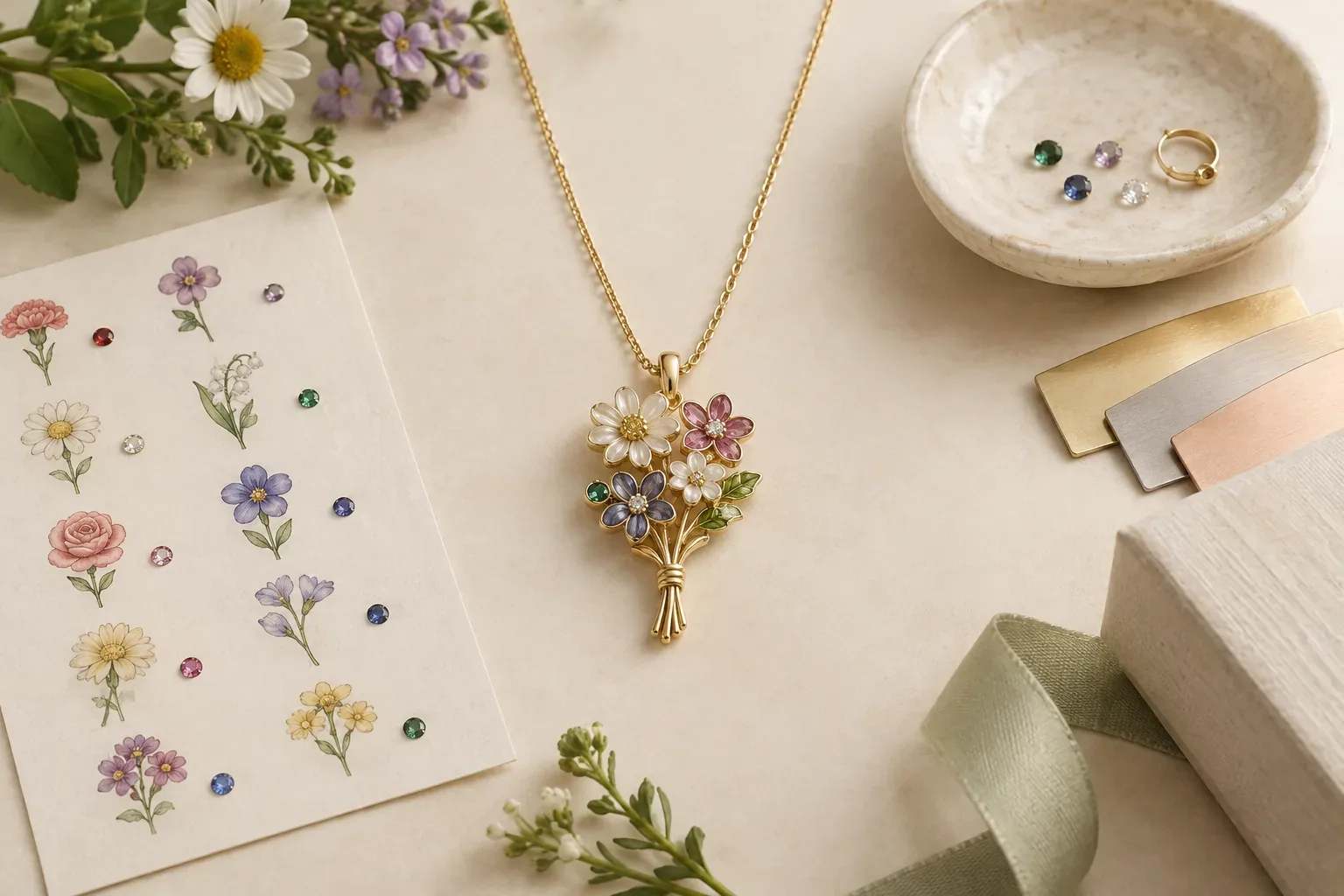
Flower motifs appear in jewelry in a few consistent ways: as engraved outlines on a pendant or tag, as three-dimensional cast forms for charms, as enamelled surfaces showing color and detail, or as abstracted line-work that suggests a petal or stem. Jewelers translate botanical forms into metal and stone in order to preserve the essence of a particular bloom while ensuring durability.
Gemstones enter the equation in two roles. First, they can represent a flower’s color or a child’s birth month by using birthstones or color-matched gems. Second, some pieces use gem cuts or settings to mimic a flower center—for example, a cluster of small diamonds to suggest a stamen cluster, or a central cabochon representing a flower head surrounded by petal-like metalwork. When selecting stones, consult guidelines on material disclosure and treatment: the Federal Trade Commission emphasizes the importance of clear disclosure between natural, lab-grown, and imitation gemstones, and that these differences matter to buyers for both value and care.
Practical planning: month mapping and motif choices
Begin by deciding the month-to-flower mapping you will use. There are many regional lists and variant traditions; one commonly used modern western mapping is: January — Carnation; February — Violet; March — Daffodil (Narcissus); April — Daisy or Sweet Pea; May — Lily of the Valley; June — Rose; July — Larkspur; August — Gladiolus (and poppy in some lists); September — Aster; October — Marigold (or Cosmos in some traditions); November — Chrysanthemum; December — Narcissus or Holly in different systems. Present this mapping to the recipient if you are unsure which tradition matters to them, because no single list is universal.
Next, decide whether you will represent flowers literally or abstractly. Literal representations work well when the bloom has a distinctive silhouette, color, or petal structure. Abstracted motifs keep the piece visually simple and are often preferred for everyday wear. Balance literal and abstract elements so the piece reads as a considered whole: for example, combine one small realistic charm with two abstracted birthstone accents rather than trying to reproduce three full, fragile blossoms at life size.
Design details: motif balance, engraving checks, and materials
Motif balance matters. A pendant that includes three children’s flowers can either use three small charms on a single chain or a single pendant that incorporates three simplified flower forms. Smaller charms create movement and an heirloom feel; a single unified pendant is more streamlined and often more durable. Think about scale in relation to the wearer’s proportions and typical wardrobe.
Engraving checks are essential. If you plan initials or a short message on the back of a pendant, check the available engraving area and character limits with the jeweler before finalizing the purchase. Many jewelers and trade organizations such as Jewelers of America recommend confirming font size, spelling, and proofing procedures in writing. If you have nonstandard characters, diacritics, or a longer inscription in mind, request a mockup or engraving template.
Choose metals and stones with care for everyday wear and allergies. Consider durable alloys for active mothers, and ask the seller about plating longevity. Follow consumer guidance on gemstone disclosure from the Federal Trade Commission: verify whether stones are natural, lab-grown, or simulated, and keep receipts and any certification. If the recipient has metal sensitivities, opt for hypoallergenic metals such as high-karat gold, platinum, or properly labeled surgical stainless steel.
Gift presentation and delivery timing
Delivery timing can amplify meaning. Some buyers schedule arrival for a child’s birthday, Mother’s Day, or a family anniversary so the jewelry will be associated with a specific memory. The Smithsonian’s seasonal histories underscore how timing and seasonality shape human-plant associations, and timing a floral-themed gift to a relevant date strengthens that connection.
If you plan to present the piece in person, include a small note explaining the month-to-flower choices and the reason you selected each motif. If shipping, confirm delivery windows and insured transit with the jeweler or carrier, and allow extra time for custom work and engraving. Jewelers of America recommends discussing production and delivery timelines before you purchase to avoid missed dates.
Care, future-proofing, and ethical considerations
Think about care and future use. Enamel and delicate three-dimensional elements may require occasional professional maintenance. Choose settings and prongs that protect stones if the piece is likely to be worn daily. The Royal Horticultural Society’s botanical notes remind designers and buyers that some floral forms are fragile when reproduced literally, which argues for stylized or reinforced metal forms for long-term wear.
Consider sustainability and disclosure. Ask sellers for information about sourcing and treatment of metals and gems. The Federal Trade Commission guidance on material disclosure protects buyers and helps maintain value. Keep purchase documents and any gem reports with the jewelry so provenance and care instructions travel with the piece.
Closing thoughts
Mothers birth flower jewelry can be an intimate, enduring way to celebrate children and family ties if built around thoughtful month mapping, clear communication with the maker, and attention to materials and timing. Use published historical guides as context, but let the recipient’s personal associations guide your final decisions so the piece becomes a meaningful, wearable family record.
Frequently asked questions
How should I map my children’s birth months to flowers?
There are several traditions; one commonly used modern western list maps January to Carnation, February to Violet, March to Daffodil, April to Daisy or Sweet Pea, May to Lily of the Valley, June to Rose, July to Larkspur, August to Gladiolus (and sometimes poppy), September to Aster, October to Marigold (or Cosmos in other lists), November to Chrysanthemum, and December to Narcissus or Holly. Because lists vary by region and source, present the mapping to the recipient if you are unsure which tradition they prefer.
Should I include both a floral motif and a birthstone for each child?
You can, but avoid trying to represent each child with full literal flowers and stones at the same scale. A more successful design is a primary motif—either a small floral charm or an engraved flower—with a single stone accent per child, or a unified pendant that combines abstract flower forms with color accents.
What engraving checks should I make before ordering?
Confirm character limits, font choices, spelling, and any special characters with the jeweler. Request a digital or physical mockup when possible and get written confirmation of the exact engraved text and placement before production begins.
How do I choose materials if the wearer has sensitive skin?
Ask about metal composition and choose hypoallergenic options such as high-karat gold, platinum, or certified surgical stainless steel. Confirm any plating details and how long plating typically lasts. Keep documentation from the seller about alloys used.
When should I schedule delivery for maximum symbolic impact?
Time delivery for a meaningful date such as a child’s birthday, Mother’s Day, a family anniversary, or the season linked to the flowers. Allow extra time for customization and verify production and shipping timelines with the jeweler ahead of purchase.
How should I care for floral enamel or delicate metalwork?
Avoid harsh chemicals, store pieces separately to prevent abrasion, and have intricate settings and enamel inspected periodically by a professional jeweler. If the piece has fragile three-dimensional elements, consider reserving it for semi-formal rather than daily wear.
Sources and further reading
- Blooming Flowers: A Seasonal History of Plants and People — Smithsonian Libraries and Archives
- Flowers and Their Meanings — Library of Congress
- Plants of the World — Royal Horticultural Society
- Buying Gemstones, Diamonds, and Pearls — Federal Trade Commission
- Jewelry Buying Guides — Jewelers of America