Meaning at a glance
Map relatives to flowers, use shared symbols or grouped motifs for repeat months, balance scale and color for legibility, confirm engraving and material disclosures, and choose formats that suit daily wear and meaning.
What the historical evidence shows
The idea of assigning meanings to flowers and using floral imagery in personal objects is long-standing but not uniform. Smithsonian Libraries and Archives describes a broad seasonal history in which people’s relationships with plants shift by era and place; flowers have served practical, decorative and symbolic roles across many societies. The Library of Congress highlights floriography—Victorian-era printed guides and popular culture—as a period when specific floral meanings became widely circulated in English-language print, but it also notes that those meanings vary by source and date. For botanical and seasonal detail, the Royal Horticultural Society provides modern, evidence-based context about plant identification and flowering times, which matters when a design aims to reflect botanical accuracy or seasonal authenticity.
Documented historical meanings versus today’s personal interpretations
Documented historical meanings are those you can trace in print, catalogues or institutional records. For example, Victorian floriography lists attributes for certain blooms—information discussed by the Library of Congress—but those lists were not globally standardized and often reflected local tastes and marketable symbolism. The Smithsonian emphasizes that plant symbolism can change as the cultural context shifts, so a flower used to indicate mourning in one period might be cheerful in another.
Modern personal interpretations are the meanings individuals or families assign when they give or wear jewelry today. These interpretations are valid for the wearer but should be distinguished from historical claims. When presenting a family birth flower piece as a gift or heirloom, say whether you are drawing on historical symbolism, seasonal associations, botanical facts, or an intimate family story so recipients understand whether the meaning is documentary or personal.
How motifs, gemstones, and traditions appear in jewelry
Floral motifs appear across formats: engraved silhouettes on lockets, low-relief cast blossoms on rings, delicate enamel flowers on pendants, and three-dimensional sculpted petals on brooches. Gemstones and birthstones are sometimes combined with floral forms to add color and sparkle; the Federal Trade Commission’s guidance on gemstones, diamonds and pearls recommends that sellers disclose natural versus lab-grown or imitation stones, which matters when color or durability are part of the design brief.
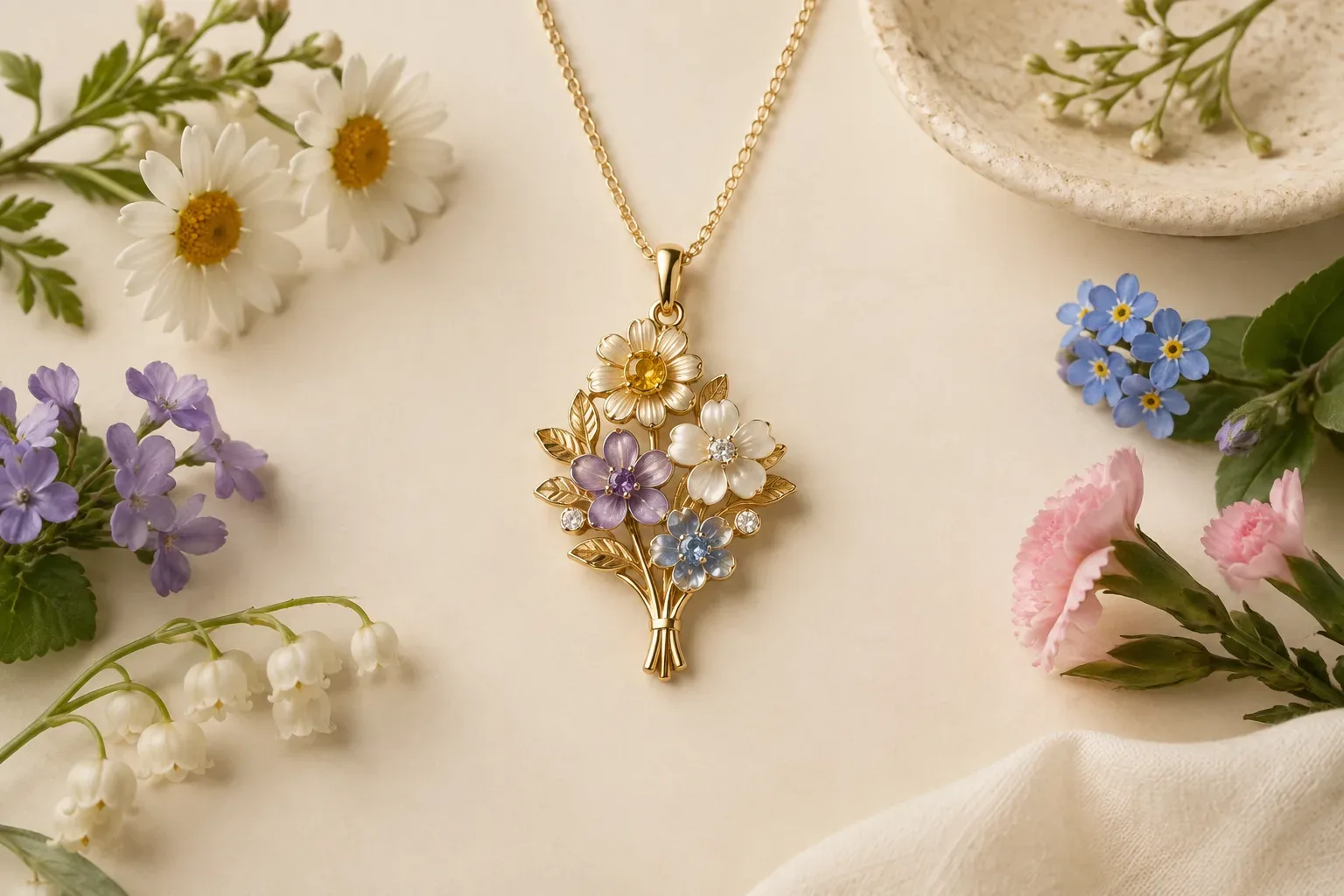
Traditional motifs can also be adapted into contemporary styles. For example, a single birth flower may be rendered in a minimalist outline on a bar necklace, while multi-flower family pieces often use clustered settings, shared stems, or a bouquet silhouette to suggest family unity. The Jewelers of America’s buying guides underline the importance of format and fit—whether a ring will hold several small motifs or whether a pendant’s size supports multiple distinct elements—so plan the physical constraints of each jewelry type early in the design process.
Mapping relatives to flowers: practical approaches
Start by deciding whether you will use strictly calendrical birth flowers (the single flower traditionally associated with each month) or a broader list that includes alternate or regional birth flowers. If you choose calendar flowers, map each relative to that month’s flower. If several relatives share a month, assign sub-roles: designate primary and secondary flowers, use a single shared bloom to symbolize the group, or select a related botanical feature such as a leaf or bud to differentiate individual contributions.
If you prefer a more personal system, allow each person to pick a flower that represents their personality or a family memory rather than their birth month. Document your choices so future wearers understand the mappings and don’t accidentally assume a historical meaning that isn’t intended.
Handling repeated months and duplicate flowers
Repeated months are common in family groups. One respectful approach is to use variations of the same motif: different finishes (matte versus polished), color accents with small gemstones, or scaled versions of the same bloom to indicate different individuals. Another approach is to combine the same flower into a bouquet composition where each bloom is distinct in size or orientation so individual identities are preserved within a single unified motif.
If legibility is a priority, avoid cramming many identical tiny motifs into a small ring bezel. Instead, select a larger canvas such as a pendant or bracelet link cluster so each duplicated flower can be carved, enameled, or set with a stone to remain visually distinct.
Balancing multiple motifs for clarity and style
Good multi-flower design balances scale, color, and contrast. Use a dominant motif to anchor the composition and smaller supporting blooms for relatives with secondary roles. Limit the color palette to two or three harmonizing stones or enamels to avoid visual clutter, and use negative space—open areas of metal or enamel—to isolate each motif so it reads clearly at the intended viewing distance.
Consider how the piece will be worn. Necklaces and large brooches can accommodate more detail than rings or thin bangles. For everyday wearability, choose designs that minimize protruding elements that might snag, and plan for secure bezel or flush settings if you include gemstones.
Confirming engraving, materials, and legibility with sellers
Before commissioning or buying, get a clear mockup or digital rendering that shows how each flower and any engraving will appear at actual size. Check the seller’s policies and documentation: the Federal Trade Commission recommends that sellers disclose whether gemstones are natural, lab-grown or simulants, and Jewelers of America emphasizes confirming metal type, hallmarking, and sizing options. Ask for magnified views or tests of prototype pieces to ensure engraved names, dates or initials will be legible after wear.
If an artisan hand-engraves blooms or initials, request a proof and ask about their process for protecting engravings over time. Consider deeper engraving for pieces intended for heavy daily wear, and discuss surface treatments—such as lacquer or rhodium plating—that can affect contrast and long-term legibility.
Choosing a wearable, durable composition
Select metals and construction appropriate to the piece’s intended use. For daily-wear pieces choose robust metals like 14k or 18k gold, platinum, or well-finished sterling silver, and favor bezel or flush settings for gemstones that minimize snags. The Jewelers of America buying guides recommend checking clasp and solder quality for bracelets and necklaces to reduce breakage risk.
If botanical accuracy matters, consult Royal Horticultural Society resources on plant form and seasonality to choose identifiable features that reproduce well at small scale. For example, some flowers have intricate centers that will be lost at ring scale; stylized silhouettes or single-petal motifs may read better and honor the flower without false botanical detail.
Respectful gifting and communication
When giving family birth flower jewelry, explain what the flowers represent and whether meanings are historical, botanical, or personal. Be mindful that floral symbolism differs by culture and period; the Library of Congress cautions that floriography’s specific associations are historically situated and not universal. Avoid assuming that a single flower’s meaning translates across cultures, and offer the recipient the option to reinterpret elements if they prefer.
If the piece references flowers from cultures not your own, research context and, when appropriate, consult family members or community sources about respectful use. Clear communication lets a family heirloom hold both aesthetic value and intentional meaning.
Final checklist before purchase or commission
Confirm the flower mapping for each person and how duplicates will be handled. Review full-size or to-scale renderings to verify legibility of motifs and engraving. Ask the seller for written disclosures on metals and gemstones in line with FTC guidance and for warranty or repair policies consistent with Jewelers of America recommendations. Decide on wearability features—clasp strength, setting security, and surface finishes—and record the meanings you and your family intend so the piece can be interpreted correctly by future generations.
Frequently asked questions
How do I represent multiple family members who share a birth month?
Use variations of the same flower—different sizes, finishes, or small gemstone accents—or present the blooms as a bouquet where each flower is distinct; larger formats like pendants or brooches read better than small rings for multiple motifs.
Should the flowers in a family piece follow historical meanings?
You can reference historical meanings from traditions like Victorian floriography, but those associations are historically specific and not universal; make clear whether a meaning is documentary or a personal family choice.
What materials should I ask about before buying?
Confirm metal type and hallmarking, and ask whether gemstones are natural, lab-grown or simulants; the Federal Trade Commission recommends full disclosure, and Jewelers of America advises checking construction, clasps and sizing.
How can I ensure engraving and small details remain legible?
Request a to-scale mockup or magnified proof, choose deeper engraving for heavy-wear items, and prefer designs with adequate negative space and contrast so text and small motifs remain readable.
Is botanical accuracy important in jewelry design?
Botanical accuracy is useful if you want identifiable flowers; consult horticultural sources such as the Royal Horticultural Society to choose features that reproduce well at the scale you plan to work with.
Sources and further reading
- Blooming Flowers: A Seasonal History of Plants and People — Smithsonian Libraries and Archives
- Flowers and Their Meanings — Library of Congress
- Plants of the World — Royal Horticultural Society
- Buying Gemstones, Diamonds, and Pearls — Federal Trade Commission
- Jewelry Buying Guides — Jewelers of America