Meaning at a glance
This article explains documented histories and changing contexts of medieval European jewelry symbols, separates museum-evidenced meanings from later personal interpretations, and gives practical guidance for choosing and wearing these motifs in modern pieces.
What the historical evidence shows (and which cultures or periods it covers)
Evidence for medieval European jewelry symbols comes primarily from surviving objects in museum collections, inventories, and art historical study; the Victoria and Albert Museum summarizes how jewellery changed in function and meaning across medieval Europe, reflecting social rank, religious life, pilgrimage, and personal devotion. The V&A places objects within broad chronological ranges commonly called the Early, High, and Late Middle Ages, and links shifts in technique and use—such as the increasing use of enamel, gemstones set in metalwork, and the production of devotional pieces—to changing social and devotional practices in those periods.
Medieval jewellery in Europe was not culturally uniform. Christian devotional symbolism—crosses, reliquary lockets, and images of saints—is well represented in church contexts and private collections, while secular markers of status appear in rings, brooches, and belt fittings. The V&A treats these as part of the wider social history of jewellery, noting that the same object types could serve multiple functions: an ornate brooch could be both a fashion accessory and a sign of rank, while a pendant could be simultaneously devotional and decorative.
Material evidence—metals, techniques such as cloisonné or champlevé enamel, and the presence of specific stones—is used by museums to date and contextualize objects. The V&A’s accounts of gemstones emphasize how gem use, cutting, and setting changed over time and how certain stones were prized for both appearance and the virtues attributed to them in medieval lapidaries.
Documented historical meanings versus modern personal interpretations
Museum documentation tends to focus on how objects were used, manufactured, and circulated rather than on one fixed symbolic “meaning.” For example, the V&A presents medieval jewellery as evidence of social practice—the ways people displayed devotion, asserted rank, or participated in pilgrimage—rather than as proof that every wearer understood a motif in exactly the same symbolic way.
Modern personal interpretations often layer contemporary ideas onto medieval motifs. Today, wearers may choose a cross, a particular gemstone, or a stylized knot for reasons of fashion, family meaning, or spiritual identity that differ from medieval contexts. Those modern meanings can be meaningful and legitimate for the wearer, but they are not the same as documented medieval uses unless supported by historical evidence.
When discussing symbolism, it is important to distinguish source types. Material, technical, and provenance data recorded by museums like the V&A support claims about how objects were made and used in their time. Later literary or folkloric traditions sometimes reinterpret medieval motifs; those reinterpretations are modern cultural layers and should be presented as such rather than as original medieval meanings.
Common medieval motifs and gemstones and how they appear in jewellery
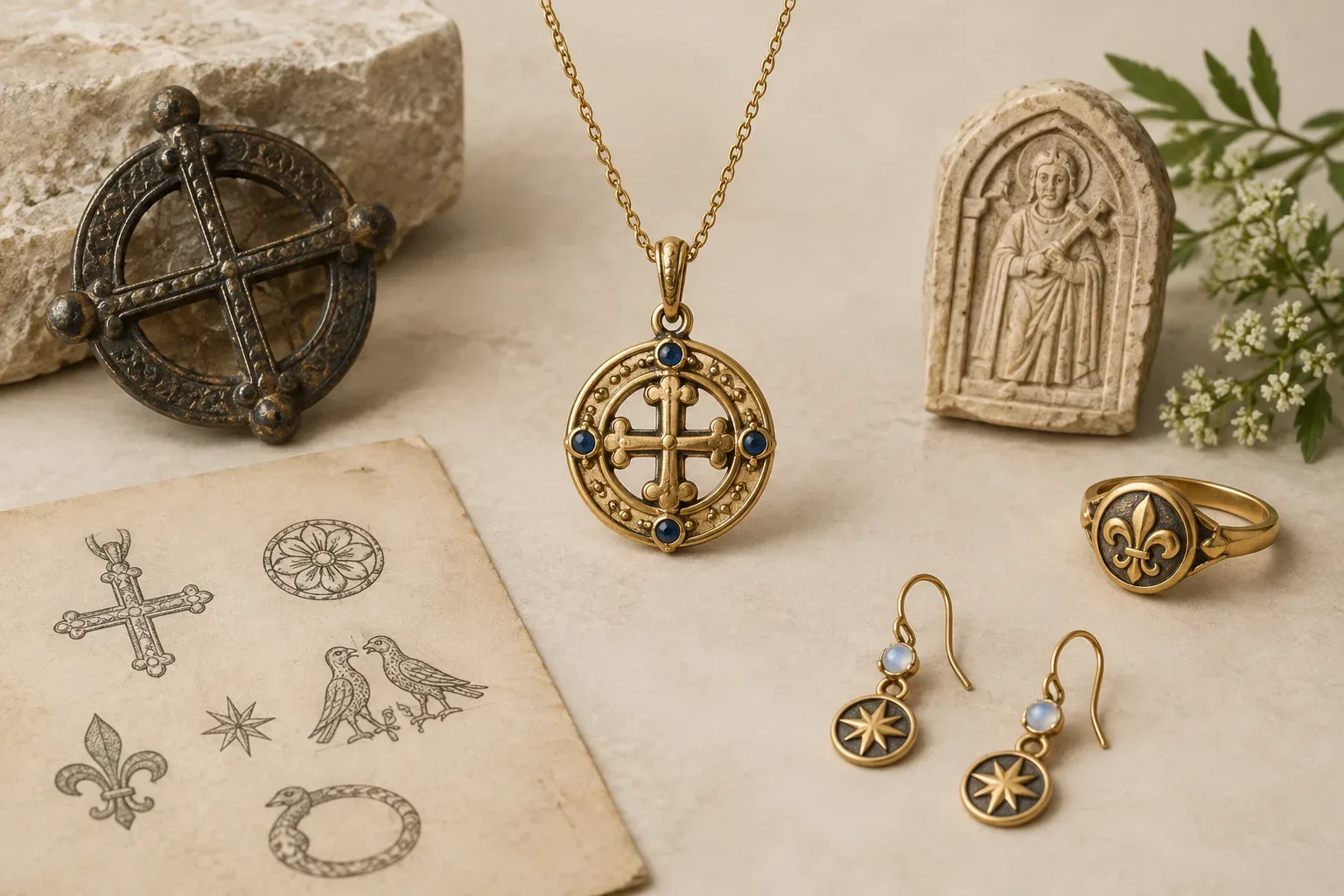
Religious motifs: Christian imagery—crosses, Christ and saint figures, reliquary pendants—appears frequently in medieval European jewellery, especially after the spread of devotional practices and pilgrimage. In museum collections, these motifs appear as pendants, reliquary lockets, and integrated elements in brooches or belt fittings, often made with precious metals and sometimes painted or enameled for visibility.
Protective or amuletic objects: Objects interpreted as protective—amulets, engraved gems, or pendants containing relic fragments—are identified in museum catalogs by their form, inscriptions, and contexts of deposition. Such pieces might combine small compartments (locket-like settings) or engraved stones set into metal mounts.
Status and identity markers: Rings, ornate brooches, and decorated belt fittings signalled social rank, office, or alliance. These show up in the archaeological and museum records as high-quality workmanship, use of costly materials, and formal shapes consistent with sartorial display.
Gemstones and their presentation: The Victoria and Albert Museum explains that gemstones were used both for their visual appeal and for virtues attributed to them in medieval lapidaries. Stones appear as cabochons or early faceted cuts set into signet rings, finger rings, pendants, and brooches. The way a gem is cut and mounted, and whether it is polished or engraved, helps curators date and interpret the piece.
Decorative techniques: Enamel, gilding, filigree and inlay are common techniques recorded in museum descriptions of medieval pieces. Enamel work is frequently used to highlight iconography, while filigree and granulation accentuate openwork settings commonly seen in high-status jewellery.
How to research provenance and authenticity before buying
Start with museum and specialist references. The Victoria and Albert Museum’s historical overviews and gemstone guides provide context for materials and techniques and can help you recognize period features and later reproductions. Use those references to form questions when you consult sellers or independent specialists.
Ask for documented provenance and condition reports from reputable dealers or auction houses, and request laboratory reports for stones where appropriate. The Federal Trade Commission advises consumers to seek clear disclosure about treatments, enhancements, and imitations when buying gemstones, diamonds, and pearls. Sellers should disclose whether a gem has been treated, whether it is synthetic, or whether it is an imitation.
If authenticity is crucial—especially when purchasing an object marketed as genuinely medieval—obtain independent appraisal and, if needed, scientific testing. Museums and experienced conservators can often advise on reputable laboratories or specialists.
Selecting and gifting medieval-inspired or historic jewellery respectfully
Be clear about the object’s status: is it an original medieval piece, a later antique inspired by medieval forms, or a modern design using medieval motifs? Representation matters: label and describe items honestly to respect both the object’s history and the recipient’s expectations.
Consider religious and cultural meaning. Symbols that were originally devotional may still carry sacred significance for some recipients. If you plan to gift a piece with explicitly religious imagery, consider the recipient’s beliefs and how wearing the symbol might be received in their community.
Prioritize ethical and informed purchasing. For gemstones and treated materials, follow the FTC’s guidance and request full disclosure about treatments and synthetic materials. If the object is an original, confirm legal export and provenance documentation to avoid supporting illicit trade.
Choose designs that acknowledge history without appropriating. If you commission or buy a modern piece inspired by medieval motifs, credit the cultural and historical source and avoid claiming that modern symbolic meanings are medieval unless supported by research. Consider gifting an accompanying note that explains the historical context and your personal reason for the gift; this makes the choice thoughtful and educational.
Wearing medieval symbols today: etiquette and reinterpretation
Wearing medieval-inspired jewelry today often blends historical reference with contemporary meaning. Many people choose motifs because they resonate aesthetically or personally; that is a valid modern use. At the same time, recognize that some motifs remain sacred or culturally specific, and wearing them requires the same sensitivity you would show toward any religious or communal symbol.
If you are representing a medieval object in a public or institutional context—such as a museum loan, exhibition, or academic presentation—use historically accurate labels and avoid projecting modern narratives onto the object without evidence. For personal wear, being informed about an emblem’s documented uses and acknowledging contemporary reinterpretation is a respectful approach.
Frequently asked questions
Were medieval jewelry symbols used the same way across Europe?
No. Museum evidence compiled by institutions such as the Victoria and Albert Museum shows that uses and meanings varied by region, period, social class, and context; a symbol that served as a devotional object in one community could function as a status marker or fashionable ornament in another.
Can I assume a gemstone’s medieval meaning applies today?
Not necessarily. The Victoria and Albert Museum documents that medieval lapidaries and cultural contexts attributed certain virtues to stones, but modern wearers often adopt different or personal meanings. Treat historical gemstone meanings as context rather than fixed modern prescription.
How can I verify the authenticity of an alleged medieval piece?
Ask for documented provenance, condition reports, and independent specialist or laboratory assessments. Museums and reputable dealers use technical criteria and provenance to assess age; the Federal Trade Commission recommends getting clear disclosure on treatments, synthetics, or imitations for gemstones.
Is it disrespectful to wear religious medieval symbols if I’m not a believer?
It depends on the symbol and the cultural context. Some symbols remain sacred for communities today. Inform yourself about the symbol’s contemporary significance and consider the recipient or audience—wearing such items thoughtfully and with respect is recommended.
What should I ask a seller before buying medieval-inspired jewelry?
Request clear statements about whether the piece is original, a period reproduction, or a modern design inspired by medieval motifs, ask for provenance and condition documentation if the item is presented as original, and request disclosure of any gem treatments or synthetic materials in line with FTC guidance.
Where should I start learning more about medieval jewellery contexts?
Museum overviews such as those from the Victoria and Albert Museum provide accessible introductions to historical techniques, materials, and social contexts, and are a useful place to begin background research.
Sources and further reading
- Bedazzled: A History of Jewellery — Victoria and Albert Museum
- An A-Z of Gemstones — Victoria and Albert Museum
- Buying Gemstones, Diamonds, and Pearls — Federal Trade Commission