Meaning at a glance
This article explains the documented history and changing contexts of medieval European jewelry—materials, techniques, social roles, and how motifs and gemstones appeared in wearable objects—separating museum-backed historical evidence from later personal or popular interpretations and offering practical selection and gifting advice for modern wearers.
Quick answer
Medieval European jewelry history shows that metals, gemstones, glass, and enamel were used in different combinations to mark status, religious identity, and personal display; museum research from the Victoria and Albert Museum emphasizes changing social contexts and regional styles, while modern buyers should verify material disclosure and treatment according to current consumer guidance from the U.S. Federal Trade Commission.
What the historical evidence shows (periods and regions)
Documentary and object-based research collected and interpreted by the Victoria and Albert Museum forms the backbone of what we know about medieval European jewelry. The term "medieval" covers several centuries and many regional traditions, and V&A scholarship and collections make clear that different areas and court cultures produced distinct styles and techniques. Objects and records from western and northern Europe, the Byzantine world, and regions affected by cross-cultural contact (for example through trade or conquest) each contribute different evidence about how jewelry was made, used, and displayed.
Because styles and meanings shifted over time, it is useful to separate broad phases rather than to treat the Middle Ages as uniform. Early medieval work preserved and adapted older traditions; high medieval courts expanded luxury display and pilgrimage-related forms; and later medieval practice incorporated Gothic ornament and new tastes. The V&A frames this history as a sequence of changing social contexts in which jewelry functioned differently for different groups and occasions.
Materials, techniques, and gemstones: museum-backed facts
Museum documentation shows that metalwork—primarily gold and silver—was the technical foundation of most high-status medieval jewelry. Techniques such as casting, openwork, granulation, and soldering were used alongside surface decoration including gilding and enamel. V&A research notes also that base metals and alloys appear in everyday or lower-status pieces, sometimes gilded to imitate gold.
Gemstones and glass played important roles in visual effect and value. The Victoria and Albert Museum’s resource on gemstones places historic materials such as sapphire, ruby, emerald, garnet, and pearls in their long-term context and describes how some stones were prized for color and rarity. Glass and paste gems were widely used as lower-cost substitutes or inlaid decoration. Some gemstones were cut minimally compared with later lapidary traditions, and settings were designed to display color and light rather than brilliant faceting.
It is also important for modern buyers to be aware of material treatment and imitation. The Federal Trade Commission provides contemporary consumer guidance on disclosure, noting that treatments, enhancements, and imitation materials should be disclosed to purchasers; this advice is relevant when evaluating both antique pieces and new jewelry made in historical styles.
Status, patronage, and daily wear in historical context
The V&A’s interpretive work emphasizes that jewelry functioned as a social signal. High-status pieces—often made of gold, set with precious stones, or decorated with enamel—were associated with courtly display, ecclesiastical patrons, and pilgrimage exchange. Lesser metals, glass, and simpler forms appear in contexts that suggest more everyday or regional use. These distinctions are visible in surviving objects and in records curated by museums.
At the same time, surviving museum pieces represent a fragmentary record. Objects preserved in collections often come from burial contexts, church treasure, or the hoards of wealthy patrons, so the archaeological and archival record can overrepresent elite material. V&A scholarship cautions against extrapolating the habits of an entire population from items that survive in museum collections alone.
Motifs and gemstones in medieval pieces: how they appear
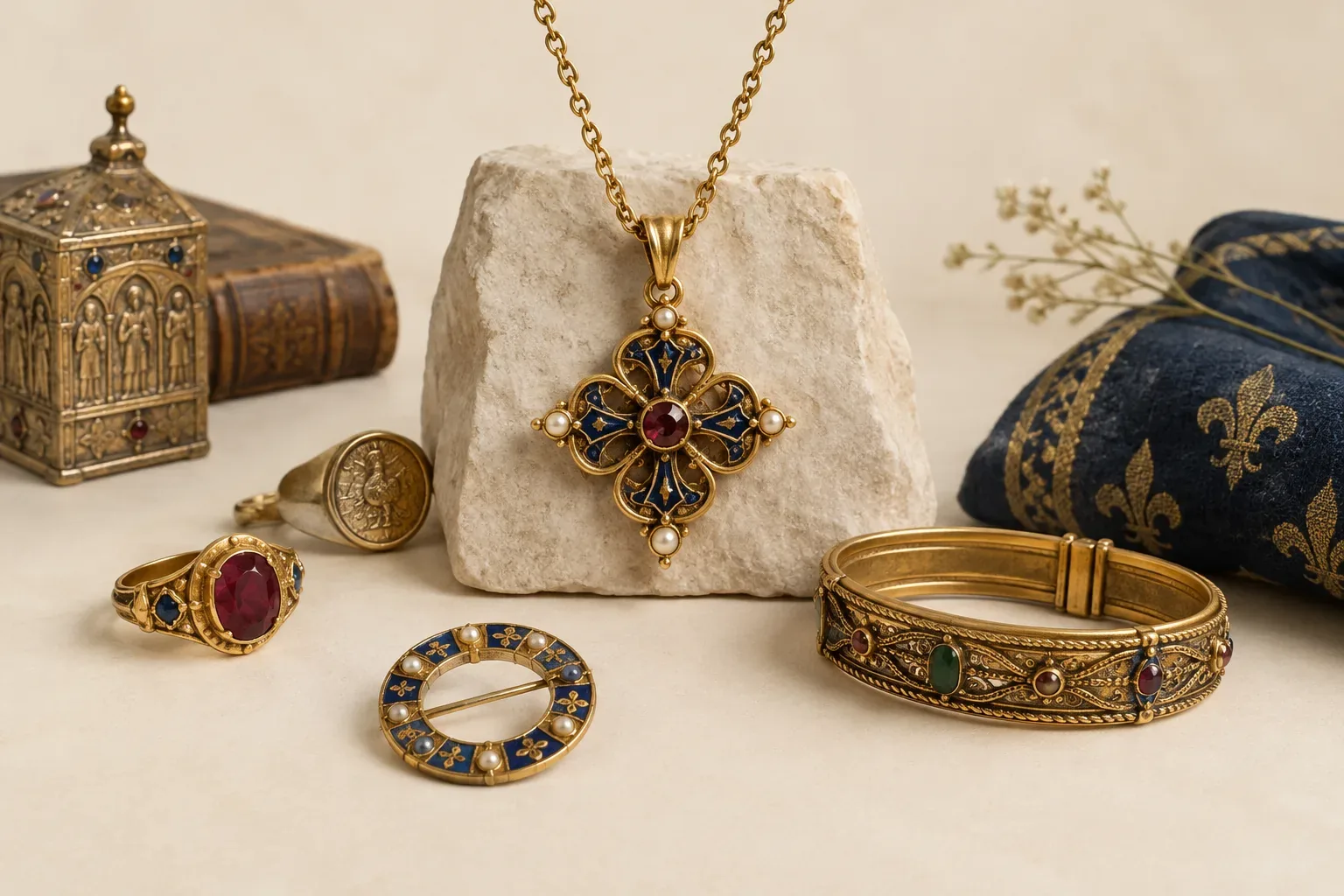
Museum descriptions show that motifs in medieval European jewelry ranged from explicitly religious symbols such as crosses and devotional images to secular decoration including vegetal scrolls, animals, interlace or knotwork, and heraldic elements. The way a motif appears—engraved, cast in relief, set with stone, or executed in cloisonné enamel—varies with technique, regional taste, and intended use. V&A collections illustrate these variations across regions and periods.
Gemstones were often used to emphasize color and light. Pearls commonly edged neck and head ornaments; rubies and sapphires provided saturated color in high-status mounts; garnets and glass often appear in northern and Anglo-Saxon contexts. The aesthetic choices recorded by the Victoria and Albert Museum show that jewelers combined motifs and materials to achieve both symbolic and visual effects without a single uniform meaning across Europe.
Documented meanings versus modern personal interpretations
Museum-backed evidence allows historians to infer some documented meanings—religious objects associated with devotion, reliquary adornment tied to pilgrimage, and certain items used as visible markers of rank at court. The Victoria and Albert Museum frames these functions in their changing social contexts and cautions that meaning is rarely static.
Modern wearers and designers often adopt medieval motifs for personal or aesthetic reasons that differ from historical functions. Contemporary symbolic readings—such as assigning a single universal meaning to a knot pattern or claiming that a particular stone confers a specific modern attribute—are interpretations layered on top of the historical record. Those contemporary meanings can be valuable personally, but they should be distinguished from what is documented in museum sources.
Practical guidance for selecting or gifting medieval-style jewelry today
If you are choosing or gifting jewelry inspired by medieval European history, start by deciding whether you want an original antique, a faithful reproduction, or a modern design that borrows motifs. For antiques and authentic period pieces, provenance and condition largely determine value and appropriateness for wear; the Victoria and Albert Museum’s exhibitions and cataloguing practices offer a model for how museums evaluate and describe such objects.
When buying either antiques or modern reproductions, ask sellers to disclose material treatments, enhancements, and imitations. The Federal Trade Commission’s consumer guidance recommends clear disclosure of any treatments or simulants in gemstones and clarity about metal content. Request written descriptions when possible and, for higher-value purchases, consider independent verification of gemstone identity and metal purity.
Be culturally and historically respectful when using motifs from specific communities or religious traditions. Research the origin of a motif or form (the Victoria and Albert Museum and similar institutions are useful starting points) and avoid claiming historical meanings as universal. Finally, consider practicality: choose secure settings, comfortable weights, and materials compatible with the wearer’s skin and daily activities if the piece is intended for regular wear.
Care, wearability, and adapting medieval designs for modern life
Many authentic medieval pieces were designed for display rather than constant, hard-wearing use. If you plan to wear an antique, consult a conservator or a reputable jeweller about appropriate repairs and whether a piece is safe for daily wear. For reproductions, seek modern metals and settings that balance historical appearance with contemporary durability.
If you want the historical look without the fragility, ask makers for reinforced settings, modern alloying for strength, and secure fastenings. When gifting, include a short note about the motif’s historical context and practical care instructions—this both educates and respects the object’s cultural background.
Closing summary
Medieval European jewelry history is best understood through museum-documented objects and scholarship that link materials and techniques to social contexts. The Victoria and Albert Museum provides a broad, evidence-based framework for those changes in style and function, while the Federal Trade Commission’s guidance helps modern buyers navigate material disclosure. Separating historically documented meanings from later or personal interpretations preserves both scholarly accuracy and the modern wearer’s freedom to find personal significance in these enduring designs.
Frequently asked questions
What metals and gemstones were common in medieval European jewelry?
Museum evidence shows that gold and silver were the principal metals for higher-status pieces, while base metals and gilding appear in more everyday forms. Gemstones such as sapphire, ruby, emerald, garnet, and pearls appear in museum collections for their color and visual impact, while glass and paste were used as economical substitutes. The Victoria and Albert Museum’s resources discuss these materials in historical context.
Did medieval people assign symbolic meanings to gemstones?
Historical records and objects indicate that gemstones could carry religious, medicinal, or status-related associations in various contexts, but meanings were not uniform across Europe. The Victoria and Albert Museum places these associations within changing social contexts rather than treating a single symbolic system as universal.
Can I wear antique medieval jewelry every day?
Many surviving medieval pieces are fragile or were designed for occasional display. Consult a conservator or reputable jeweller before wearing an antique daily. For regular use, consider a reproduction made with modern alloys and secure settings that maintain the historical look while offering modern durability.
How can I verify materials and treatments when buying medieval-style jewelry?
Ask sellers for written disclosure about metal content and any gemstone treatments or simulants. The Federal Trade Commission advises transparent disclosure of enhancements and imitation materials. For valuable purchases, seek independent testing for gemstone identity and metal purity.
Is it respectful to wear medieval motifs from specific cultures?
Using motifs from medieval cultures can be appropriate if you first research the motif’s origin and documented historical context. The Victoria and Albert Museum’s catalogues and articles are good starting points for that research. Avoid assuming a single meaning for a symbol and be cautious about claiming cultural ownership or making broad statements about intent.
Sources and further reading
- Bedazzled: A History of Jewellery — Victoria and Albert Museum
- An A-Z of Gemstones — Victoria and Albert Museum
- Buying Gemstones, Diamonds, and Pearls — Federal Trade Commission