Meaning at a glance
The mask motif in jewelry has varied documented roles—from echoes of ritual and theatrical masks to decorative and sentimental fashions—and its meanings have shifted with culture and context; this article separates museum-documented history from later popular readings and offers practical guidance for choosing, wearing, and gifting mask-themed pieces.
What the historical record shows
Museum collections and curatorial overviews collect and interpret examples of mask imagery and related motifs in jewellery across many periods and regions. The Victoria and Albert Museum describes how jewellery changes meaning as its social context changes, and its holdings include examples that link personal ornament to ritual, theatrical costume, and fashionable display (Victoria and Albert Museum).
Across recorded history, the relationship between masks and jewellery appears in several recurring contexts. In some cultures, masks have been part of communal or ritual performance and those shapes or facial motifs have occasionally been adapted into small-scale ornaments or amuletic forms; in other cases, theatrical and carnival masks inspired decorative accessories and costume jewellery. The V&A’s exhibitions and catalogues note that motifs often travel between contexts—ritual object, stage prop, fashionable emblem—taking on new associations each time (Victoria and Albert Museum).
In later European fashion, masquerade and theatrical culture contributed to an aesthetic of disguise and mystery that designers translated into pendants, brooches, and enamelled pieces. Curators at the V&A trace how changing tastes and technologies—enamelling, gem cutting, metalwork—allowed mask-like faces and stylised visages to appear as decorative motifs in private jewellery and public display (Victoria and Albert Museum).
Documented historical meanings versus modern interpretations
When museums document jewellery, they base interpretations on provenance, maker’s records, and the context in which an object was used or worn. In those cases, mask imagery may be recorded as connected to ritual practice, theatrical costume, protection beliefs, or simple ornament—each claim tied to evidence in the object’s history (Victoria and Albert Museum).
By contrast, modern popular or personal interpretations often layer new meanings onto older motifs. Contemporary wearers may see mask jewellery as representing anonymity, empowerment, mystery, identity play, or social commentary. These modern readings can be meaningful and authentic for the wearer, but they are distinct from the historical, evidence-led meanings described by curators and scholars. The two kinds of meaning can coexist, but they should be named and treated separately.
How the mask motif and materials appear in jewellery
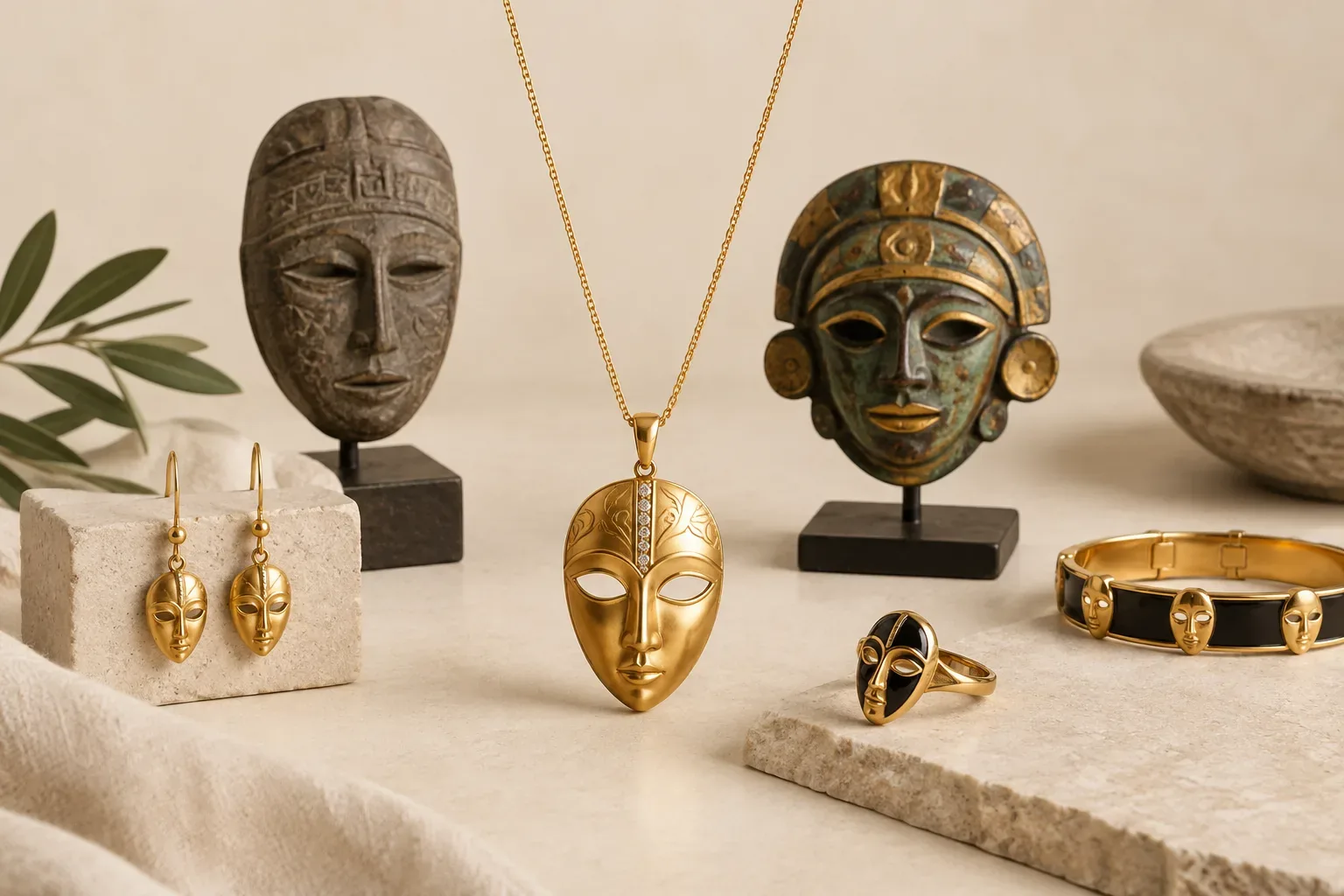
Designers and makers translate mask imagery into jewellery in a range of forms: pendants and lockets that take a facial silhouette, small cast or stamped mask charms, cameo-style profiles that echo visage motifs, enamelled brooches with stylised faces, and beads or settings that incorporate fossil or organic materials shaped like faces. The Victoria and Albert Museum’s coverage of jewellery history shows how techniques such as cameo carving, enamelling, and gem setting have been used to render figurative motifs—including faces and masks—at different times (Victoria and Albert Museum).
Gemstones and materials associated with mask-themed pieces vary by period and style. Organic materials such as amber have been used historically and in contemporary artisanal pieces for their warm colour and worked surface; carved cameos often use shell or stone to present a profile; enamel and metals provide durable colour and detail for stylised masks. For guidance on gemstones—identification, common historical uses, and context—refer to the Victoria and Albert Museum’s overview of gemstones (Victoria and Albert Museum).
Because gemstones and materials can be treated, enhanced, or imitated, the U.S. Federal Trade Commission recommends that buyers ask about material treatments, lab reports, and truthful disclosure from sellers. Sellers should disclose whether stones are heat-treated, dyed, lab-grown, or simulated, and buyers should request this information when assessing value and meaning (Federal Trade Commission).
Choosing and gifting mask jewellery respectfully
Begin by researching provenance. If a piece or design claims to be inspired by a specific cultural or religious mask tradition, look for clear information from the maker about source, permission, and whether community artisans were involved. Museum descriptions and curatorial catalogues can help establish historical context, and reputable sellers will identify a design’s inspirations honestly (Victoria and Albert Museum).
Consider the recipient’s cultural identity and preferences. Some mask designs carry sacred or ceremonial significance in their source cultures; wearing those images as fashion can be sensitive. When in doubt, choose pieces by makers from the culture in question, select clearly contemporary, decorative reinterpretations rather than sacred designs, or ask the recipient whether they welcome a culturally specific motif.
Prioritise ethical sourcing and accurate disclosure. Ask sellers about materials, treatments, and any certificates for gemstones, following the consumer guidance the Federal Trade Commission offers on buying gemstones and jewellery. For higher-value purchases, request independent gemological reports and written descriptions of treatments or lab-grown origins (Federal Trade Commission).
Match style to intent. If the gift is meant to evoke mystery and play, look for contemporary, stylised mask pendants, enamel brooches, or costume pieces. If the intention is historical interest or collection, seek pieces with documented provenance and museum-style labels or reputable dealer verification. If you prefer a piece with symbolic protection or personal meaning, discuss a design that communicates that intention directly with the maker so the symbolism is explicit and consensual.
Practical wear, care, and ethical notes
Treat mask jewellery like any other piece of fine or costume jewellery in terms of care: follow the maker’s care instructions, protect organic materials such as amber from chemicals and heat, and clean metals and gemstones according to their specific needs. Many contemporary sellers include care recommendations; follow them to keep materials intact and colours stable.
Be mindful in public contexts. Wearing mask imagery that references living cultural or religious practices may cause discomfort or misunderstanding. If you are wearing a motif with cultural roots different from your own, be prepared to explain that you chose a respectful, ethically sourced piece and, when possible, to credit the source or maker.
If purchasing museum-style or historically inspired pieces, seek reputable dealers and compare notes with museum publications and catalogues to avoid misattributing origins. The Victoria and Albert Museum’s work on jewellery history can serve as a reference for identifying historically documented styles and techniques (Victoria and Albert Museum).
Conclusion
Mask jewellery meaning is not uniform: curatorial evidence links mask motifs to a range of historical uses, while contemporary meanings are often personal or stylistic. Use museum resources to understand documented histories, follow consumer guidance for disclosure on materials, and select or gift pieces with provenance, respect, and clear communication about the intended meaning.
Frequently asked questions
Does mask jewelry have a single, universal meaning?
No. Museum evidence shows that mask motifs have different functions and meanings depending on culture and period; modern wearers also attach personal meanings that differ from historical uses (Victoria and Albert Museum).
Is it offensive to wear mask motifs from other cultures?
It can be. Some masks are part of living cultural or religious practices. To be respectful, research provenance, prefer makers from the source culture when possible, and avoid using sacred designs as mere fashion statements (Victoria and Albert Museum).
How can I tell if a gemstone or material in mask jewellery is genuine?
Ask the seller for full disclosure about treatments, lab-grown origins, or simulations. The Federal Trade Commission advises buyers to request written information and independent reports for valuable stones (Federal Trade Commission).
Can a mask pendant be a protective amulet?
Historically, some face-shaped or amuletic objects were used for protection in particular cultures, and such claims are recorded in museum catalogues when supported by provenance. Modern protective uses are personal interpretations unless specifically documented for a given tradition (Victoria and Albert Museum).
What should I look for when gifting mask jewellery?
Consider the recipient’s cultural background and tastes, verify provenance and maker information, ask about materials and treatments, and choose ethically sourced or community-made pieces when the design references a living tradition (Victoria and Albert Museum; Federal Trade Commission).
Sources and further reading
- Bedazzled: A History of Jewellery — Victoria and Albert Museum
- An A-Z of Gemstones — Victoria and Albert Museum
- Buying Gemstones, Diamonds, and Pearls — Federal Trade Commission