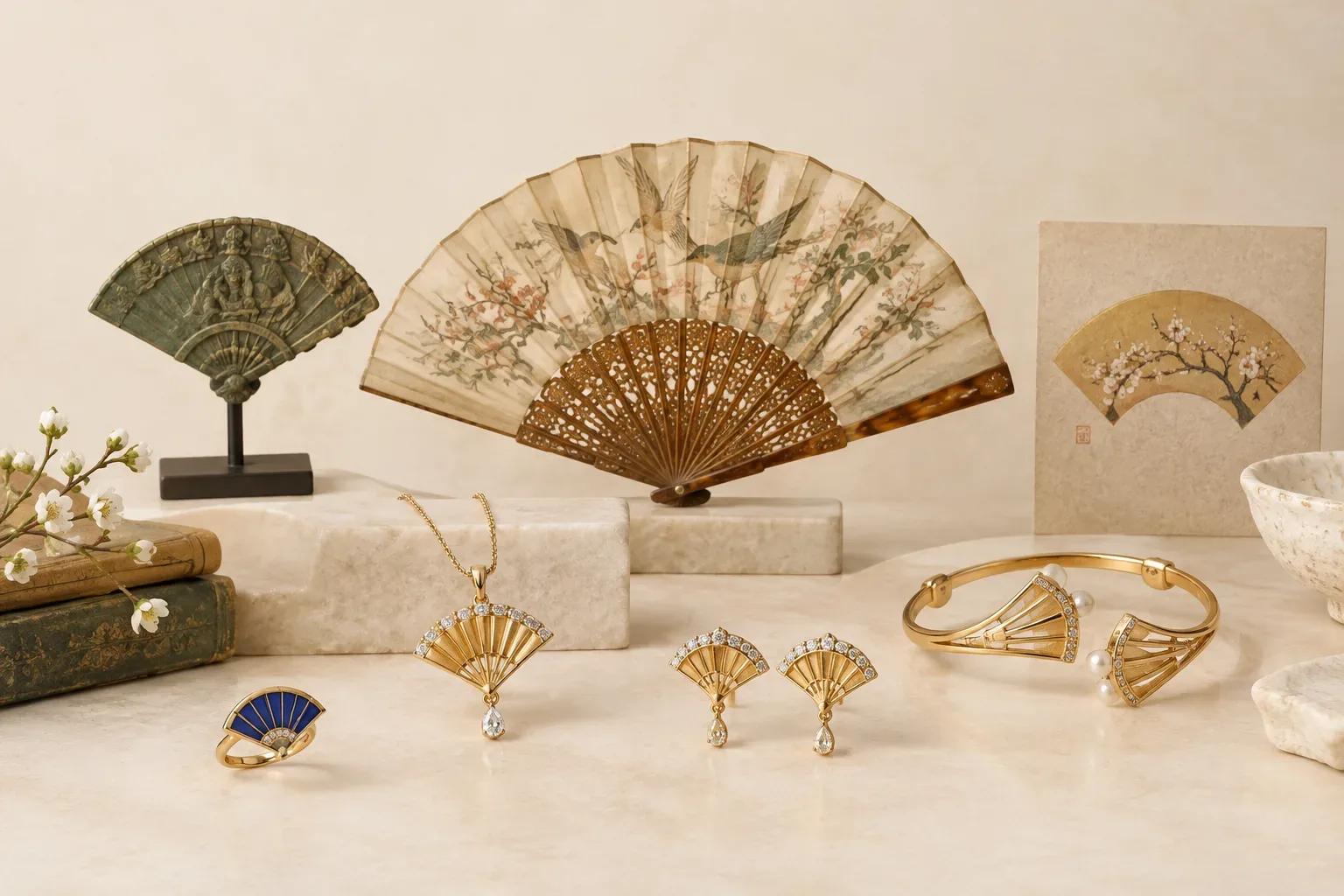
Meaning at a glance
The fan motif in jewelry has documented roots in multiple cultural and fashion contexts; museum collections show fans used as literal accessories and decorative motifs, while contemporary wearers attach personal or stylistic meanings. Choose or gift fan jewelry with attention to provenance, materials, and respectful cultural context.
Documented historical evidence and cultural contexts
Collections and exhibitions curated by institutions such as the Victoria and Albert Museum make clear that the fan was both a utilitarian object and a decorative motif across multiple regions. In East Asia, folding fans and rigid ceremony fans have long been part of dress and performance traditions; museums include related objects and dress accessories as evidence of that relationship. In European decorative arts and costume, fan shapes and fan-inspired mounts appear in accessories and jewelry as designers adapted the motif from both domestic and foreign fashions. The V&A's overview of jewellery history highlights how motifs circulate between cultures and how objects that began as practical tools can become fashion statements or status objects in a different context.
Separating documented meanings from modern interpretations
Documented historical meanings derive from the object’s use, context of wear, and contemporary records or inventories preserved in museum collections. For example, museum labels and catalogues often describe whether a fan-shaped object belonged to ceremonial dress, was worn as a hair ornament, or functioned purely as decoration. Those documentary notes are the primary historical evidence for meaning. By contrast, modern wearable interpretations—such as reading a fan pendant as a symbol of secrecy, flirtation, or empowerment—are contemporary, personal, or marketing-driven readings rather than fixed historical facts. A single motif can attract layered meanings over time, but it is important to distinguish what is recorded by curators and historians from what is newly attributed by designers, wearers, or sellers.
How the fan motif, gemstones, and materials appear in jewelry
In jewelry, the fan motif appears in a variety of forms: as miniature folding-fan reproductions set into brooches, as fan-shaped pendants and lockets, as hairpins that echo fan ribs, and as stylized enamel or metalwork that suggests the radiating lines of an open fan. Museum collections document examples where artisans have carved mother-of-pearl or shell into fan shapes, used enamel to paint delicate fan scenes, or mounted a fan silhouette in gold or silver as an accent piece. The V&A's resources on gemstones and materials describe how different stones and substances—mother-of-pearl, jade, coral, enamel, and various gemstones—were traditionally used in decorative arts and jewellery, and how choices of material shaped an object's appearance and social value.
Gemstones and organic materials commonly associated with fan-style pieces include carved mother-of-pearl used for inlay or miniature fan panels, jade or other hardstones for carved amuletic pieces, and small accent gems such as seed pearls or rose-cut diamonds in European fan brooches and pendants. The look of a fan can also be achieved entirely in metal through repoussé, engraving, or the use of radiating filigree. When gemstones are involved, the identification and treatment history of those gems matter to value and transparency; consumer guidance from the Federal Trade Commission stresses that sellers should disclose treatments, imitations, and material substitutions when they affect appearance or durability.
Changing contexts: from accessory to symbol
The movement of the fan motif across cultures and time shows how objects can shift in meaning. A functional hand fan in one setting may appear in another as a miniature decorative object attached to hair or clothing, and later still as a purely symbolic pendant referencing elegance or leisure. The Victoria and Albert Museum’s survey of jewellery history emphasizes this fluidity, showing that jewelry motifs often acquire new social meanings as they travel between cultural and fashion contexts. Understanding a fan motif’s original context—whether ceremonial, practical, or fashion-driven—helps prevent misreading its historic significance when it appears in contemporary design.
Choosing or gifting fan jewelry respectfully and practically
Start by asking about provenance: is the piece an antique, a reproduction, or a contemporary design inspired by traditional forms? When provenance matters, museum catalogues and dealers’ records help establish historical authenticity, while contemporary makers can supply information about cultural sourcing and artisanal methods. Consider materials and disclosures: if the piece contains gemstones or organic materials, request written information about treatments, enhancements, or imitations, as advised by the Federal Trade Commission for any significant purchase. That disclosure protects both buyer and seller and clarifies long-term care needs.
Think about cultural context. If a design explicitly references a living cultural or ceremonial form—such as a ritual fan from a specific community—choose pieces made by practitioners of that tradition or buy through vendors who explain the design’s meaning and give credit to its origin. If the piece is a fashion reinterpretation that merely borrows a fan silhouette, be mindful of how you present it as a gift: explain whether it is inspired by a tradition or is a broadly decorative motif, and avoid implying an authoritative cultural meaning that is not documented.
Match style to intention. For everyday wear and versatility, a small, stylized fan pendant in gold or silver is unobtrusive and easy to pair. For a statement or commemorative gift, choose an item with higher-quality materials—such as carved mother-of-pearl set in a well-made mount or a designer enamel brooch—and obtain documentation about materials and maker. For pieces meant to acknowledge heritage, prioritize artisans from the culture represented and ask for information about their techniques and the symbolism they assign.
Care, authentication, and resale considerations
Care requirements depend on the materials. Organic elements such as mother-of-pearl and certain shells are sensitive to acids, perfumes, and prolonged moisture, while enamel and delicate inlays can chip under impact. The V&A’s discussions of gemstones and materials offer a general framework for matching care to material: identify what the piece is made from and follow conservation-friendly practices—gentle cleaning, avoiding ultrasonic cleaners for fragile settings, and storing pieces separately to prevent abrasion.
For authentication and resale, documentation raises value and helps future owners understand cultural and historical context. Request written provenance, maker’s marks, or purchase receipts when available. If gemstones are significant to the piece, ask for any certification the seller can provide and inquire explicitly about treatments—dyeing, heating, filling, or reconstituting—because the Federal Trade Commission expects sellers to disclose treatments that affect a gem’s value or permanence. That transparency supports ethical collecting and respectful use of culturally significant designs.
Bringing a fan motif into your personal jewelry story
If you are drawn to the fan motif, decide whether you value historical authenticity, cultural connection, or contemporary aesthetics. A historically documented antique fan brooch carries a different set of meanings and care needs than a modern minimalist fan pendant. For many wearers, the most meaningful choice is one that aligns with their knowledge and intentions: a piece purchased from an artisan with clear cultural ties offers a living connection to a tradition; a museum-sourced antique connects the wearer to documented history; and a contemporary design can be a neutral, stylish emblem of personal taste.
Remember that symbolism in jewellery is often layered and personal. Use documented history as a guide but allow room for your own respectful interpretation, and when appropriate, acknowledge the design’s origins to friends or recipients when giving fan jewelry as a gift.
Frequently asked questions
Does a fan motif always mean flirtation or secrecy?
No. While popular culture sometimes assigns meanings like flirtation or secrecy to fan imagery, documented historical meanings vary by time and place and tend to depend on how the fan was used. Museum records show the fan was a practical accessory, a fashion element, or a ceremonial object in different contexts. Modern symbolic readings are personal or stylistic rather than universally historic.
What materials should I look for in quality fan jewelry?
Quality depends on construction and materials. Historically appropriate materials for fan motifs include mother-of-pearl, carved hardstone, enamel, and well-worked metals. If gemstones are used, request disclosure about treatments or imitations because these affect value and care. The Federal Trade Commission advises buyers to ask sellers for information on any enhancements, treatments, or substitutions.
How can I gift fan jewelry respectfully to someone from a culture that uses fans ceremonially?
Research and disclosure are key. If the design references a living cultural or ceremonial tradition, favor pieces made by artisans from that community or reputable sellers who explain the piece’s origin. When in doubt, present the gift with context: explain whether the piece is a fashion reinterpretation or a culturally specific item, and avoid implying a fixed ceremonial meaning unless it is documented and appropriate to give.
Are fan-shaped antiques more valuable than modern pieces?
Value depends on provenance, materials, condition, and market demand rather than shape alone. An antique fan brooch with high-quality materials and documented provenance may be valuable to collectors, while a well-made contemporary piece by a known designer can also command high prices. Documentation and condition are important factors for resale.
How do I care for fan jewelry with mother-of-pearl or enamel?
Avoid soaking or exposing such pieces to acids, perfumes, or abrasive cleaners. Clean gently with a soft, dry or slightly damp cloth and store separately to prevent scratches. For significant antiques or delicate inlays, consult a conservator for specific care recommendations.
Sources and further reading
- Bedazzled: A History of Jewellery — Victoria and Albert Museum
- An A-Z of Gemstones — Victoria and Albert Museum
- Buying Gemstones, Diamonds, and Pearls — Federal Trade Commission